Blogs

QRadar SIEM Security Analyst Career: Skills, Syllabus and Practice Test

A QRadar SIEM security analyst investigates the offenses that IBM's security information and event management platform raises, separating a real attack from ordinary noise through searches, threat hunting and dashboard review. The role sits inside the security operations centre rather than on the infrastructure side, and the credential IBM issues for it is the IBM Certified Analyst - Security QRadar SIEM V7.5.

That credential is tested as C1000-162: 64 questions, a 90-minute limit and a 64% pass mark, for US$200 as of November 2026. Here you will find what fills an analyst's shift, the skills that get candidates shortlisted, how IBM splits the exam into five weighted domains, and a week-by-week route to the console time the test expects.

Security analyst tracing a glowing network graph across a wall of monitors

What does a QRadar SIEM security analyst actually do each day?

The day starts with the offense queue. QRadar groups related events and flows into a single offense and ranks each one by magnitude, a score built from severity, relevance and credibility. An analyst works down that queue, opening the highest-magnitude offenses first, reading the contributing rules and the raw events behind them, and deciding within minutes whether the activity needs escalation, more investigation, or can be closed as a false positive with a note explaining why.

D-CI-DS-23 Exam: Dell Cloud Infrastructure Design Syllabus, Practice Test and Study Plan

The D-CI-DS-23 exam leads to the Dell Technologies Certified Cloud Infrastructure Design 2023 credential. It has 60 questions in 90 minutes, a 63% passing score and a US$230 fee as of November 2026, and it tests how you design compute, storage, network, management and platform layers for private, hybrid and multicloud environments.

This is a design exam, not an operations exam. It asks which architecture you would recommend, why, and what you would measure before you recommend it. The quickest way to see whether that style suits you is a timed D-CI-DS-23 practice test: candidates who run servers every day often score well on the hardware questions and lose marks on business value, cloud management platforms and PaaS design, which carry almost a third of the syllabus between them.

The sections below follow the seven syllabus areas Dell publishes for this exam, show how the 60 questions are likely to spread across them, and turn that spread into a study plan with a realistic number of hours. The Cloud Infrastructure Design syllabus page lists every objective word for word if you want the raw list open beside this guide.

Glowing 3D cloud above an isometric data centre linked by neon data streams

C1000-178 Cognos Analytics v12 Administrator: Syllabus, Exam Format and Practice Test Plan

C1000-178 is the IBM exam behind the IBM Certified Cognos Analytics v12 Administrator - Professional credential. It has 60 questions in 90 minutes, needs a score of 73% to pass and carries a US$200 fee (October 2026 pricing). It covers installation, security, content management, performance tuning and recovery of a Cognos Analytics 12 environment.

If you already look after a Cognos server and want proof of it, the fastest way to measure your readiness is a timed run through the C1000-178 practice test, which mirrors the 60-question, 90-minute format and shows which of the five syllabus areas you lose marks in. The rest of this guide walks through each of those areas, the scenarios IBM likes to build questions around, and an eight-week plan that fits around a full-time job.

BI platform administrator with a tablet beside a server rack and chart screens

Who is the C1000-178 certification written for?

The credential is aimed at the person who keeps a Cognos Analytics installation running for everyone else. That usually means a BI platform administrator, a middleware or application server engineer who inherited Cognos, or a reporting lead in a smaller company who installs, secures and patches the product alongside writing reports. IBM files it under its Data, Analytics, and AI certification category, at the Professional level, which signals that the questions assume hands-on time rather than classroom knowledge.

QRadar SIEM Administrator Career: Skills, Syllabus and Practice Test Plan

A QRadar SIEM administrator keeps IBM's security information and event management platform collecting, parsing and correlating data correctly, so that analysts see real offenses instead of noise. The role sits between infrastructure and the security operations centre, and IBM certifies it with the IBM Certified Administrator - Security QRadar SIEM V7.5 credential.

IBM examines that credential as C1000-156: 62 questions in 90 minutes, with a passing score of 61%, at a fee of US$200 as of October 2026. This guide explains what the job involves day to day, which skills hiring managers look for, what each of the eight syllabus sections tests, and how to build a preparation plan around a working lab.
Security engineer watching data streams on monitors in a dim operations room

What does a QRadar SIEM administrator actually do each week?

Most of the week goes on data quality. A SIEM is only as useful as the events it receives, so the administrator spends hours confirming that firewalls, domain controllers, endpoint agents, cloud services and network devices are all sending logs, that QRadar recognises each source with the right Device Support Module (DSM), and that the fields analysts depend on, such as user name, source IP and destination port, are parsed rather than left inside the raw payload.


Adobe Workfront Project Manager Certification: Syllabus, Career Value and Practice Test Plan

The Adobe Workfront Project Manager Certified Professional credential proves you can take work from a request to a closed project inside Workfront: triage what comes in, build a realistic timeline, assign people, track dates and money, and close out cleanly. It is a Professional-level exam for business practitioners, not for developers or system administrators.

Adobe examines it as AD0-E911: 50 questions in 100 minutes, with 33 correct answers needed to pass and a fee of US$125 as of October 2026. The three exam sections follow a project's life, so this guide does the same. It walks through the job, the format, each section of the syllabus, the preparation that works and where the badge takes you. To see the question style first, open the free Workfront Project Manager sample questions.

Project manager pointing at a project timeline on a wall screen in a studio

What does a project manager actually do inside Workfront?

A Workfront project manager spends less time drawing plans than a traditional scheduler and more time keeping one shared record honest. Requests arrive through queues instead of inboxes. Plans live as projects whose tasks carry owners, hours and dates. Status comes from the system because people update their own work, so the manager's skill is knowing which number to trust and which setting produced it.

Certified GitHub Enterprise Administrator: Syllabus, Skills and Study Plan

A GitHub Enterprise administrator runs the platform an organisation's developers build on: who can sign in, what each person can reach, which automation is allowed to run and how code stays secure. Microsoft certifies this job through its GitHub Administration credential, an intermediate exam aimed at administrators, DevOps engineers and technology managers.

The credential is examined as GH-100: 100 minutes, 65 questions and a scaled score of 700 out of 1000 to pass. Sitting it in the United States costs US$99 as of September 2026; Microsoft sets the fee by the country where the exam is proctored, so check the price at checkout. Before you book, the free GitHub Administration sample questions show the scenario style you will face, and the rest of this guide explains the job, the five skill areas and a six-week plan to get ready.

Platform administrator reviewing repository permissions on two monitors in an office

What does a GitHub Enterprise administrator actually do?

Most of the work is governance at scale. A developer who owns one repository decides its branch protection and its collaborators. An enterprise administrator decides those things for hundreds of organisations and thousands of repositories at once, through policies that individual owners cannot quietly override. The job exists because a setting that is harmless in one repository becomes a risk when it is repeated across an entire company.

IBM Maximo Manage Functional Deployment: Role, Skills and Career Path

A Maximo Manage functional deployment professional configures IBM Maximo Application Suite so that an organisation's assets, work orders, inventory and purchasing all run inside one system. The role translates how a plant, fleet or facility actually operates into working Maximo configuration, and IBM certifies it at professional level.

The credential that recognises this work is examined as C1000-183, a 90-minute exam of 61 questions with a 67% pass mark and a registration fee of $200 USD as of September 2026. This guide sets out what the role does day to day, which skills the exam measures, how the nine syllabus areas are weighted, and how to build the hands-on experience that makes the certification worth holding.

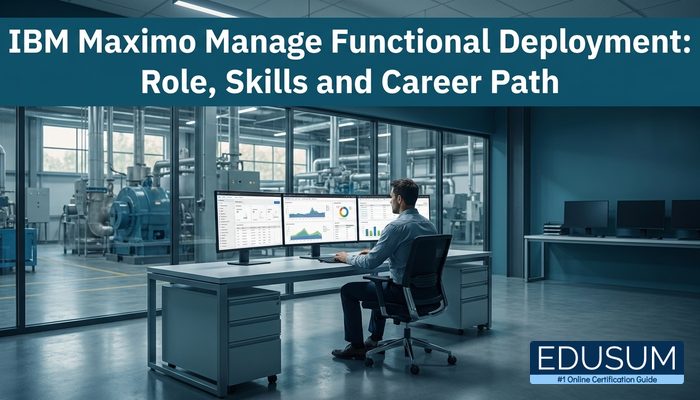
Maintenance planner reviewing asset management software in a plant control room

What a functional deployment professional does day to day

Maximo Manage is the work and asset management application inside IBM Maximo Application Suite. A functional deployment professional owns the functional design of that application: the organisations and sites, the asset and location hierarchies, the job plans, the storerooms, the purchasing flow and the security groups that decide who may touch each of them. It is a configuration role rather than an infrastructure one, and the distinction matters when you choose which certification to sit.

Threat Intelligence Analyst Career: Skills, Exam and Certification Path

A threat intelligence analyst collects, processes and analyses information about attackers so an organisation can anticipate and respond to cyber threats. CREST assesses this role through its Registered Threat Intelligence Analyst exam, aimed at people who already work in a team delivering threat intelligence and have at least two years of hands-on experience.

If that describes you, the CRTIA practice test on EduSum lets you check your readiness against the same syllabus areas this guide walks through, before you book a seat. You can also start with the free threat intelligence analyst sample questions to see the question style.

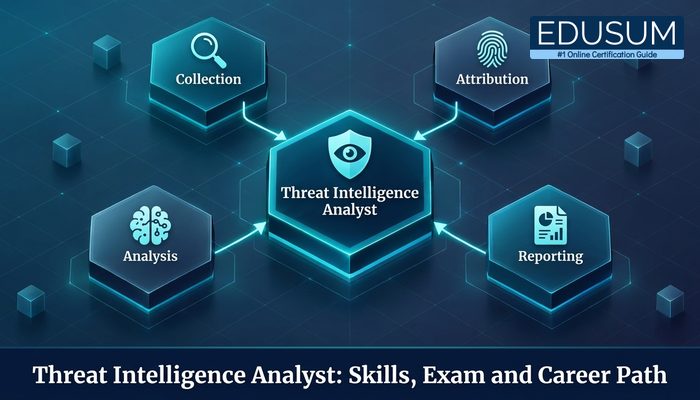
Cover image of a threat intelligence analyst career, skills, exam and certification path

What does a threat intelligence analyst actually do?

On its Registered Threat Intelligence Analyst certification page and in the syllabus, CREST defines the role as responsible for the collection, processing and analysis of data, information and intelligence in order to produce threat intelligence outputs. In practice that means turning raw material, from domain registration records to social media activity and malware indicators, into a clear assessment a decision-maker can act on.

IBM C1000-189: Does Your Certification Trump Experience?

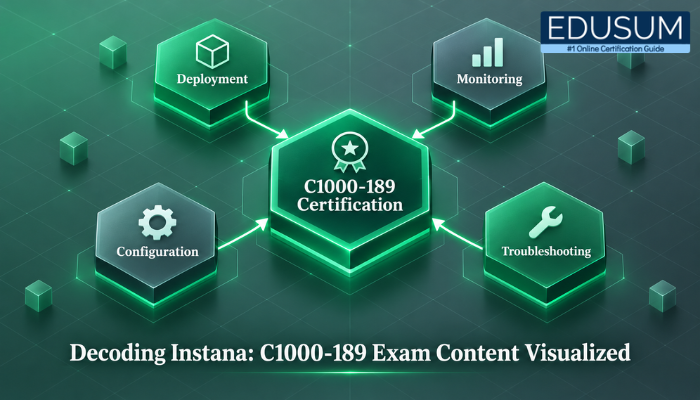
Isometric diagram connecting Deployment, Monitoring, Configuration, and Troubleshooting to the C1000-189 Certification.

The IBM C1000-189 certification, validating expertise in IBM Instana Observability v1.0.277 administration, marks a professional's proficiency in managing and optimizing complex application environments. This professional credential is ideal for system administrators, site reliability engineers (SREs), and observability specialists aiming to formally recognize their skills in implementing, configuring, and maintaining IBM Instana solutions. This article delves into the inherent value of such a certification, exploring its interplay with practical experience and offering insights into preparing for the Instana Observability certification syllabus, ultimately clarifying its role in career progression.

For many IT professionals, the question of whether a certification truly "trumps" on-the-job experience is a perennial debate. While practical exposure is undeniably invaluable, a targeted credential like the IBM C1000-189 offers a structured validation of knowledge that experience alone might not always provide. It demonstrates a standardized understanding of best practices, tools, and methodologies within the IBM Instana ecosystem, proving a candidate's readiness to tackle specific administrative challenges from day one.

AVIXA ANP Study Path: Maximizing Your Practice Test Benefits

An AV technician uses a tablet to diagnose a rack of networked audiovisual equipment, demonstrating the real-world application of AVIXA ANP certified skills.

The AVIXA Certified Audiovisual Network Professional (ANP) certification validates a professional's expertise in designing, deploying, and maintaining networked audiovisual (AV) systems, particularly those utilizing AV over IP technologies. This credential, identified by the exam code ANP, targets individuals responsible for ensuring robust and reliable AV network performance. Acquiring this certification signifies a deep understanding of AV network infrastructure, signal flow, and system integration within a networked environment. This comprehensive article delves into the ANP exam details, syllabus, benefits, and crucial preparation strategies, highlighting how a dedicated AVIXA ANP practice test regimen can reveal your readiness and guide your study efforts effectively. Whether you are aiming to enhance your career, validate specialized skills, or simply understand what the AVIXA ANP certification entails, this guide offers essential insights.

Unpacking the AVIXA ANP Exam Structure

Understanding the AVIXA Certified Audiovisual Network Professional (ANP) exam structure is the foundational step for any candidate. This certification is a significant milestone for those working with networked AV systems, confirming a specialized skill set in a rapidly evolving field. Familiarity with its administrative details helps candidates strategize their study plan and manage their time during the actual examination efficiently.

Syndicate content