
QRadar SIEM Security Analyst Career: Skills, Syllabus and Practice Test
A QRadar SIEM security analyst investigates the offenses that IBM's security information and event management platform raises, separating a real attack from ordinary noise through searches, threat hunting and dashboard review. The role sits inside the security operations centre rather than on the infrastructure side, and the credential IBM issues for it is the IBM Certified Analyst - Security QRadar SIEM V7.5.
That credential is tested as C1000-162: 64 questions, a 90-minute limit and a 64% pass mark, for US$200 as of November 2026. Here you will find what fills an analyst's shift, the skills that get candidates shortlisted, how IBM splits the exam into five weighted domains, and a week-by-week route to the console time the test expects.

What does a QRadar SIEM security analyst actually do each day?
The day starts with the offense queue. QRadar groups related events and flows into a single offense and ranks each one by magnitude, a score built from severity, relevance and credibility. An analyst works down that queue, opening the highest-magnitude offenses first, reading the contributing rules and the raw events behind them, and deciding within minutes whether the activity needs escalation, more investigation, or can be closed as a false positive with a note explaining why.
Most of the investigation happens in search. An analyst filters Log Activity and Network Activity by time window, source IP, user name or asset, then widens or narrows the query as the picture changes. Ariel Query Language turns a multi-step filter into one saved statement that colleagues can reuse, and a good analyst builds a personal library of AQL queries for the attack patterns their organisation sees most often: lateral movement between servers, a login from an unexpected country, or a process spawning from an unusual parent.
Dashboards run in the background all day. Pulse and the default QRadar dashboards surface trends, such as a sudden rise in failed logins or an unusual spike in outbound traffic, before any single event would have triggered a rule on its own. Analysts tune their own dashboards around the assets and threat types their shift is responsible for, so an anomaly stands out against a baseline they already recognise.
The rest of the shift is documentation and escalation. Every offense that becomes a confirmed incident needs a clear record: what was observed, which indicators of compromise matched, and what action was taken. Analysts who write that record well make the next shift's handover shorter and give the rule-tuning team the evidence it needs to either confirm a detection or quiet a rule that fires on something harmless.
Most security operations centres run the analyst seat in shifts, because offenses do not stop arriving outside business hours. A tier-one analyst usually owns first triage and clear-cut closures, while a tier-two or senior analyst picks up anything ambiguous, coordinates with the administration team when a log source looks wrong, and leads the investigation when an offense turns into a real incident. New analysts typically spend their first months almost entirely in tier-one triage, building the pattern recognition that later lets them move faster through ambiguous cases.
Which skills do employers look for in QRadar analyst roles?
Job postings for QRadar analysts converge on a short list. The first is AQL and advanced search: writing a query that pulls the right events out of millions in seconds, rather than paging through the Log Activity tab by eye. Candidates who can describe filtering on a specific field, grouping results and saving the query for reuse are consistently rated above those who only know the quick filter menus.
Offense triage and chaining comes next. Employers want someone who understands how QRadar groups events into an offense, how magnitude is calculated from severity, relevance and credibility, and how to chain related offenses together instead of investigating the same incident five times under five different offense IDs.
Threat hunting ability is increasingly its own line item. That means going beyond the alerts a rule already raised, forming a hypothesis about an attacker behaviour, and searching payloads and flow data to prove or disprove it. Familiarity with indicators of compromise, reference sets that flag known-bad IPs or hashes, and the difference between a true positive and a well-disguised false positive all sit inside this skill.
Rule literacy matters even though analysts rarely build rules from scratch. Understanding how an event rule, a building block and a reference set combine to raise an offense lets an analyst explain why something fired, and recommend a tuning change to the administration team with the right detail instead of a vague complaint about noise. Finally, reporting and communication skills decide how far an analyst advances: writing an incident summary a manager can act on, and briefing a SOC lead under time pressure, are judged as closely as the technical investigation itself.
Analysts also need a working relationship with whoever administers the QRadar deployment, even when that is a different person or a different team entirely. An analyst who notices that a log source stopped updating, or that a rule is firing far more often than it used to, is often the first person to see the symptom. Reporting it clearly, with the log source name, the time it changed and an example offense, turns a vague complaint into a fix the administration team can act on the same day.
How is the QRadar SIEM V7.5 analyst exam structured?
Pearson VUE delivers the analyst exam as one proctored, multiple-choice sitting: 64 questions inside a 90-minute window, with 64% needed to pass. Averaged out, that is roughly 84 seconds per item, enough to read a short scenario twice but not enough to second-guess every answer. IBM lists the fee at US$200 for November 2026; expect the amount on your card statement to shift slightly with local tax and the day's exchange rate.
| Exam detail | Value |
|---|---|
| Certification | IBM Certified Analyst - Security QRadar SIEM V7.5 |
| Exam code | C1000-162 |
| Delivery | Pearson VUE, proctored |
| Format | 64 multiple-choice questions in 90 minutes |
| Passing score | 64% |
| Exam fee | US$200 (as of November 2026) |
The objectives, a study guide and the scheduling link all live on IBM's own IBM Certified Analyst - Security QRadar SIEM V7.5 page. Open it again close to your booking date: IBM updates exam versions as QRadar itself changes, and sitting a version that no longer matches what you studied is an easy mistake to avoid.
The questions assume someone who already works the offense queue day to day. Expect scenarios that describe a partial investigation, such as an offense with three contributing rules and a magnitude score, and ask what the analyst should check next, or which search narrows the result set fastest. Pure definitions are a minority; most items test judgement under a description of a real console screen.
What do the five syllabus domains test, and how much does each weigh?
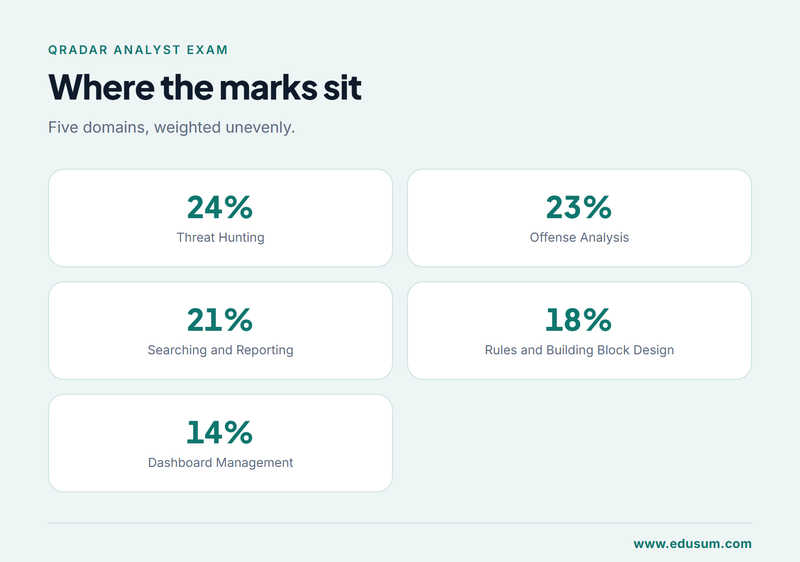
IBM splits this exam into five domains that are far from equal in size. Together, Threat Hunting and Offense Analysis decide nearly half the result, and Dashboard Management sits at the opposite end with the lightest weighting. The breakdown below shows every figure, with what each domain actually asks of you set out underneath.
| Domain | Weight |
|---|---|
| Threat Hunting | 24% |
| Offense Analysis | 23% |
| Searching and Reporting | 21% |
| Rules and Building Block Design | 18% |
| Dashboard Management | 14% |
Threat Hunting (24%)
The largest domain covers investigating event and flow parameters, running AQL queries, filtering logs, analysing indicators of compromise, distinguishing a genuine threat from a false positive, and reviewing raw payloads. A typical question gives a short description of suspicious traffic and asks which field or query would confirm it fastest. Candidates who have only read about QRadar, rather than hunted inside it, lose the most marks here.
Offense Analysis (23%)
This domain tests identifying how a security threat occurred, analysing which rules matched and which did not, examining the IP addresses and assets involved, recognising threat actor behaviour, and performing offense management including reading and explaining the magnitude score. Expect questions that present an offense summary and ask what it indicates, or what the next triage step should be.
Searching and Reporting (21%)
Here the exam checks Ariel Query Language syntax, building advanced searches, creating threat reports, exporting results, and scheduling recurring reports. You should be able to read a short AQL statement and say what it returns, and know which search type, quick filter, saved search or AQL, fits a given task fastest.
Rules and Building Block Design (18%)
This domain covers regular expressions, reference sets, content packs, analysing event and flow data, and recommending updates to the rules and building blocks that detect threats. Analysts are not expected to write rules from nothing, but they are expected to read one and explain which condition fired and why, and to suggest a specific tuning change rather than a general complaint.
Dashboard Management (14%)
The smallest domain covers creating and maintaining dashboards and using QRadar Pulse for security monitoring visualisation. Questions focus on choosing the right widget for a monitoring need and arranging dashboards so that an anomaly stands out against a known baseline, rather than on the mechanics of building one from scratch.
Which domains cost candidates the most marks?
Candidates coming from a general SOC analyst background, with limited QRadar-specific time, usually lose the most marks in Rules and Building Block Design. They can read an offense and investigate it, but they have rarely opened a building block or traced which reference set fed a rule, so questions that ask why a rule matched feel unfamiliar.
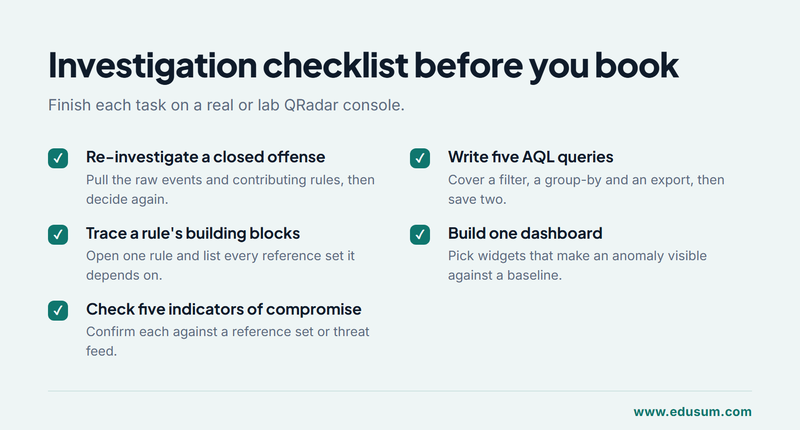
Candidates moving over from the administrator side of QRadar tend to struggle with Threat Hunting in the opposite way: they know the platform's configuration deeply but have spent little time forming a hypothesis and chasing it through payloads and flow data, which is a different habit of mind from keeping the pipeline healthy. A useful self-test is to pick a closed offense from any lab or sandbox and explain, from memory, every search you would run to prove it was a false positive before closing it.
Searching and Reporting catches candidates who rely on the quick filter menus and have never written a full AQL statement by hand. Practise writing at least five AQL queries against a lab instance, including one that groups results and one that exports to a report, before sitting the exam. Watching someone else run a query in a video does not build the muscle memory the scenario questions test.
A quick way to find your own weak domain before committing six weeks to study is to time yourself re-investigating a handful of past offenses from memory, without opening the console for help. Note where you hesitate: if it is deciding which search to run next, the gap is Threat Hunting or Searching and Reporting; if it is explaining why a rule fired, the gap is Rules and Building Block Design. That one exercise points to exactly which weeks of the plan below deserve the extra hour.
Is there an official IBM practice test for the analyst certification?
Yes: IBM's own objectives document, the guide on its learning platform, and the QRadar product documentation together make up the official preparation path for this credential, and they are the final word on what the exam covers, which version is current, and how booking works.
EduSum has no affiliation with IBM and sells none of its material. What we offer instead is a practice test built independently from the published syllabus: full-length, timed, and scored by domain, so a weak spot in Dashboard Management or Threat Hunting shows up clearly rather than hiding inside one overall percentage. Try the free sample questions for this analyst exam first, and decide from there whether the format fits how you study.
Steer clear of sites selling actual exam dumps. Sitting the test on memorised leaked questions breaks the terms of IBM's certification agreement, and a credential earned that way can be pulled. It also will not survive an interview: a hiring manager who asks you to walk through confirming a suspicious login will notice within two follow-up questions if you never actually learned to investigate one.
How can you prepare for the analyst exam in six weeks?
Six weeks works for someone already spending part of their week inside the QRadar console. Budget about an hour on weekday evenings and a longer stretch on a weekend day. If you are new to the product, stretch the plan to twelve weeks and use the extra time investigating simulated offenses, since the exam is written for people with real screen time, not just reading time.
Start week one by mapping the territory: list every domain, grade each as confident, partial or unknown, and line up access to a QRadar instance, whether a lab, a trial, or the environment at work. Spend the rest of the week simply reading offenses that already exist, without acting on them, to build a feel for how magnitude and contributing rules relate to what actually happened.
Weeks two and three cover Threat Hunting and Offense Analysis, the two domains worth nearly half the exam. Pick five closed offenses and re-investigate each from scratch: read the contributing rules, pull the raw events, and decide again whether you agree with how it was closed. Note every indicator of compromise you check along the way and why.
Week four is for Searching and Reporting. Write AQL queries for five different questions, such as which assets saw the most denied connections this week, then save two of them and build a scheduled report from one. Compare how long the same task takes through the quick filter menus instead, so you understand when each approach is faster.
Week five covers Rules and Building Block Design and Dashboard Management. Open three rules that fired on your practice offenses and trace every building block and reference set each one depends on. Then build one dashboard around an asset group you care about and add the widgets that would make an anomaly visible within a shift.
Week six simulates exam day itself: full attempts, 64 questions, the clock set to 90 minutes, no pausing. Log the domain behind every miss, and if one domain keeps reappearing, return to the console instead of your notes -- rereading rarely fixes a gap that only hands-on repetition closes. Schedule the real exam once two attempts in a row land safely past 64%.
Where does a QRadar security analyst career lead next?
This credential matters most where IBM QRadar SIEM is already running day to day: large financial institutions, insurers, public-sector bodies, telecom carriers, and the managed security providers who staff consoles for several client organisations at once. None of them need someone to pick a SIEM; they need someone who can sit down at the one they already have and start working its offense queue immediately.
The underlying skills travel well past QRadar. Working down an alert queue, shaping a structured query against raw event data, and separating a genuine attack from background noise are the same problem on any SIEM, however the vendor labels its offenses or its query language. Someone who has built those habits properly on QRadar picks up a different platform already knowing what a credible investigation looks like.
From here, common moves include a senior or tier-two analyst role with wider ownership of escalations, a dedicated threat-hunting position that works proactively instead of from the queue alone, or a detection-engineering seat that turns recurring investigation patterns into new rules and building blocks. IBM's own portfolio places the administrator and deployment credentials alongside this one, and stacking more than one signals to a hiring panel that you can both keep the platform running and work the cases it surfaces, not just one half of the job.
Whichever direction you choose, keep a record of the investigations you worked through while preparing. A short portfolio of well-documented offenses, each with the evidence checked and the reasoning written out, is stronger interview material than the certificate alone, and it keeps the habits the exam tests fresh after you pass it.
Frequently Asked Questions
How long is the QRadar SIEM V7.5 analyst exam, and how many questions does it have?
Expect 64 questions inside a 90-minute sitting, a little over 80 seconds per item on average. Several questions walk through part of an investigation and ask what you would check or search next, so budget time to read each scenario rather than rushing straight to the answer choices.
What score do you need to pass the QRadar SIEM analyst exam?
64% is the bar IBM sets for the IBM Certified Analyst - Security QRadar SIEM V7.5 exam. Since Threat Hunting and Offense Analysis make up almost half the available marks between them, candidates who fall short usually trace it back to one of those two domains.
How much does it cost to sit the QRadar SIEM analyst exam?
Pearson VUE lists the fee at US$200, current as of November 2026. What actually lands on your card can vary a little between countries once local tax and the exchange rate are applied, so check the figure shown at checkout rather than relying on this number alone.
Do you need hands-on QRadar experience before booking the analyst exam?
There is no mandatory prerequisite on paper, yet the scenario questions are written for someone who has actually triaged offenses before. If you have not, spend time on a QRadar instance running searches and working through real or simulated offenses before you book a seat.
How does the QRadar analyst certification differ from the administrator one?
The analyst path lives inside the console: offenses, searches, dashboards and threat hunting. The administrator path keeps the platform itself running: setup, onboarding data sources, tuning noisy rules and fixing problems when something breaks. Most candidates pick whichever matches their actual job; sitting both simply proves you can cover either side if needed.
Which domain is weighted most heavily on the analyst exam?
Threat Hunting holds the largest share at 24%, just ahead of Offense Analysis at 23% and Searching and Reporting at 21%. Dashboard Management carries the least weight at 14%, so a study plan that mirrors these percentages covers the exam more efficiently than one that treats every domain equally.
- IBM Certification |
- IBM Certified Analyst - Security QRadar SIEM V7.5 |
- C1000-162 Security QRadar SIEM Analysis |
- C1000-162 Online Test |
- C1000-162 Questions |
- C1000-162 Quiz |
- C1000-162 |
- IBM Security QRadar SIEM Analysis Certification |
- Security QRadar SIEM Analysis Practice Test |
- Security QRadar SIEM Analysis Study Guide |
- IBM C1000-162 Question Bank |
- Security QRadar SIEM Analysis Certification Mock Test |
- Security QRadar SIEM Analysis Simulator |
- Security QRadar SIEM Analysis Mock Exam |
- IBM Security QRadar SIEM Analysis Questions |
- Security QRadar SIEM Analysis |
- IBM Security QRadar SIEM Analysis Practice Test |
- C1000-162 Syllabus |
- Security QRadar SIEM Analysis Books |
- Security QRadar SIEM Analysis Certification Syllabus |
- IBM C1000-162 Books |
- IBM Security QRadar SIEM Analysis Training |
- Security QRadar SIEM Analysis Certification Cost |
- IBM Security QRadar SIEM Analysis Books |
- Security QRadar SIEM Analysis Sample Questions |
- IBM C1000-162 Practice Test Free |
- IBM Security Certification


