
D-CI-DS-23 Exam: Dell Cloud Infrastructure Design Syllabus, Practice Test and Study Plan
The D-CI-DS-23 exam leads to the Dell Technologies Certified Cloud Infrastructure Design 2023 credential. It has 60 questions in 90 minutes, a 63% passing score and a US$230 fee as of November 2026, and it tests how you design compute, storage, network, management and platform layers for private, hybrid and multicloud environments.
This is a design exam, not an operations exam. It asks which architecture you would recommend, why, and what you would measure before you recommend it. The quickest way to see whether that style suits you is a timed D-CI-DS-23 practice test: candidates who run servers every day often score well on the hardware questions and lose marks on business value, cloud management platforms and PaaS design, which carry almost a third of the syllabus between them.
The sections below follow the seven syllabus areas Dell publishes for this exam, show how the 60 questions are likely to spread across them, and turn that spread into a study plan with a realistic number of hours. The Cloud Infrastructure Design syllabus page lists every objective word for word if you want the raw list open beside this guide.
Does Dell Technologies offer an official practice test or question bank for D-CI-DS-23?
Dell Technologies does not sell a D-CI-DS-23 question bank. What Dell provides is the exam description on its D-CI-DS-23 exam page, the recommended Cloud Infrastructure Design training, and the wider Dell certification framework that explains how its credentials fit together. Those are the vendor's materials, and they define what the exam can ask.
Everything else is independent. Practice tests sold by training sites, including the one EduSum offers, are written by people outside Dell. They are useful for one thing the vendor material does not give you: rehearsal under exam conditions, with 60 questions against a 90-minute clock and a score report that shows which syllabus area cost you marks. Use them to find gaps, then close those gaps with the Dell course and hands-on design work.
Be wary of anything sold as real exam questions. Dell's candidate agreement forbids sharing live exam content, a certification earned that way can be revoked, and memorised answers do not survive the scenario wording Dell uses, where two options are technically valid and only one fits the stated business constraint.
How is the D-CI-DS-23 exam structured: questions, time, passing score and fee?
The exam is delivered through Pearson VUE and every candidate sees the same headline format. The table gives the figures Dell publishes for this version, with the time per question worked out so you can pace a practice run the same way.
| Item | D-CI-DS-23 detail |
|---|---|
| Full exam name | Dell Technologies Cloud Infrastructure Design 2023 |
| Credential | Dell Technologies Certified Cloud Infrastructure Design 2023 |
| Number of questions | 60 |
| Time limit | 90 minutes (90 seconds per question on average) |
| Passing score | 63% |
| Exam fee | US$230, as of November 2026 |
| Delivery | Pearson VUE |
A 63% pass mark sounds forgiving, but do the arithmetic before you rely on it. If every question counted equally, 63% of 60 would mean about 38 correct answers, so you could miss 22. Dell does not publish whether some questions carry more weight or whether the score is scaled, so treat 38 as a floor and aim for 45 or more in your final practice rounds. That margin absorbs the handful of questions where two answers look right.
Retake rules come from Dell's certification policy for all its exams, not from anything specific to D-CI-DS-23. Check the waiting period and attempt limit on Dell's exam page before you book a second sitting, and budget for a second US$230 fee if your first attempt is a trial run, because each sitting is paid separately.
What does the D-CI-DS-23 syllabus cover, domain by domain?
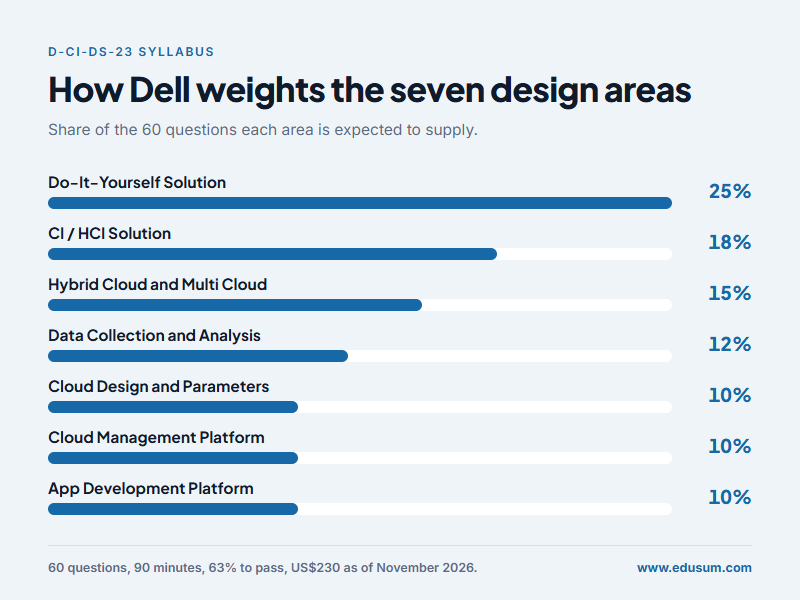
Dell splits the exam into seven areas. The weights add up to 100%, and multiplying each weight by 60 gives a fair estimate of how many questions come from it. Those counts are an estimate, not a Dell figure, but they are the right way to divide study time.
| Syllabus area | Weight | About how many of 60 questions |
|---|---|---|
| Introduction to Cloud Design and Design Parameters | 10% | 6 |
| Data Collection and Analysis | 12% | 7 |
| Architecting a Do-It-Yourself Solution | 25% | 15 |
| Architecting a CI / HCI Solution | 18% | 11 |
| Cloud Management Platform | 10% | 6 |
| Hybrid Cloud and Multi Cloud | 15% | 9 |
| Application Development and Deployment Platform | 10% | 6 |
Introduction to Cloud Design and Design Parameters (10%)
This area sets the vocabulary for the rest of the exam. Dell expects you to describe the digital business imperatives that push an organisation towards cloud, the core cloud concepts, and the approaches and goals of a cloud infrastructure design. It also covers the phases of a cloud solution design project and a cloud reference architecture, with design considerations for compute, storage, network, the cloud management platform (CMP), hybrid and multicloud, and the application platform or PaaS layer.
Expect questions that name a project phase and ask what belongs in it. A common trap is picking an implementation task for an assessment-phase question. If the scenario says the customer has not yet agreed on requirements, the right answer is almost never a hardware choice.
Data Collection and Analysis (12%)
Here the exam moves from theory to evidence. You need to describe the data collection process, the metrics that matter and the tools that gather them, then the analysis process, business value analysis and design best practices. In practice that means knowing which measurements size an environment: CPU utilisation and idle time, memory consumption, storage capacity and growth, IOPS, latency, throughput and network bandwidth at peak rather than on average.
Dell's own assessment tool, Live Optics, collects this kind of workload data from existing servers and storage, so it is worth knowing what it reports even if the exam phrases the question generically. Business value analysis is the half that operations staff skip: total cost of ownership, return on investment and the way a design ties back to a stated business goal such as faster provisioning or lower data centre spend.
Architecting a Do-It-Yourself Solution (25%)
The largest area, worth roughly 15 of the 60 items, covers a cloud built from separately chosen components. Dell lists three objectives, one each for compute, network and storage: explain the benefits, challenges and considerations of designing each technology inside a cloud infrastructure. The word that keeps returning is considerations, which tells you the questions are about trade-offs rather than specifications.
For compute, think about rack versus blade versus modular servers, CPU core density against licensing cost, virtualisation overcommit ratios and failure domains. For network, think about leaf-spine fabrics, oversubscription, VLAN and overlay segmentation, and redundant uplinks. For storage, think about block, file and object, tiering, replication, and the latency a given workload can tolerate. A do-it-yourself build gives the most flexibility and the most integration work, and the exam rewards you for naming both.
Architecting a CI / HCI Solution (18%)
This area asks you to explain the design decisions behind converged infrastructure, and then behind hyper-converged and cloud-in-a-box infrastructure. Converged infrastructure ships compute, storage and network as a pre-validated stack with separate tiers. Hyper-converged infrastructure collapses compute and software-defined storage into the same nodes, so capacity grows one node at a time; Dell's VxRail is the familiar example. Cloud in a box goes further, delivering a self-contained private cloud with its management layer already in place.
The questions usually describe a customer and ask which model fits. Small IT teams that want fast deployment and a single support contract lean towards HCI or cloud in a box. Workloads that need compute and storage to scale independently, or very large storage pools, can favour converged or do-it-yourself designs. Know the cost of each choice, not only its strengths.
Cloud Management Platform (10%)
The CMP is the layer that turns infrastructure into a service. Dell asks you to describe its key functions, its reference architecture and the infrastructure it runs on, then the key requirements and considerations for designing a CMP solution. Key functions include a self-service catalogue, orchestration and automation, metering and chargeback, monitoring, policy and governance. VMware Aria Automation, formerly vRealize Automation, is one widely deployed example.
Design questions in this area often hinge on availability. If the CMP goes down, users cannot request resources even though the underlying infrastructure is healthy, so the management layer needs its own redundancy, backup and capacity planning.
Hybrid Cloud and Multi Cloud (15%)
Worth about nine questions, this area covers design considerations for hybrid cloud and multicloud, plus disaster recovery. Hybrid cloud joins a private environment to one or more public clouds so workloads can move or burst between them; multicloud uses several public providers, often for different services. The design issues are connectivity, identity federation, data gravity and egress charges, consistent security policy and a single operational view.
Disaster recovery questions turn on two numbers. Recovery point objective is how much data the business can afford to lose; recovery time objective is how long it can be without the service. Synchronous replication protects a near-zero RPO but limits distance and adds latency, while asynchronous replication allows distance at the price of some data loss. Pick the method the stated objectives demand, not the most expensive one.
Application Development and Deployment Platform (10%)
The final area covers the environment developers build on. Dell asks you to describe the application development and deployment environment and its requirements, then explain the design considerations of do-it-yourself and packaged PaaS solutions. A do-it-yourself platform assembles containers, an orchestrator such as Kubernetes, a registry and CI/CD pipelines from separate parts. A packaged PaaS arrives integrated and supported as one product.
The trade-off mirrors the infrastructure one: freedom and lower licence cost against integration effort and the skills needed to keep it running. Questions often describe a team's size and skills and ask which approach is realistic for them.
Which D-CI-DS-23 domain is hardest for candidates from an operations background?
For most system and storage administrators, the hardest marks are in Data Collection and Analysis and in the Cloud Management Platform area, not in the hardware-heavy domains. Administrators already know how a server, switch or array behaves. What they rarely do day to day is justify a design in business terms or plan the service layer that sits above the hardware.
Business value analysis is the usual weak point. A question may give you current utilisation figures and a business goal, then ask which finding supports a consolidation proposal. The answer depends on reading the metric correctly: low average CPU use with high peaks argues for a different design than low use all day. Practise reading utilisation reports and stating, in one sentence, what each number means for the design.
Candidates from a developer background have the opposite problem. They handle the PaaS area comfortably and then struggle with storage protocols, replication and network fabric design, which together sit inside the 25% do-it-yourself area. If that describes you, start there, because it is the single biggest block of questions.
A quick way to find your own weak area is to take one full practice run before you study anything, then sort the misses by syllabus area. The area with the most misses per question, not the most misses in total, is where an hour of study buys the most marks.
What real-world design scenarios appear on the D-CI-DS-23 exam?
The exam uses short customer stories. Each one gives a business goal, a constraint and some current-state data, then asks for a recommendation. Working through the scenario types below with a pen, before you see any answer options, is the best rehearsal for the real thing.
Sizing a consolidation from collected metrics
A customer runs 200 virtual machines on ageing servers and wants to cut hardware. You are given average and peak CPU, memory and IOPS figures. The design question is how many new hosts are needed, and the trap is sizing for the average. A sound design sizes for peak demand, adds headroom for growth and allows for one host failing without the rest running out of capacity.
Choosing between HCI and a separately built cloud
A regional business with a three-person IT team wants a private cloud live within one quarter. Here the constraint is people and time, which points towards a hyper-converged or cloud-in-a-box design with a single support path. Change the story so the customer needs to grow storage four times faster than compute, and a design that scales the two independently becomes the stronger answer.
Setting disaster recovery to stated objectives
A payments service may lose no more than a few seconds of data and must be back within 15 minutes, while an internal reporting system can lose a day of data and be down for a day. The exam expects different protection for each: synchronous or near-synchronous replication to a nearby site for the first, scheduled backup and recovery for the second. Recommending the same protection for both wastes money or misses the objective.
Placing workloads in a hybrid design
A retailer wants seasonal web traffic to burst into a public cloud while customer records stay on premises for regulatory reasons. The design points to watch are the network link between sites, latency between the web tier and the database, egress charges when data leaves the public cloud, and a single identity and policy model across both environments.
Designing the management layer for self-service
Developers wait two weeks for a virtual machine because every request goes through a ticket. The fix sits in the CMP area: a self-service catalogue with pre-approved templates, automated provisioning and quotas, plus metering so each team sees what it consumes. A question may also test whether you remember to make the CMP itself highly available.
How should you build a six-week D-CI-DS-23 study plan?
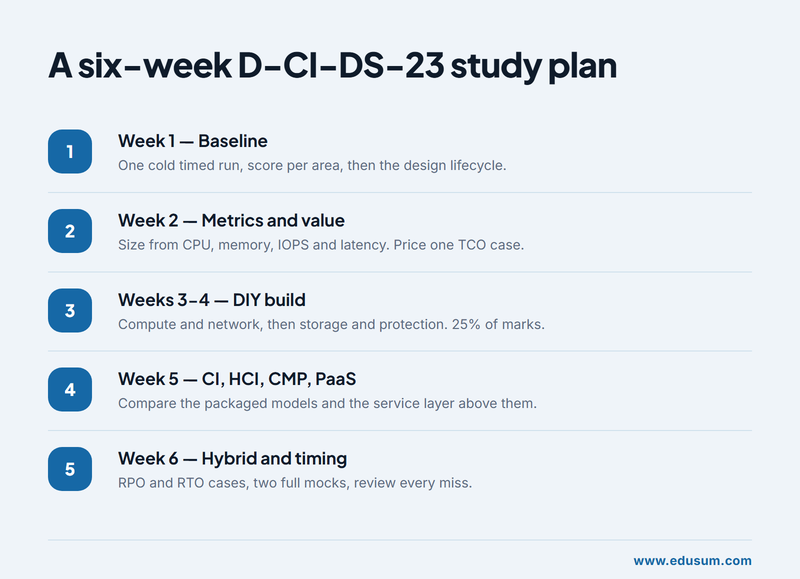
Six weeks at six to eight hours a week, roughly 40 hours in total, suits a candidate who already works with virtualisation and storage. Someone new to infrastructure design should double the early weeks rather than skip ahead. The plan below spends time in proportion to the syllabus weights.
- Week 1, baseline and design vocabulary. Take one timed practice run cold and record your score per syllabus area. Then study the design lifecycle, the reference architecture and cloud concepts from the introduction area.
- Week 2, data collection and business value. Learn which metrics size compute, memory, storage and network, and practise turning a utilisation report into a one-line design finding. Work through one total cost of ownership comparison by hand.
- Weeks 3 and 4, the do-it-yourself build. Give the 25% area two full weeks: one for compute and network, one for storage and data protection. For every technology, write down one benefit, one challenge and one design consideration.
- Week 5, CI, HCI, CMP and PaaS. Compare converged, hyper-converged and cloud-in-a-box designs side by side, then cover CMP functions and the two PaaS approaches.
- Week 6, hybrid, recovery and timed practice. Study hybrid and multicloud design with RPO and RTO examples, then sit two full timed practice tests and review every miss against its syllabus objective.
Book the exam at the start of week 4, not at the end. A fixed date keeps the last three weeks honest, and Pearson VUE slots near the date you want can fill up. If your week 6 practice scores sit below 75%, move the date rather than sit the exam hoping the real questions will be easier.
Review is where the marks are won. For each wrong practice answer, write the objective it belongs to and the reason the correct option fits the scenario better than the one you chose. After two rounds the reasons start to repeat, and those repeated reasons are the design principles the exam is really testing.
What mistakes cost candidates points on the D-CI-DS-23 exam?
Most lost marks come from a few predictable habits rather than from missing knowledge. Each one below has a simple counter you can practise.
- Answering the technology, not the requirement. The best technical option is wrong if it breaks the stated budget, timeline or skills constraint. Underline the constraint in every scenario before reading the options.
- Sizing for averages. Designs sized on average utilisation fail at peak. When a question gives both figures, the peak usually decides the answer.
- Treating every workload the same. Recovery, performance and placement should follow each workload's own objectives. Uniform protection is a common wrong option.
- Skipping the smaller areas. The three 10% areas together are worth roughly 18 of the 60 items, more than the largest single area. Leaving any of them unstudied makes the pass mark much harder to reach.
- Running out of time. At 90 seconds a question, a long scenario that takes four minutes steals time from three short ones. Mark it, move on and come back.
- Forgetting the management layer. A design with no plan for how the CMP stays available, or how users request resources, is incomplete in Dell's view.
The time habit is the easiest to fix. In every practice run, check the clock at question 20 and question 40. You should have at least 60 and 30 minutes left; if not, you are spending too long on the long scenarios.
Who should take the Dell Cloud Infrastructure Design certification?
The credential fits people whose job is to recommend an architecture rather than only run one: pre-sales and solutions architects at partners and resellers, infrastructure architects inside larger organisations, and senior administrators moving into design roles. It is vendor-specific in places, through the CI and HCI area, but most of the syllabus describes design thinking that applies to any private or hybrid cloud.
If you work for a Dell partner, check with your partner programme manager whether the credential counts towards a programme requirement before you pay the fee yourself, since many partners plan certification as part of their competency targets. Independent candidates gain a structured way to show design skills that a CV line about running virtual machines does not prove.
The certification has a 2023 version label. Dell refreshes its exams over time, so confirm on the Dell exam page that D-CI-DS-23 is still the current version before you start a six-week plan, and look for any announced replacement.
Final thoughts
D-CI-DS-23 rewards judgement more than recall. Learn the seven areas in proportion to their weight, practise turning metrics and business goals into a single recommendation, and rehearse under the real 90-minute clock until 45 correct answers out of 60 feels routine. Do that and the 63% pass mark stops being the target and becomes the safety margin.
Frequently Asked Questions
Does Dell Technologies sell an official question bank for the D-CI-DS-23 exam?
No. Dell publishes the exam description, the recommended Cloud Infrastructure Design course and its certification framework, but it does not sell a D-CI-DS-23 question bank. Practice tests from training sites, EduSum's included, are independent products for rehearsing timing and finding weak syllabus areas.
How many questions are on the D-CI-DS-23 exam and how long do I get?
D-CI-DS-23 has 60 questions with a 90-minute limit, which works out to about 90 seconds for each question. The passing score is 63%, and the exam fee is US$230 as of November 2026, delivered through Pearson VUE.
Which part of the D-CI-DS-23 syllabus carries the most weight?
Architecting a Do-It-Yourself Solution is the largest area at 25%, roughly 15 of the 60 questions. It covers the benefits, challenges and considerations of compute, network and storage technologies in a cloud design. The CI and HCI area follows at 18%.
How long does it take to prepare for D-CI-DS-23?
Around 40 hours over six weeks suits someone who already works with virtualisation and storage. Candidates new to infrastructure design usually need longer, mainly for data collection, business value analysis and the cloud management platform topics.
Is the D-CI-DS-23 certification only useful for Dell products?
Only partly. The converged and hyper-converged area draws on Dell's own designs, but most of the syllabus covers vendor-neutral design work: sizing from metrics, hybrid and multicloud placement, disaster recovery objectives, management platforms and PaaS choices that apply to any private or hybrid cloud.
- Dell Technologies Certification |
- Dell Technologies Cloud Certification |
- Dell Technologies Certified Cloud Infrastructure Design 2023 |
- D-CI-DS-23 Cloud Infrastructure Design |
- D-CI-DS-23 Online Test |
- D-CI-DS-23 Questions |
- D-CI-DS-23 Quiz |
- D-CI-DS-23 |
- Dell Technologies Cloud Infrastructure Design Certification |
- Cloud Infrastructure Design Practice Test |
- Cloud Infrastructure Design Study Guide |
- Dell Technologies D-CI-DS-23 Question Bank |
- Cloud Infrastructure Design Certification Mock Test |
- Cloud Infrastructure Design Simulator |
- Cloud Infrastructure Design Mock Exam |
- Dell Technologies Cloud Infrastructure Design Questions |
- Cloud Infrastructure Design |
- Dell Technologies Cloud Infrastructure Design Practice Test |
- D-CI-DS-23 Syllabus |
- Cloud Infrastructure Design Books |
- Cloud Infrastructure Design Certification Syllabus |
- Dell Technologies D-CI-DS-23 Books |
- Dell Technologies Cloud Infrastructure Design Training |
- Cloud Infrastructure Design Certification Cost |
- Dell Technologies Cloud Infrastructure Design Books


