
C1000-184 Exam Guide: Db2 13 for z/OS DBA Associate Syllabus and Practice Test
C1000-184 is the single exam for the IBM Certified Db2 13 for z/OS Database Administrator - Associate credential. You answer 60 questions in 90 minutes and need 44 correct, which is 73%, to pass. The fee is US$200 as of November 2026, and the exam spans seven sections, from planning and operations to SQL, locking and performance.
The quickest way to find out where you stand is to sit a timed attempt of the C1000-184 practice test before you open a single manual. It follows the same 60-question, 90-minute pattern and breaks your result down by section, so the study hours described below go to the areas that actually cost you marks. Start the C1000-184 practice test, note your weakest two sections, then use this guide to close them.
Who is the C1000-184 Db2 13 for z/OS certification meant for?
IBM describes the credential as one for an entry-level DBA who understands the fundamental concepts of Db2 13 for z/OS, whether that knowledge came from hands-on work or from formal and informal study. In practice the candidates are junior mainframe database administrators, application developers moving into database support, z/OS system programmers who are now asked to look after a Db2 subsystem, and people joining a mainframe team from a distributed database background such as Db2 for LUW, Oracle or SQL Server.
The exam expects day-to-day competence rather than architecture. IBM's own wording asks for basic to intermediate administration tasks, basic SQL, the ability to create databases and database objects, and a basic grasp of database security and transaction isolation. You are not asked to design a data sharing group or tune a whole sysplex. You are asked whether you know what each Db2 address space does, which command to issue, and why a program needs a BIND before its SQL can run.
There is no prerequisite certification, and the credential sits in IBM's Data, Analytics, and AI group. On IBM's credential record, C9006800 replaces the older code C8003803 and is not scheduled to be replaced, so it is the current entry point for Db2 on z/OS. The natural next step is the Professional-level C1000-181 exam, compared later in this guide.
What is the C1000-184 exam format, and how many correct answers pass it?
The C1000-184 exam has 60 multiple-choice questions, a 90-minute time limit and a pass mark of 44 correct answers. IBM lists the exam as Live, delivers it in English only, and schedules it through Pearson VUE, at a physical test centre or with remote online proctoring in countries where Pearson VUE offers it.
| Exam detail | C1000-184 |
|---|---|
| Credential | IBM Certified Db2 13 for z/OS Database Administrator - Associate |
| Number of questions | 60 |
| Exam length | 90 minutes |
| Pass mark | 44 of 60 correct (73%) |
| Fee | US$200 (November 2026) |
| Language | English |
| Booking | Pearson VUE |
Ninety minutes for sixty items gives you exactly a minute and a half per question. Most items are short recall or recognition questions, such as which address space owns the buffer pools or which isolation level allows uncommitted reads. A smaller number describe a scenario, show an SQL statement or a fragment of command output, and ask for the correct next step. Answer the quick ones first, flag the scenarios, and come back with the time you banked.
The 44-correct threshold leaves room for sixteen wrong answers. That margin disappears quickly if you skip a whole section, because the three largest sections together supply 61% of the questions. A candidate who is strong on SQL but has never issued a DISPLAY command rarely passes, even with a perfect score in Application Development.
Prices can differ by country and IBM can change them, so confirm the amount on IBM's C1000-184 certification page before you book. The same page links IBM's Sample Test, the Study Guide PDF and a paid Assessment Exam.
What do the seven C1000-184 syllabus sections actually test?
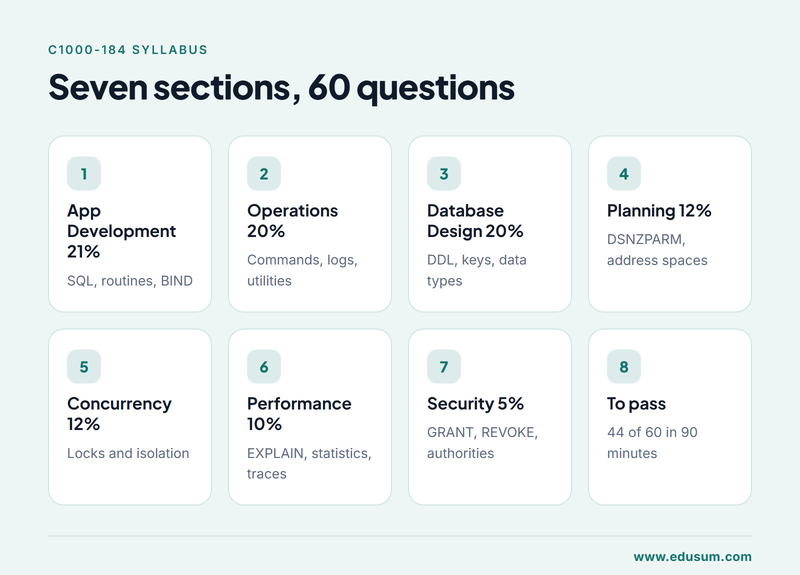
IBM publishes seven weighted sections for C1000-184. Application Development is the largest at 21%, Operations and Database Design follow at 20% each, Planning and Data Concurrency carry 12% each, Performance 10% and Security 5%. Multiplied across 60 questions, that works out to roughly 13, 12, 12, 7, 7, 6 and 3 of the 60. The full objective list is on the C1000-184 syllabus page.
| Section | Weight | About this many questions |
|---|---|---|
| Application Development | 21% | 13 |
| Operations | 20% | 12 |
| Database Design | 20% | 12 |
| Planning | 12% | 7 |
| Data Concurrency | 12% | 7 |
| Performance | 10% | 6 |
| Security | 5% | 3 |
Planning (12%)
Planning checks that you understand how a Db2 subsystem is put together before anyone connects to it. Expect questions on subsystem parameters, the DSNZPARM settings assembled into a load module that Db2 reads at start-up, and on which settings can be changed online. You should be able to name the main address spaces and their jobs: the system services address space (ssnmMSTR) for logging and commands, the database services address space (ssnmDBM1) for buffer pools, data access and the EDM pool, the IRLM for locking, and the distributed data facility (ssnmDIST) for remote connections.
The section also covers migration and continuous delivery. Db2 13 receives new capability through function levels delivered in maintenance, rather than waiting for a new version. Know the difference between the catalog level, the function level that is activated, and the APPLCOMPAT setting that controls which SQL behaviour a package sees, and know that a Db2 12 subsystem must reach function level 510 before it can migrate to Db2 13. Data sharing appears at concept level: several Db2 members in a group share one catalog and one set of data, coordinated through coupling facility structures for locks, the shared communications area and group buffer pools.
Operations (20%)
Operations is where people who learned Db2 from books lose the most marks, because the questions assume you have issued the commands yourself. You need to tell Db2 commands, which begin with the subsystem's command prefix, such as -DISPLAY DATABASE, -START DATABASE, -STOP DB2 or -DISPLAY THREAD, apart from DSN subcommands such as BIND, REBIND, FREE and RUN that are issued under the TSO DSN command processor. Know how applications connect, through TSO, CICS, IMS, the call attach facility, RRSAF or DDF for remote clients.
Logging and recovery are the core of the section. Db2 writes changes to the active log, offloads full active log data sets to archive logs, and records the inventory of both in the bootstrap data set, the BSDS. On restart Db2 reads the log to complete committed work and back out work that was in flight, so you should be able to describe the restart phases and what an indoubt thread is. The section closes with a basic tour of the utilities (COPY, RECOVER, REORG, RUNSTATS, LOAD, UNLOAD, CHECK DATA and QUIESCE) and of the catalog in DSNDB06 and the directory in DSNDB01, which together describe every object Db2 manages.
Security (5%)
Security is the smallest section, three questions or so, and it is narrowly defined. It covers the Data Control Language, GRANT and REVOKE, applied to tables, views, plans, packages, databases and system privileges, and the authorization hierarchy of administrative authorities such as installation SYSADM, SYSADM, SECADM, DBADM, SYSCTRL and SYSOPR. Know what each authority can and cannot do, and what happens to privileges granted by a user whose own privilege is later revoked.
Database Design (20%)
Database Design tests the DDL you write to build a database and its contents. You should be comfortable with CREATE and ALTER for databases, table spaces, tables, indexes, views and aliases, and with the object hierarchy that links them: a storage group, a database, table spaces inside it, tables inside a table space and index spaces created alongside each index. Recognise the universal table space types, partition-by-growth and partition-by-range, as the normal choice for new tables in Db2 13.
The rest of the section is relational fundamentals that apply on any platform: Db2 data types (INTEGER, DECIMAL, DECFLOAT, CHAR, VARCHAR, DATE, TIMESTAMP, the LOB types and XML), primary keys, unique constraints, check constraints, and referential integrity with its delete rules of RESTRICT, NO ACTION, CASCADE and SET NULL. A typical item shows two tables and a foreign key and asks what happens to the child rows when a parent row is deleted.
Application Development (21%)
The largest section asks you to think like a developer who runs SQL against Db2 for z/OS. It covers basic DML, meaning SELECT, INSERT, UPDATE, DELETE and MERGE, the difference between static and dynamic SQL, and how to confirm a statement worked through SQLCODE, SQLSTATE and the SQLCA or GET DIAGNOSTICS. It also covers stored procedures, user-defined functions and triggers: when each one fires or is called, and which kind suits a given requirement.
Program preparation is the part to learn by heart. A COBOL or PL/I program containing embedded SQL goes through the Db2 precompiler or coprocessor, which separates the SQL into a database request module, the DBRM. The DBRM is bound into a package, packages are reached through a plan, and BIND options such as ISOLATION, VALIDATE, QUALIFIER and the access path choices are fixed at that moment. Expect questions that ask what a REBIND changes and why a program fails with a timestamp mismatch.
Data Concurrency (12%)
Data Concurrency is about how Db2 lets many programs work on the same data without corrupting it. You need the four isolation levels and their trade-offs: uncommitted read (UR), cursor stability (CS), read stability (RS) and repeatable read (RR). Know the lock sizes Db2 can take, lock escalation and the LOCKMAX setting, and the difference between a timeout and a deadlock, both detected by the IRLM.
The section also checks the unit of work. A logical unit of work ends with COMMIT or ROLLBACK, savepoints let a program undo part of its work, and a long-running batch job that never commits holds its locks and grows the log until other work times out. A question might describe such a job and ask for the best fix; the answer is almost always a commit at regular intervals, not a different isolation level.
Performance (10%)
Performance at Associate level means reading the evidence rather than tuning a system. You should know how to run EXPLAIN and read the PLAN_TABLE: the ACCESSTYPE column showing a table space scan or index access, MATCHCOLS showing how many index columns were used to match, and the sort indicators. Know why catalog statistics gathered by RUNSTATS drive the optimizer's choice of access path, and why out-of-date statistics are the first suspect when a query slows down after a large load.
Traces close the section. Db2 offers statistics, accounting, performance, audit and monitor traces, each recording different IFCID records, and a monitor product formats them into reports. You are not asked for IFCID numbers; you are asked which trace answers which question, for example accounting to see where one plan spent its time, and statistics to see how the whole subsystem behaved.
Which C1000-184 sections cost candidates the most marks?
Operations and Data Concurrency cause the most failures, for opposite reasons. Operations is wide: commands, start-up, logging, restart, utilities and the catalog all sit in one 20% section, and each topic is only worth one or two questions, so gaps are spread thinly and hard to spot. Data Concurrency is narrow but deep, and its questions are written as scenarios where two answers both sound safe.
Candidates arriving from a distributed database usually find Database Design and the SQL half of Application Development familiar. What catches them is everything specific to z/OS: address space names, the TSO DSN processor, program preparation with DBRMs and packages, and the BSDS. If that describes you, give Planning and Operations twice the hours their weightings suggest.
Mainframe staff have the reverse problem. Operators and system programmers often know the commands and the log well, but lose marks on referential integrity rules, triggers, user-defined functions and the detail of isolation levels. For them, Database Design and Data Concurrency are where the extra study time pays back.
Does IBM publish its own practice test or question bank for C1000-184?
IBM provides three preparation resources on its C1000-184 certification page: a free Sample Test that shows the style of question, a Study Guide PDF that expands each objective with references, and a paid Assessment Exam booked through Pearson VUE that returns a score report. IBM does not publish a question bank of real exam items, and any site that claims to sell the actual questions is offering something IBM's testing policy forbids.
EduSum's C1000-184 practice test is an independent study tool, not an IBM product. It gives you full-length timed attempts in the same 60-question, 90-minute shape, a score for each of the seven sections, and an explanation for every answer, so you can repeat the cycle of test, review and retest as often as you need. IBM's Sample Test is the best way to see the question style once; repeated timed practice is what builds the pace and the section-by-section confidence.
IBM also recommends three courses: Db2 for z/OS 13 Introduction to System Administration (CV854G), Db2 13 for z/OS Basic Database Administration (CV845G) and Db2 13 for z/OS Utilities for Database Administrators (CV972G). IBM states that its courses do not teach the answers and that every certification test assumes on-the-job experience, so treat the courses as structure and the lab as the real teacher.
How can you prepare for C1000-184 in six weeks?
Plan on six to eight study hours in each of six weeks if you already use Db2 at work. Order the weeks by weighting and by how much each topic depends on the one before. Each week ends with a short section quiz, and the final week is timed full-length practice only.
- Week 1, baseline and Planning. Take one timed practice test cold and record your section scores. Then study the address spaces, DSNZPARM, function levels, APPLCOMPAT and data sharing concepts.
- Week 2, Operations. Issue -DISPLAY DATABASE, -DISPLAY THREAD, -START and -STOP against a test subsystem. Trace one restart through the log and the BSDS, and run COPY, RUNSTATS and REORG on a small table space.
- Week 3, Database Design and Security. Build a storage group, database, universal table space, tables, indexes and a view by hand. Add foreign keys with each delete rule and test them, then GRANT and REVOKE across two user IDs.
- Week 4, Application Development. Prepare one program through precompile, compile, link and BIND. Write a native SQL stored procedure, a scalar UDF and an AFTER trigger, and compare static and dynamic execution.
- Week 5, Data Concurrency and Performance. Open two sessions and create a lock wait, a timeout and a deadlock deliberately. EXPLAIN the same query before and after RUNSTATS and compare the PLAN_TABLE rows.
- Week 6, timed practice. Two or three full-length timed attempts with fresh questions, reviewing every wrong answer against the syllabus objective it belongs to.
If your employer cannot give you a test subsystem, IBM Z Xplore and similar learning environments offer hands-on z/OS access, and many sites run a sandbox Db2 for exactly this purpose. Reading about a lock timeout and causing one yourself are very different kinds of preparation, and the exam's scenario questions reward the second.
How does C1000-184 compare with the C1000-181 Professional exam?
C1000-184 and C1000-181 cover the same product at two depths. Both cost US$200 and give you 60 questions in 90 minutes. The Professional exam's cut-off is 66% against 73% for the Associate, because its questions are harder. The Professional syllabus adds disaster recovery, encryption and auditing, SQL tuning, workload manager classification, JSON, REST services and the IBM Db2 Analytics Accelerator.
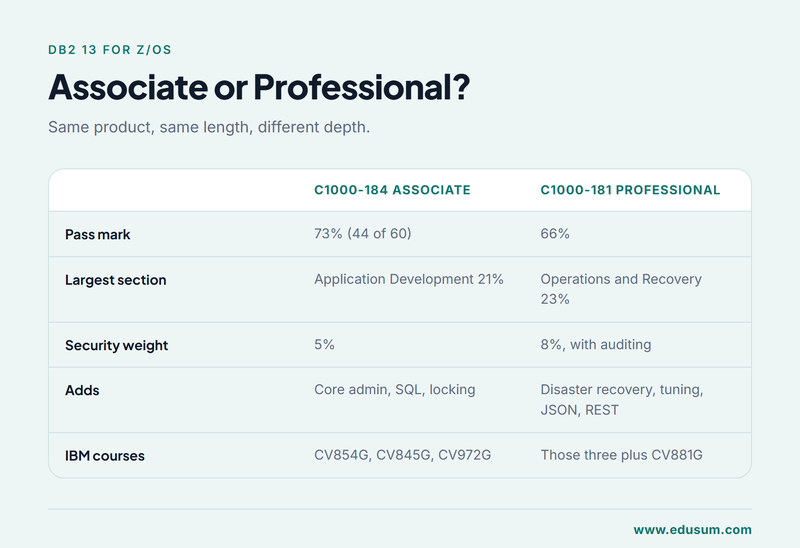
The two exams also weight their topics differently. In C1000-181, Operations and Recovery is the largest section at 23% and Performance rises to 17%, while Security and Auditing is 8%. IBM adds a fourth recommended course for the Professional level, Db2 13 for z/OS Advanced Database Administration (CV881G), on top of the three Associate courses.
Neither credential is a formal prerequisite for the other, but the order matters in practice. Passing C1000-184 first confirms the foundations that every C1000-181 scenario builds on, and the work you do for it, especially on logging, utilities and EXPLAIN, carries straight into the Professional preparation.
What mistakes make candidates fail C1000-184?
The most common mistake is treating the exam as an SQL test. SQL matters, but Application Development is 21% of the questions and much of that section is program preparation, BIND and routines rather than SELECT statements. Candidates who drill queries and skip packages, plans and DBRMs leave easy marks behind.
The second is mixing up Db2 commands with DSN subcommands and utilities. -DISPLAY DATABASE is a Db2 command, BIND is a DSN subcommand, and RUNSTATS is a utility run in a batch job. Questions that show a command and ask what will happen depend on knowing which of the three you are looking at.
The third is learning isolation levels as a list instead of as behaviour. Knowing that UR stands for uncommitted read is not enough; you need to know which anomalies each level allows, and why a reporting job and an update job might be bound with different levels on purpose.
The last is booking the sitting before practice scores are stable. Wait until you score well above 73% on two timed attempts in a row, each with a new set of questions, and only then choose a date with Pearson VUE.
What does the C1000-184 credential lead to after you pass?
A pass on C1000-184 brings IBM's Associate-level Db2 13 for z/OS DBA certification, issued as a digital badge you can add to a CV or professional profile. It shows an employer that you can work in a Db2 13 for z/OS environment without close supervision: issue the right commands, build objects correctly, prepare programs, and read an access path.
Db2 for z/OS still runs the core records of many banks, insurers, airlines and government agencies, and IBM continues to extend it through function levels, as described on IBM's Db2 for z/OS product page. Teams that run it are replacing retiring specialists, so a current Db2 13 credential is a practical signal for a junior DBA. The next step is C1000-181, which moves from running the subsystem to recovering, securing and tuning it.
Frequently Asked Questions
How many questions are on the C1000-184 exam, and how long do I get?
You face 60 questions with 90 minutes on the clock, so each item gets about ninety seconds. Most questions are short, so answering those first leaves extra time for the scenario items that show SQL or command output.
What is the passing score for C1000-184?
IBM requires 44 correct answers out of 60, which is 73%. That allows sixteen wrong answers, but the three biggest sections supply 61% of the questions, so skipping any one of them makes the pass mark very hard to reach.
How much does the C1000-184 exam cost?
IBM lists the price as US$200 in November 2026, booked through Pearson VUE. Prices can vary by country and may change, so check the amount on IBM's certification page or at the booking step before you pay.
Which C1000-184 section has the most questions?
Application Development, at 21% or roughly 13 of the 60, is the biggest single section. Two more, Operations and Database Design, are close behind at 20% each, while Security contributes only 5%, around three items.
Is C1000-184 still a current IBM exam?
Yes. In November 2026 IBM shows both the exam and the credential as Live, with no replacement announced. The credential, code C9006800, itself replaced the earlier credential C8003803.
Do I need z/OS experience before taking C1000-184?
IBM sets no prerequisite, but the questions assume you have worked with a Db2 for z/OS subsystem. Candidates from other databases should spend extra time on address spaces, commands, logging and program preparation, which have no direct equivalent elsewhere.
- IBM Certification |
- IBM Certified Db2 13 for z/OS Database Administrator - Associate |
- C1000-184 Db2 13 for z/OS Database Administrator Associate |
- C1000-184 Online Test |
- C1000-184 Questions |
- C1000-184 Quiz |
- C1000-184 |
- IBM Db2 13 for z/OS Database Administrator Associate Certification |
- Db2 13 for z/OS Database Administrator Associate Practice Test |
- Db2 13 for z/OS Database Administrator Associate Study Guide |
- IBM C1000-184 Question Bank |
- Db2 13 for z/OS Database Administrator Associate Certification Mock Test |
- Db2 13 for z/OS Database Administrator Associate Simulator |
- Db2 13 for z/OS Database Administrator Associate Mock Exam |
- IBM Db2 13 for z/OS Database Administrator Associate Questions |
- Db2 13 for z/OS Database Administrator Associate |
- IBM Db2 13 for z/OS Database Administrator Associate Practice Test |
- C1000-184 Syllabus |
- Db2 13 for z/OS Database Administrator Associate Books |
- Db2 13 for z/OS Database Administrator Associate Certification Cost


