
QRadar SIEM Administrator Career: Skills, Syllabus and Practice Test Plan
A QRadar SIEM administrator keeps IBM's security information and event management platform collecting, parsing and correlating data correctly, so that analysts see real offenses instead of noise. The role sits between infrastructure and the security operations centre, and IBM certifies it with the IBM Certified Administrator - Security QRadar SIEM V7.5 credential.
IBM examines that credential as C1000-156: 62 questions in 90 minutes, with a passing score of 61%, at a fee of US$200 as of October 2026. This guide explains what the job involves day to day, which skills hiring managers look for, what each of the eight syllabus sections tests, and how to build a preparation plan around a working lab.
What does a QRadar SIEM administrator actually do each week?
Most of the week goes on data quality. A SIEM is only as useful as the events it receives, so the administrator spends hours confirming that firewalls, domain controllers, endpoint agents, cloud services and network devices are all sending logs, that QRadar recognises each source with the right Device Support Module (DSM), and that the fields analysts depend on, such as user name, source IP and destination port, are parsed rather than left inside the raw payload.
The second large block of time is tuning. New rules and content packs arrive with default thresholds that rarely suit a particular network. An administrator adds identity exclusions for vulnerability scanners and backup servers, places trusted ranges in the network hierarchy, and adjusts building blocks so that a brute-force rule does not fire every time a service account retries a password. The goal is an offense queue small enough for the SOC to work through in a shift.
The rest of the job is platform care. Licences for events per second and flows per minute must cover peak load, managed hosts such as Event Processors and Flow Processors need health monitoring, nightly configuration backups have to succeed, and applications from the IBM App Exchange need installing, upgrading and occasionally removing when they consume more memory than the appliance can spare. When something breaks, the administrator is the person who reads the system notifications first.
In larger organisations the work is split. One team member may own log source onboarding while another manages the distributed deployment and upgrades. In a managed security service provider the same person might administer several customer tenants from one console. Either way, the administrator is judged on two outcomes: no data silently missing, and no flood of false positives.
Which skills do employers ask for in QRadar administrator roles?
Job descriptions for QRadar administrators repeat a fairly stable list. The first item is nearly always log source onboarding and parsing: adding sources through the Log Source Management app, choosing protocols such as Syslog, JDBC or a vendor API, and writing custom event properties with regular expressions or JSON paths when a DSM misses a field. Candidates who can explain why an event lands as Unknown and how to fix it stand out in interviews.
Rule writing and tuning come next. Employers want someone who understands the difference between event rules, flow rules, common rules and offense rules, who builds reusable logic with building blocks, and who knows when an Anomaly Detection Engine rule fits better than a plain threshold. Reference sets and reference maps appear in most postings because they let a rule check an IP, user or hash against a list that other tools keep up to date.
Platform skills follow: Linux administration on Red Hat based appliances, networking fundamentals, storage planning for the Ariel database, and comfort with the QRadar REST API for automation. Python or shell scripting is often listed as desirable rather than required. Many roles also ask for experience coordinating with an external SOC or MSSP, since the administrator frequently acts as the technical contact between the business and whoever watches the console overnight.
Soft skills matter more than the postings suggest. Tuning a rule means telling a system owner that their noisy server is hiding attacks, and onboarding a log source means persuading another team to change a device configuration. Administrators who document every exclusion with a reason and an owner earn the trust that keeps a SIEM running well after the original project team has moved on.
How is the QRadar SIEM V7.5 administrator exam structured?
The administrator exam is a single, proctored, multiple-choice test delivered through Pearson VUE. It contains 62 questions, allows 90 minutes, and requires 61% to pass. That works out to just under one and a half minutes per question, so long scenario questions need to be balanced against shorter recall items. The fee of US$200 is a list price as of October 2026; local taxes and currency conversion can change what you pay at checkout.
| Exam detail | Value |
|---|---|
| Certification | IBM Certified Administrator - Security QRadar SIEM V7.5 |
| Exam code | C1000-156 |
| Product version | QRadar SIEM V7.5 |
| Number of questions | 62 |
| Duration | 90 minutes |
| Passing score | 61% |
| Exam fee | US$200 (as of October 2026) |
IBM publishes the objectives, a preparation guide and the booking link on its IBM Certified Administrator - Security QRadar SIEM V7.5 certification page. Check that page shortly before you book, because IBM revises exam versions as the product moves on, and the version you study for should match the version you sit.
The questions are written for someone who has already run QRadar in production. Expect scenarios that describe a symptom, such as events arriving but not matching any rule, or a managed host showing a warning, and ask which action an administrator should take first. Pure definitions are a minority. If you have only watched training videos, the scenario wording will feel harder than the topic list suggests.
What do the eight syllabus sections test, and how much does each weigh?
The syllabus divides the exam into eight sections of very different size. Two of them, System Configuration at 20% and Troubleshooting at 16%, account for more than a third of the marks between them. User Management, at 6%, is the smallest. The table below lists every section with its weighting, followed by what each one covers in practice.
| Section | Weight |
|---|---|
| System Configuration | 20% |
| Troubleshooting | 16% |
| Data Source Configuration | 14% |
| Performance Optimization | 13% |
| Reporting, Searching and Offense Management | 13% |
| Accuracy Tuning | 10% |
| Tenants and Domains | 8% |
| User Management | 6% |
System Configuration (20%)
This is the broadest section. It covers licence management, administering managed hosts, the distributed deployment architecture, configuration and data backups, SNMP and email templates, the network hierarchy, reference data, automatic updates, the asset database, and installing apps. A typical question asks which component of a distributed deployment should receive a new log source, or what happens to events that exceed the licensed rate. Know the roles of the Console, Event Collector, Event Processor and Flow Processor well enough to draw them from memory.
Troubleshooting (16%)
Troubleshooting rewards hands-on experience more than any other section. It covers reviewing and responding to system notifications, resolving common documented issues, managing and troubleshooting apps, running health checks, and using the basic GUI and the REST API. Learn what the common notifications mean, for example events being routed directly to storage because a pipeline queue filled, and the order in which you would investigate them.
Data Source Configuration (14%)
Here the exam tests flow sources, log sources, exporting event and flow data, vulnerability information sources, custom event and flow properties, custom log source types, and data obfuscation. The DSM Editor is central to several of these objectives, because it is where you test a regular expression against a sample payload and map the result to a QRadar Identifier. Obfuscation questions usually concern hiding personal data such as user names from operators who lack the right permission.
Performance Optimization (13%)
Performance questions deal with identity exclusions, resource constraints, rule configuration and tuning, index management, search management, and routing rules with event forwarding. The practical theme is load. A badly ordered rule test or a search on an unindexed custom property can slow the whole pipeline, and routing rules can drop or bypass correlation for high-volume, low-value events before they consume licence and CPU.
Reporting, Searching and Offense Management (13%)
This section covers managing reports, using the different search types, managing offenses, and sharing content between users. You should be able to explain when to use a quick filter, a saved search or an Ariel Query Language statement, how offense chaining and closing work, and how report schedules and distribution are set up. Content sharing questions often turn on who owns a saved search and who can see it.
Accuracy Tuning (10%)
Accuracy tuning focuses on Anomaly Detection Engine rules, building blocks, content packs, native information sources, and integrations. The key idea is precision: getting the right offenses to fire, rather than more of them. Expect questions on which ADE rule type, anomaly, threshold or behavioural, suits a given pattern, and on how a building block can be reused across several rules.
Tenants and Domains (8%)
Multi-tenancy questions distinguish the network hierarchy from domain definitions, and cover managing domains and tenants, allocating licences across tenants, and assigning users to tenants. This section matters most to MSSP staff, but anyone can score here by learning the difference between segmenting data by domain and simply describing the network with hierarchy objects.
User Management (6%)
The smallest section covers user accounts, security profiles, user roles, and authentication and authorisation. Remember the split: a user role decides what a person can do, such as editing rules or viewing the Admin tab, while a security profile decides which networks, log sources and domains that person can see.
Which sections cost candidates the most marks?
Candidates from an analyst background usually lose marks in System Configuration and Troubleshooting. Analysts spend their day on the Offenses and Log Activity tabs, so they know searching and offense handling well, but they may never have added a managed host, restored a configuration backup or read a pipeline notification. Together those two sections carry 36% of the exam, which is enough to fail on even with a perfect score elsewhere.
Candidates from an infrastructure background tend to struggle with the reverse: Accuracy Tuning and Reporting, Searching and Offense Management. They can deploy an appliance, yet questions about why an ADE rule did not fire, or which search type returns grouped results fastest, need time spent inside the analyst views. A useful self-test is to explain, without notes, how an event travels from a source device to a closed offense, naming every component and decision point along the way.
Data Source Configuration catches both groups because it mixes two skills: protocol setup, which feels like infrastructure work, and payload parsing, which feels like analysis. Practise building at least one custom log source type and two custom event properties from real sample logs before the exam. Watching someone else do it in a video does not build the instinct the scenario questions test.
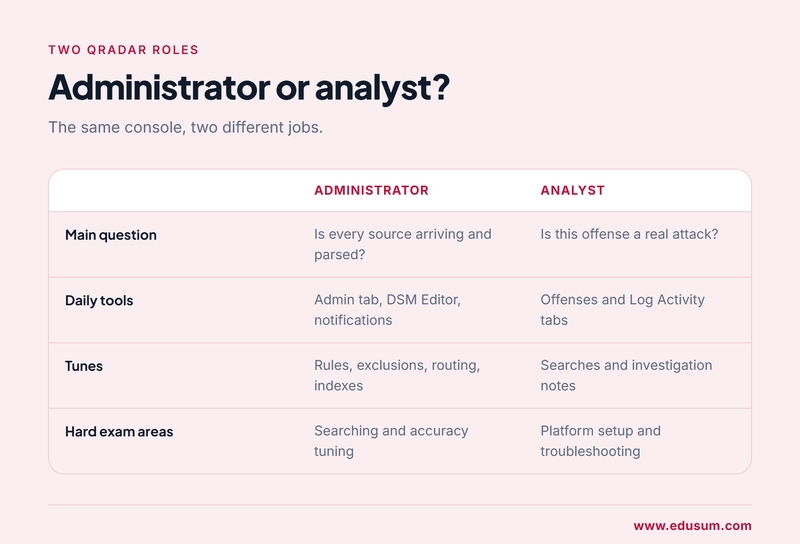
The comparison above shows why the administrator and analyst paths divide the product between them. IBM certifies the analyst side separately, so if your daily work is investigation rather than platform care, check whether the analyst credential fits you better before you book the administrator exam.
Does IBM offer an official practice test for the QRadar administrator certification?
IBM provides the official preparation material for this credential: the exam objectives, a preparation guide on IBM's learning platform, and the product documentation. Those are the authoritative sources for what the exam covers. IBM's own resources are where to confirm the current exam version, objectives and booking rules.
EduSum is not IBM and does not sell IBM material. Our practice test is an independent question bank written to the published syllabus, with timed full-length attempts and section-level results, so you can see which of the eight areas still needs work. Before buying anything, try the free QRadar administration sample questions to judge whether the question style suits your preparation.
Be cautious with anything sold as real exam questions or dumps. Using leaked exam content breaches IBM's certification agreement and can lead to a revoked credential. It also defeats the purpose: an interviewer who asks how you would clear a full event pipeline will spot memorised answers within a couple of follow-up questions.
How can you prepare for the administrator exam in six weeks?
Six weeks is realistic for someone who already works with QRadar part-time. Plan on roughly an hour a day on weekdays and a longer lab session at weekends. Someone new to the product should double the timeline and spend the extra weeks running a lab, because the exam assumes production experience.
Week one is for mapping. Print the syllabus, mark each objective as confident, partial or unknown, and set up a lab. IBM offers a QRadar Community Edition for learning, which runs as a single virtual machine and supports enough events per second for practice. Install it early, because setup itself teaches several System Configuration objectives.
Weeks two and three cover System Configuration, Data Source Configuration and Troubleshooting, the three sections worth half the exam. In the lab, add syslog and file-based log sources, break one deliberately by changing its format, and fix it with the DSM Editor. Take a configuration backup, change several settings, and restore it to see what returns. Read every system notification that appears and look up its meaning.
Week four is for rules and tuning. Write an event rule, a flow rule and an offense rule, then wrap a condition in a building block and reuse it. Create an ADE rule of each type. Add a reference set fed by a simple script through the REST API, which also covers the API objective under Troubleshooting.
Week five covers the remaining sections: searches, AQL, reports, offense handling, users, roles, security profiles, domains and tenants. Configure two domains in the lab, assign a user to one, and confirm what that user can and cannot see. This one exercise answers most of the questions in the two smallest sections.
Week six is timed practice. Sit full-length practice exams under the real limit of 90 minutes for 62 questions, and for every wrong answer write down the objective it belongs to. If the same objective appears three times, go back to the lab rather than rereading notes. Book the exam once you score comfortably above the pass mark on two consecutive attempts.
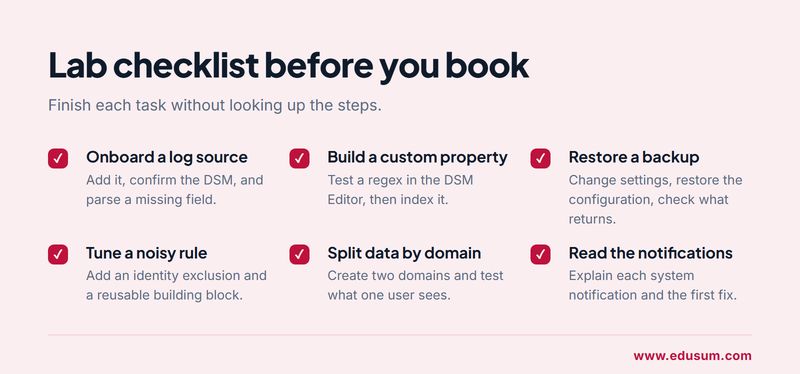
Use the checklist above as an exit test for week five. Each item is a task you should be able to finish in the lab without searching for instructions. Any item you cannot complete points to the section where your next study hours belong.
Where does a QRadar administrator career lead next?
The certification is most valuable where QRadar is already installed. Banks, insurers, government bodies, telecom operators and MSSPs run large on-premises deployments, and they hire administrators to keep those platforms healthy. In 2024 Palo Alto Networks bought IBM's QRadar SaaS business, but the on-premises QRadar products were not part of that sale, and IBM continues to offer QRadar SIEM software for customers who run it themselves.
That change is worth weighing honestly. Some organisations that used the cloud edition have migrated to other platforms, and every SIEM market shift creates migration projects. Administrators who understand QRadar deeply are well placed for that work, because a migration starts by documenting what the old system collects, how it parses each source and which rules actually matter.
The skills also transfer. Log source onboarding, parsing, rule tuning, capacity planning and multi-tenant design are the same problems in every SIEM, whatever the product calls them. A QRadar administrator who later works on a different platform starts with the hardest part already learnt: knowing what good data looks like and how to prove it is arriving.
Typical next steps include a senior SIEM engineer or security engineering role, a detection engineering position that writes and tests correlation logic across tools, or a SOC architecture role responsible for the whole monitoring stack. Within IBM's own portfolio, the QRadar deployment and analyst credentials sit beside the administrator one, and holding two of them shows you understand both the platform and the investigations it supports.
Whichever direction you choose, keep the lab you built for the exam. A working QRadar instance, with your own custom properties, rules and dashboards, is the strongest evidence you can bring to an interview, and it keeps your skills current as IBM releases new versions of the product.
Frequently Asked Questions
How many questions are on the QRadar SIEM V7.5 administrator exam?
The exam has 62 multiple-choice questions and a time limit of 90 minutes, which gives you just under one and a half minutes per question. Many questions are scenarios describing a symptom in a QRadar deployment and asking which action an administrator should take, so leave time to read each one carefully.
What is the passing score for the QRadar administrator certification?
You need 61% to pass the IBM Certified Administrator - Security QRadar SIEM V7.5 exam. Because System Configuration and Troubleshooting together carry 36% of the marks, weakness in those two sections is the most common reason candidates fall short of the pass mark.
How much does the QRadar SIEM administrator exam cost?
The exam fee is US$200 as of October 2026. It is booked through Pearson VUE, and the amount charged can differ slightly by country because of local taxes and currency conversion. Confirm the current price on the booking page before you schedule your attempt.
Do I need QRadar experience before taking the administrator exam?
IBM does not make experience a formal requirement, but the questions assume you have administered QRadar in practice. Candidates without production experience should build a lab with QRadar Community Edition and practise onboarding log sources, tuning rules and restoring backups before sitting the exam.
What is the difference between the QRadar administrator and analyst certifications?
The administrator credential covers running the platform: deployment, licences, log and flow sources, tuning, users, tenants and troubleshooting. The analyst credential focuses on investigating offenses and searching events. Choose the one that matches your daily work, or take both to show you understand the whole product.
Which syllabus section carries the most weight on the administrator exam?
System Configuration carries the most weight at 20%, followed by Troubleshooting at 16% and Data Source Configuration at 14%. User Management is the smallest at 6%. Spending study time in proportion to these weightings is the simplest way to raise your score.
- IBM Certification |
- IBM Certified Administrator - Security QRadar SIEM V7.5 |
- C1000-156 Security QRadar SIEM Administration |
- C1000-156 Online Test |
- C1000-156 Questions |
- C1000-156 Quiz |
- C1000-156 |
- IBM Security QRadar SIEM Administration Certification |
- Security QRadar SIEM Administration Practice Test |
- Security QRadar SIEM Administration Study Guide |
- IBM C1000-156 Question Bank |
- Security QRadar SIEM Administration Certification Mock Test |
- Security QRadar SIEM Administration Simulator |
- Security QRadar SIEM Administration Mock Exam |
- IBM Security QRadar SIEM Administration Questions |
- Security QRadar SIEM Administration |
- IBM Security QRadar SIEM Administration Practice Test |
- C1000-156 Syllabus |
- Security QRadar SIEM Administration Books |
- Security QRadar SIEM Administration Certification Syllabus |
- IBM C1000-156 Books |
- IBM Security QRadar SIEM Administration Training |
- Security QRadar SIEM Administration Certification Cost |
- IBM Security QRadar SIEM Administration Books |
- IBM Security Certification


