
IBM Maximo Manage Functional Deployment: Role, Skills and Career Path
A Maximo Manage functional deployment professional configures IBM Maximo Application Suite so that an organisation's assets, work orders, inventory and purchasing all run inside one system. The role translates how a plant, fleet or facility actually operates into working Maximo configuration, and IBM certifies it at professional level.
The credential that recognises this work is examined as C1000-183, a 90-minute exam of 61 questions with a 67% pass mark and a registration fee of $200 USD as of September 2026. This guide sets out what the role does day to day, which skills the exam measures, how the nine syllabus areas are weighted, and how to build the hands-on experience that makes the certification worth holding.
What a functional deployment professional does day to day
Maximo Manage is the work and asset management application inside IBM Maximo Application Suite. A functional deployment professional owns the functional design of that application: the organisations and sites, the asset and location hierarchies, the job plans, the storerooms, the purchasing flow and the security groups that decide who may touch each of them. It is a configuration role rather than an infrastructure one, and the distinction matters when you choose which certification to sit.
The everyday work starts with a requirement expressed in the language of the business. A maintenance manager wants preventive maintenance raised automatically when a pump reaches a meter reading. A finance controller wants every work order charged to the right GL account. A safety officer wants a permit attached to any job on high-voltage equipment. Each of those becomes a configuration decision, and the professional-level exam is built around the judgement those decisions require.
A typical week involves some combination of the following:
- Gathering and challenging functional requirements from maintenance, stores, procurement and finance teams, then mapping them onto Maximo's existing data model before reaching for customisation.
- Configuring applications, domains, workflows and escalations so the system enforces a process instead of relying on people to remember it.
- Building asset and location hierarchies that will still make sense after five years of plant changes.
- Setting up job plans, preventive maintenance records, safety plans and work scheduling so planners can see capacity rather than guess at it.
- Defining storerooms, reorder rules, contracts and purchasing approval limits.
- Designing security groups so that access follows the organisation's structure rather than being granted case by case.
- Testing configuration against real scenarios and handing over documentation the client's own administrators can maintain.
The people who do this well tend to come from two directions. Some arrive from maintenance and reliability engineering and learn the software; others arrive from enterprise software consulting and learn how a plant runs. Both routes work, and both have a predictable weak spot, which the exam tends to find.
The skills the professional-level certification tests
IBM's professional credential sits above the associate level, and the difference is one of judgement rather than recall. An associate is expected to know where a setting lives; a professional is expected to know which of three defensible configurations fits the client's process, and what each will cost in maintenance later. The published syllabus divides that judgement across nine areas.
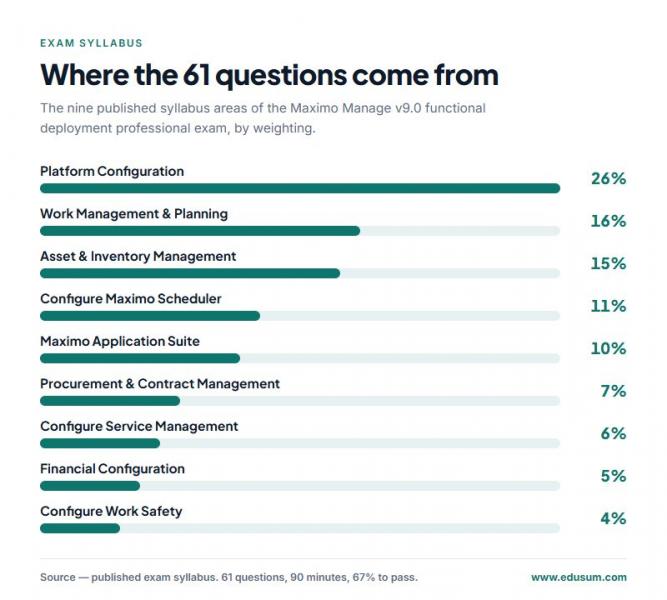
The full breakdown is published on the exam syllabus page, and it is worth reading before you plan any study at all, because the weightings are uneven enough to change where your time should go:
| Syllabus area | Weighting | Questions (approx.) |
|---|---|---|
| Platform Configuration | 26% | 16 |
| Work Management & Planning | 16% | 10 |
| Asset & Inventory Management Configuration | 15% | 9 |
| Configure Maximo Scheduler | 11% | 7 |
| Maximo Application Suite | 10% | 6 |
| Procurement & Contract Management | 7% | 4 |
| Configure Service Management | 6% | 4 |
| Financial Configuration | 5% | 3 |
| Configure Work Safety | 4% | 2 |
The question counts in the third column are arithmetic, not an IBM figure: they are each weighting applied to the 61 questions and rounded. Treat them as a guide to effort, not a promise about any individual exam form.
How the exam is structured and scored
The exam runs for 90 minutes and contains 61 questions, which leaves a little under 90 seconds per question. The pass mark is 67%. If every question carries equal weight, that is roughly 41 correct answers out of 61, so you can afford to lose about 20 questions across the whole paper and still pass.
| Detail | Value |
|---|---|
| Certification | IBM Certified Maximo Manage v9.0 Functional Deployment - Professional |
| Exam code | C1000-183 |
| Number of questions | 61 |
| Duration | 90 minutes |
| Passing score | 67% |
| Registration fee | $200 USD (September 2026) |
| Product version | Maximo Manage v9.0 |
That margin sounds generous and rarely feels it. The reason is pacing: the scenario-style questions that carry the most judgement are also the longest to read, and candidates who answer in strict order often meet three of them in a row near the end with eleven minutes left. Answer every question you can settle in under a minute on the first pass, flag the rest, and come back. An unanswered question scores nothing, while a considered guess on a four-option question does not.
IBM publishes the authoritative description of the credential, including its place in the wider certification path, on the IBM Certified Maximo Manage v9.0 Functional Deployment - Professional page. Check it before you book: IBM revises exam details and delivery arrangements from time to time, and the vendor's own page is the only source that is right by definition.
Platform configuration carries more weight than anything else
At 26%, platform configuration is more than a quarter of the paper and nearly twice the next largest area. If you are short of time, this is where the time goes. The area covers the mechanisms that make Maximo behave like the client's business rather than like a default install.
Expect to be comfortable with the Application Designer, domains and value lists, workflow design, escalations, cron tasks, communication templates, and the organisation and site structure that sits underneath all of them. The questions that separate candidates here are rarely about where a screen lives. They are about consequence: what happens to existing records when you change a domain, why an escalation fires twice, which level of the organisation hierarchy a given setting belongs at, and what a security group grants once it is combined with another.
The organisation and site model deserves particular attention because it is the decision that is hardest to reverse. Settings applied at organisation level cascade to every site beneath them; settings applied at site level do not. Get that wrong in a design workshop and the correction, two years later, is a data migration rather than a configuration change. The exam knows this, and asks about it.
Workflow is the other reliable source of difficulty. A workflow that works in a demo will still fail in production if the escalation that drives it points at a person who has left, or if its conditions overlap with a second workflow on the same record. Practise reading a workflow definition and predicting its behaviour, rather than only building one.
Work management, scheduling, service and safety
Taken together, work management and planning (16%), Maximo Scheduler (11%), service management configuration (6%) and work safety (4%) make up 37% of the exam. These four areas share a theme: they are where the maintenance process meets the calendar and the people who have to carry it out.
Work management covers job plans, work order types and statuses, preventive maintenance and the routes that generate it, and the relationship between a work order and the asset or location it is raised against. The judgement being tested is usually about reuse. A job plan written once and applied to three hundred assets is maintainable; three hundred individually edited work orders are not, and the configuration choices that lead to each outcome look similar on the day they are made.
Maximo Scheduler adds capacity and time to that picture: graphical scheduling, assignment of labour and crews, and the constraints that stop a planner committing work nobody can perform. Candidates who have only ever used Maximo as a record-keeping system tend to lose marks here, because scheduling is the part of the product that assumes you have thought about labour availability as data rather than as something the supervisor knows.
Service management configuration deals with service requests, ticket templates and the service desk flow into work orders. Work safety, the smallest area at 4%, covers safety plans, hazards, precautions, lock-out and tag-out and the way those attach to job plans and work orders. Four per cent is roughly two questions, so it is not worth days of study, but it is worth an hour: the concepts are small, self-contained and easy marks once seen.
Assets, inventory, procurement and finance in a live deployment
Asset and inventory management configuration is the third largest area at 15%, and it carries the decisions with the longest half-life in a Maximo deployment. Asset hierarchies, location systems, classifications and specifications, meters and condition monitoring, item masters, storerooms and reorder rules are all configured once and lived with for years.
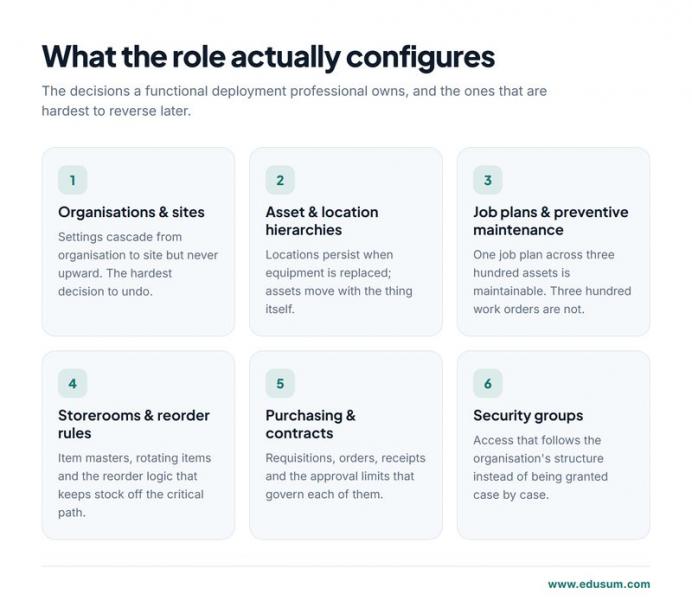
The recurring exam theme is the difference between an asset and a location, and when to use each. Locations describe where work happens and persist when equipment is replaced; assets describe the thing itself and move. Rotating items complicate this further, because the same physical unit is tracked as inventory in a storeroom and as an asset once installed. Candidates who have only worked on one deployment often know their own project's convention rather than the product's capability, and the exam is written against the product.
Procurement and contract management (7%) covers purchase requisitions, purchase orders, receipts, invoices, vendors and the contract types Maximo supports, along with the approval limits that govern them. Financial configuration (5%) covers GL account structures, chart-of-account validation, currencies and the resource codes that make a work order's cost land in the right place. Neither is large, but they interlock: a purchase order that cannot resolve a GL account will not progress, and questions frequently test that seam rather than either area alone.
The Maximo Application Suite area (10%) sits above all of it and covers the suite context in which Manage now runs, including how applications are licensed and accessed and how Manage relates to the other suite components. Candidates upgrading their knowledge from earlier Maximo versions should not skip this: it is the area where prior experience is most likely to be out of date rather than merely incomplete.
How to prepare when you already work with Maximo
Most people sitting a professional-level exam are not starting from zero; they are working with Maximo on one deployment and need to generalise. The preparation problem is therefore coverage rather than comprehension, and a plan that follows the weightings beats one that follows the product documentation front to back.
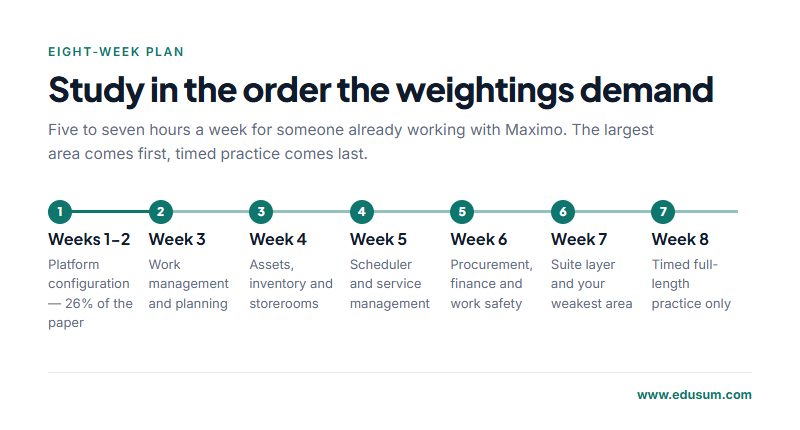
A workable eight-week approach, assuming five to seven hours a week:
- Weeks 1-2 — platform configuration. The largest area first, while your attention is freshest. Build a domain, wire an escalation, design a workflow with a condition, and change something at organisation level to watch it cascade.
- Week 3 — work management and planning. Job plans, preventive maintenance, routes, work order lifecycles. Write one job plan and apply it to several assets rather than reading about the feature.
- Week 4 — assets and inventory. Hierarchies, classifications, meters, storerooms, reorder rules, rotating items.
- Week 5 — scheduler and service management. Graphical scheduling, labour and crew assignment, service requests and ticket templates.
- Week 6 — procurement, contracts, finance and work safety. The four smaller areas together, which sum to 22% and share more concepts than their separation suggests.
- Week 7 — the suite layer and your weakest area. Maximo Application Suite context, then whatever your practice scores say you are worst at.
- Week 8 — timed practice only. Full-length, timed, no notes. The purpose is pacing and stamina, not new material.
Two habits raise scores more than extra reading. The first is configuring rather than reading: if you have access to a sandbox, twenty minutes building the thing beats two hours reading about it, because the exam asks what happens next and only configuration teaches that. The second is explaining your answer aloud, including on the questions you get right. A right answer for the wrong reason is a question you will lose when the scenario is reworded, and it is invisible unless you say the reason out loud.
IBM also publishes a recommended learning path for the credential, which lists the courses it considers relevant preparation, on the IBM learning path page. It is worth comparing against your own gaps rather than following wholesale, since much of it assumes no prior Maximo exposure.
Does IBM publish an official practice test or question bank?
IBM is the certifying body, so anything described as official for this exam has to come from IBM. Its certification and learning path pages are the authoritative source for the objectives, the recommended courses and the exam's current status, and only IBM's own sample material is an official practice test for this credential. Everything else, including ours, is third-party preparation.
Our practice test for this exam is an unofficial one built for the published syllabus. It offers a bank of more than 270 questions with unlimited timed attempts for two months, a result history so you can see which syllabus areas are actually weak, and a money-back guarantee if you fail at the first attempt. A free set of sample questions is published alongside it, so you can see how the questions are framed before paying for anything.
The honest way to use any question bank, ours included, is as a diagnostic rather than a syllabus. A bank tells you which areas you are weak in; it cannot tell you why a given configuration is correct on a real deployment, and a candidate who has memorised answers without that understanding tends to pass narrowly and then struggle in the role the certification was meant to open.
Mistakes that cost candidates the pass mark
The failure patterns on this exam are consistent enough to be worth naming.
- Studying one deployment instead of the product. Your project made choices; the exam tests the range of choices available. Anyone who has only worked on a single implementation should deliberately read about the options their project rejected.
- Under-weighting platform configuration. It is 26% of the paper and the least glamorous area, so it is the one most often left until a rushed final week.
- Confusing the associate and professional scopes. Preparing with associate-level material leaves you fluent in where settings live and short on why one is chosen over another.
- Treating the smaller areas as noise. Work safety, financial configuration, procurement and service management together make up 22% — more than a fifth of the exam, and cheaper marks per hour of study than the large areas.
- Ignoring the suite layer. Experience with Maximo 7.6 or Manage v8 is valuable but partly out of date, and the Maximo Application Suite area is exactly where it shows.
- Answering in strict order. The long scenario questions are worth the same as the short ones. Leaving three of them for the last ten minutes is a pacing decision, not bad luck.
Where the role leads next
Functional deployment is a consulting-shaped role, and the credential is most useful to people whose work is judged by clients or internal stakeholders rather than by uptime. It signals that you can be handed a requirement and trusted to configure a defensible answer, which is the thing a delivery manager is actually buying when they staff a project.
From here the common directions are solution architecture, where you own the design across several suite components rather than the configuration of one; reliability and asset management strategy, where the Maximo knowledge supports process work rather than the other way round; and the technical track, where deployment, integration and administration matter more than functional design. The functional route is the one that keeps you closest to the business process, and it is the hardest of the three to automate away.
Certification does not create any of those moves on its own. What it does is remove a filter: on a shortlist where every candidate claims Maximo experience, a current credential against v9.0 is a checkable fact rather than a claim, and it is usually the difference between a first conversation and none.
Final thoughts
The professional-level Maximo Manage functional deployment credential rewards people who have configured the product and thought about why. Its 61 questions in 90 minutes at a 67% pass mark are not a memory test, and the uneven syllabus weightings are the clearest guidance IBM gives about where understanding is expected to be deepest — a quarter of the paper on platform configuration alone.
If you work with Maximo daily, the gap is usually coverage rather than capability: the areas your own deployment never used. Map the nine syllabus areas against what you have actually configured, be honest about the blanks, and spend your preparation there. That is the shortest route to a pass, and more usefully, it is also the route that leaves you better at the job afterwards.
Frequently Asked Questions
What does a Maximo Manage functional deployment professional do?
They own the functional design of a Maximo Manage deployment: organisations and sites, asset and location hierarchies, job plans, storerooms, purchasing flow, workflows and security groups. The role turns business requirements from maintenance, stores and finance teams into working configuration, rather than managing the underlying infrastructure.
How many questions are on the C1000-183 exam and how long does it last?
It contains 61 questions with a 90-minute time limit. To pass you need 67%, which on equally weighted questions is about 41 correct answers. Pacing matters more than that margin suggests, because the longest scenario questions carry no more marks than the short ones.
What is the passing score for the Maximo Manage v9.0 functional deployment exam?
The published passing score is 67%. Against 61 questions of equal weight that is approximately 41 correct answers. IBM can revise exam details, so confirm the current figure on IBM's own certification page before you book your seat.
Which syllabus area carries the most weight?
Platform configuration, at 26% of the exam — roughly 16 of the 61 questions, and nearly twice the next largest area. It covers Application Designer, domains, workflow, escalations, cron tasks, communication templates and the organisation and site structure beneath them.
How much does the exam cost?
The registration fee is $200 USD as of September 2026. Prices vary by country and IBM adjusts them periodically, so check the current fee on IBM's certification page when you book. Third-party preparation material, including practice tests, is priced separately.
Does IBM publish an official practice test for this certification?
IBM is the certifying body, so only material IBM itself publishes can carry that description. Our practice test is third-party preparation built for the published syllabus, with more than 270 questions and unlimited timed attempts for two months.
How long does it take to prepare if I already use Maximo at work?
About eight weeks at five to seven hours a week is realistic for someone working with Maximo daily. The problem is usually coverage rather than comprehension, so follow the syllabus weightings and concentrate on the areas your own deployment never happened to use.
How does the professional level differ from the associate level?
The associate level tests where settings live; the professional level tests judgement about which of several defensible configurations fits a client's process and what each costs to maintain. Preparing with associate-level material leaves candidates short on that reasoning.
- IBM Certification |
- IBM Sustainability Certification |
- IBM Certified Maximo Manage v9.0 Functional Deployment - Professional |
- C1000-183 Maximo Manage Functional Deployment Professional |
- C1000-183 Online Test |
- C1000-183 Questions |
- C1000-183 Quiz |
- C1000-183 |
- IBM Maximo Manage Functional Deployment Professional Certification |
- IBM C1000-183 Question Bank |
- Maximo Manage Functional Deployment Professional Certification Mock Test |
- IBM Maximo Manage Functional Deployment Professional Questions |
- Maximo Manage Functional Deployment Professional |
- IBM Maximo Manage Functional Deployment Professional Practice Test |
- C1000-183 Syllabus |
- Maximo Manage Functional Deployment Professional Books |
- IBM C1000-183 Books |
- IBM Maximo Manage Functional Deployment Professional Training |
- Maximo Manage Functional Deployment Professional Certification Cost |
- IBM Maximo Manage Functional Deployment Professional Books |
- IBM C1000-183 Practice Test Free |
- Maximo Manage Functional Deployment Professional Certification Sample Questions


