
ISACA CGEIT: Master IT Governance & Boost Your Career
The ISACA Certified in the Governance of Enterprise IT (CGEIT) credential stands as a crucial validation for senior professionals steering the strategic direction of an organization's IT. This certification equips leaders with the expertise to align IT investments with business objectives, manage IT resources effectively, ensure value delivery, and optimize IT-related risks. Tailored for those who govern, manage, and advise on enterprise IT, the CGEIT demonstrates a deep understanding of IT governance principles and their practical application. This article will clarify the profound significance of the CGEIT, detail its exam structure and syllabus, illuminate its strategic advantages, identify ideal candidates, and outline a focused preparation pathway to empower your journey towards certification.
Validating Enterprise IT Governance Leadership
The ISACA CGEIT certification formally recognizes individuals who possess the knowledge and experience to establish, manage, and provide advisory services for the governance of enterprise IT. It validates a professional's ability to ensure that IT assets are utilized efficiently, delivering value in line with strategic business goals while effectively managing associated risks. Achieving this credential signifies a mastery of complex governance frameworks and their practical implementation in diverse organizational settings.
CGEIT Exam Structure and Assessment Overview
The ISACA CGEIT exam, identified by the exam code CGEIT, is designed to thoroughly test a candidate's proficiency across critical IT governance domains. It is a rigorous assessment demanding comprehensive knowledge and practical application skills. Candidates are provided with ample time to complete the examination, ensuring a fair opportunity to demonstrate their expertise.
The key elements of the exam structure include:
- Exam Price: ISACA Member: $575 (USD), ISACA Nonmember: $760 (USD)
- Duration: 240 minutes, providing candidates four hours to complete the assessment.
- Number of Questions: The exam comprises 150 multiple-choice questions.
- Passing Score: A scaled score of 450 out of a possible 800 is required to pass. This scaling ensures fairness across different exam versions.
Understanding these parameters is the first step toward building a successful exam strategy, allowing candidates to budget their time and set realistic expectations for the passing threshold.
Navigating the Core Domains of the CGEIT Exam
The CGEIT examination covers four primary domains, each reflecting a critical area of IT governance. These domains are weighted differently, indicating their relative importance in the overall governance landscape. A balanced preparation approach, dedicating study time proportional to these weights, is crucial for success.
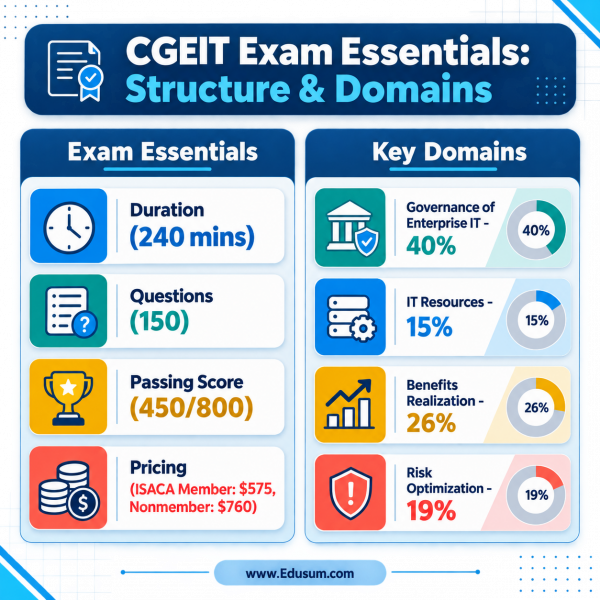
The syllabus topics and their respective weightages are:
- Governance of Enterprise IT (40%): This foundational domain focuses on the principles, frameworks, and mechanisms required to establish and maintain effective IT governance. It covers strategic alignment, enterprise architecture, IT value management, risk management, and performance measurement. Professionals must understand how to integrate IT governance with overall corporate governance, ensuring that IT strategies support and enable business objectives. This domain also delves into organizational structures, roles, and responsibilities necessary for robust governance.
- IT Resources (15%): This domain addresses the strategic management and optimization of an organization's IT resources, including human capital, infrastructure, applications, and information. It emphasizes resource planning, acquisition, allocation, and lifecycle management to maximize efficiency and effectiveness. Candidates are expected to demonstrate knowledge of best practices for ensuring that IT resources are appropriately provisioned, maintained, and aligned with organizational needs, supporting both current operations and future growth.
- Benefits Realization (26%): Focusing on value creation, this domain explores how organizations can ensure that IT investments deliver expected benefits and contribute tangibly to business outcomes. It encompasses defining, tracking, and optimizing the value derived from IT initiatives. Topics include portfolio management, investment appraisal, performance measurement, and stakeholder communication regarding value delivery. Professionals need to understand how to establish a clear line of sight between IT projects and business benefits, and how to monitor and report on the achievement of those benefits.
- Risk Optimization (19%): This domain concentrates on identifying, assessing, managing, and monitoring IT-related risks to an acceptable level. It involves understanding risk frameworks, risk appetite, and the integration of IT risk management with enterprise-wide risk management. Candidates must be proficient in developing and implementing risk response strategies, establishing risk awareness programs, and ensuring compliance with relevant regulations and policies. The objective is to protect organizational assets and maintain the continuity of business operations.
Each domain represents a vital pillar of effective enterprise IT governance, and proficiency across all is essential for a CGEIT-certified professional. Understanding these areas deeply contributes not only to exam success but also to real-world impact.
Requirements for CGEIT Certification Eligibility
Achieving the ISACA CGEIT certification is not solely dependent on passing the exam; it also requires a demonstrated history of relevant professional experience. This ensures that certified individuals possess not only theoretical knowledge but also practical application skills in the field of IT governance. Candidates must meet specific experience criteria, which typically involve a minimum number of years in IT governance management, advisory, or oversight roles. This includes experience in managing, providing consulting to, or auditing the governance of enterprise IT. Detailed requirements for this certification can be found on the official ISACA CGEIT page, providing clear guidance on the necessary professional background. Adherence to ISACA's Code of Professional Ethics is also a mandatory component for maintaining the credential, emphasizing integrity and responsibility in practice.
Elevating Professional Standing with ISACA CGEIT
The ISACA CGEIT certification significantly enhances a professional's standing within the global IT community. It serves as a clear differentiator, signaling a profound commitment to excellence in IT governance and strategic leadership. This credential is not merely a badge; it is a testament to an individual's validated expertise in aligning IT with business objectives, optimizing resources, and managing risks effectively. It fosters credibility among peers, executives, and stakeholders, positioning certified professionals as trusted advisors.
Forging a Path to Enhanced Professional Recognition
In today's complex business landscape, the demand for IT governance expertise is soaring. Organizations increasingly recognize the critical role that well-governed IT plays in achieving strategic goals and maintaining competitive advantage. The CGEIT certification offers distinct advantages for professionals seeking to advance their careers and contribute meaningfully to their organizations.
Key benefits of ISACA CGEIT certification include:
- Global Recognition: The CGEIT is an internationally respected credential, opening doors to opportunities worldwide and signifying a universally understood standard of excellence.
- Enhanced Credibility: It validates a professional's ability to effectively manage, advise, and oversee the governance of enterprise IT, increasing trust among employers and clients.
- Demonstrated Expertise: The certification confirms a deep understanding of IT governance frameworks, principles, and practices, showcasing a leader's strategic capabilities.
- Career Advancement: CGEIT holders are often prioritized for senior-level roles such as IT Director, CIO, Senior IT Consultant, and Head of IT Governance, leading to significant career opportunities.
- Increased Earning Potential: Studies consistently show that certified IT professionals, particularly those with advanced credentials like CGEIT, command higher salaries compared to their non-certified counterparts.
These advantages underscore the value proposition of investing in the CGEIT certification for long-term professional growth and impact. Further insights into how this certification can benefit your career can be explored in articles discussing the top advantages of ISACA CGEIT certification.
Driving Enterprise Value through Effective IT Governance
For organizations, employing CGEIT-certified professionals translates into tangible benefits across the entire enterprise. These individuals are adept at translating IT capabilities into business value, ensuring that technology investments yield optimal returns. Their expertise in risk optimization, resource management, and benefits realization directly impacts an organization's operational efficiency and strategic agility.
The value of ISACA CGEIT certification for enterprises is multifaceted:
- Strategic Alignment: CGEIT professionals ensure that IT strategies and investments are tightly integrated with overarching business objectives, preventing misalignment and wasted resources.
- Optimized Resource Utilization: They possess the skills to manage IT resources—people, infrastructure, and applications—more effectively, leading to improved operational efficiency and cost savings.
- Enhanced Risk Management: With a CGEIT, organizations gain leaders capable of identifying, assessing, and mitigating IT-related risks, safeguarding assets and ensuring business continuity. This leads to a more robust and resilient IT environment.
- Improved Benefits Realization: These professionals are skilled at measuring and maximizing the value derived from IT initiatives, demonstrating a clear return on IT investments. They ensure that projects deliver their intended benefits, contributing directly to organizational success.
- Stronger Compliance and Governance: CGEIT holders help establish and maintain strong governance frameworks, ensuring compliance with legal, regulatory, and internal policies, thereby reducing the risk of penalties and reputational damage.
Ultimately, the presence of CGEIT-certified individuals within an organization fosters a culture of disciplined IT management and strategic foresight, directly contributing to long-term success and competitive advantage.
Advancing Your Career with ISACA CGEIT Certification
The ISACA CGEIT certification is a significant catalyst for career advancement, particularly for professionals aspiring to or already in senior leadership roles within IT and business governance. It validates the strategic thinking and comprehensive understanding required to bridge the gap between business objectives and IT capabilities. This credential opens doors to elevated responsibilities and positions of greater influence.
Exploring CGEIT Certification Career Opportunities
Professionals holding the ISACA CGEIT certification are highly sought after for their ability to provide strategic guidance and ensure the effective governance of enterprise IT. The credential positions them for roles that demand a blend of technical acumen and business leadership. This expertise is crucial in industries where technology plays a pivotal role in achieving organizational objectives and managing complex risks.
Common CGEIT certification career opportunities include:
- Chief Information Officer (CIO): Responsible for an organization's overall IT strategy and implementation.
- Chief Technology Officer (CTO): Oversees the technology development and deployment, particularly in technology-driven companies.
- IT Director/Manager: Leads IT departments, managing operations, projects, and teams to support business goals.
- IT Governance Manager/Consultant: Specializes in developing, implementing, and advising on IT governance frameworks and policies.
- Senior IT Auditor/Assessor: Evaluates IT systems and processes to ensure compliance, security, and effectiveness, with a governance-focused lens.
- Enterprise Architect: Designs and maintains the overall IT architecture, ensuring alignment with business strategy.
These roles highlight the strategic and impactful nature of the positions accessible to CGEIT-certified professionals, underscoring how ISACA CGEIT enhances IT career trajectories by shifting focus from operational to strategic leadership.
Analyzing the ISACA Certified in the Governance of Enterprise IT Salary Potential
One of the most compelling advantages of obtaining the ISACA CGEIT certification is its positive impact on earning potential. Professionals who invest in this advanced credential typically see a significant CGEIT certification salary increase, reflecting the high demand and specialized nature of IT governance expertise. Employers are willing to compensate highly for individuals who can ensure IT assets deliver strategic value and mitigate enterprise-level risks.
Factors influencing ISACA Certified in the Governance of Enterprise IT salary include:
- Experience Level: More experienced CGEIT professionals, particularly those with a track record of successful governance implementations, command higher salaries.
- Geographic Location: Salaries can vary significantly based on the economic conditions and demand for IT governance professionals in different regions or countries.
- Industry Sector: Highly regulated industries (e.g., finance, healthcare) or those heavily reliant on IT (e.g., tech, telecommunications) often offer higher compensation for CGEIT holders.
- Organizational Size and Complexity: Larger enterprises with more complex IT environments typically offer more attractive remuneration packages for senior governance roles.
- Specific Job Role: Roles like CIO or top-tier consultants generally offer higher salaries than IT governance managers, reflecting greater responsibility and strategic impact.
While specific figures vary, the CGEIT certification consistently places its holders among the top earners in the IT and governance sectors, providing a strong return on investment for the effort expended.
Ideal Candidates for the CGEIT Journey
The ISACA CGEIT certification is designed for a very specific segment of IT professionals who operate at the intersection of business strategy and IT management. It caters to those who are tasked with overseeing, advising, or actively participating in the strategic governance of an organization's information technology. The credential signifies a deep understanding of enterprise IT governance and its critical components, making it highly valuable for individuals aiming for executive and advisory positions.
Identifying Professionals Suited for CGEIT Certification
The CGEIT certification for IT governance professionals is particularly relevant for individuals who have already established a solid foundation in IT and are looking to formalize their expertise in governance, risk, and compliance (GRC) aspects of technology. These professionals typically possess several years of experience and are ready to take on or enhance their strategic leadership responsibilities.
Who should get ISACA CGEIT certification:
- Senior IT Managers and Directors: Those responsible for the overall management and strategic direction of IT departments, ensuring alignment with business goals.
- IT Governance Professionals: Individuals whose primary role involves designing, implementing, and monitoring IT governance frameworks.
- IT Consultants: Advisors who guide organizations on best practices for IT strategy, risk management, and value delivery.
- Chief Information Officers (CIOs) and Chief Technology Officers (CTOs): Executive leaders who oversee the entire IT landscape and are accountable for its strategic contribution to the enterprise.
- Senior Business Leaders with IT Oversight: Executives who, while not exclusively IT-focused, have significant responsibilities for IT's performance and risk within the organization.
- IT Auditors: Professionals involved in assessing the effectiveness of IT governance structures and controls.
These roles underscore the strategic imperative of the CGEIT, affirming its value for professionals who are crucial in shaping an organization's digital future and ensuring its resilience.
Defining the Scope of Strategic IT Management with CGEIT
The ISACA CGEIT skills validation goes beyond mere technical proficiency; it confirms a professional's ability to engage in strategic IT management CGEIT. This involves a holistic perspective on how IT contributes to, and is governed within, the broader enterprise. CGEIT holders are equipped to make decisions that balance innovation with stability, and opportunity with risk.
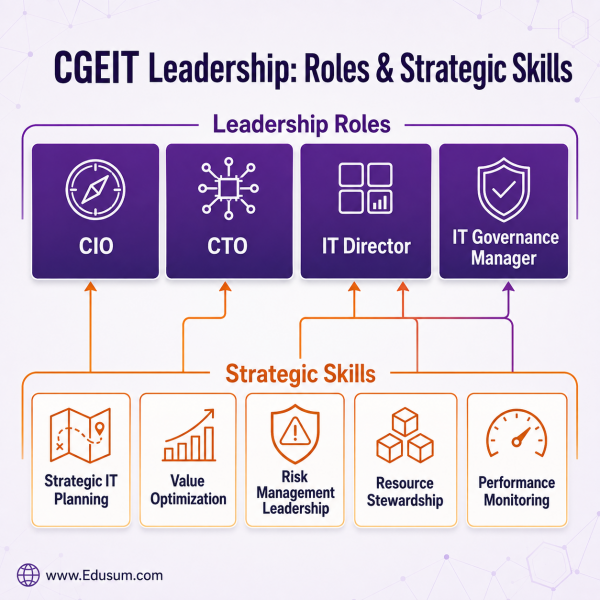
Key areas where CGEIT validates strategic IT management skills include:
- Strategic IT Planning: Developing and implementing IT strategies that directly support and enable the organization's mission and objectives.
- Value Optimization: Ensuring that all IT investments and initiatives are evaluated for their potential to deliver business value and that this value is consistently realized.
- Risk Management Leadership: Overseeing the identification, assessment, and mitigation of IT-related risks, protecting organizational assets and ensuring operational continuity.
- Resource Stewardship: Strategically allocating and managing IT resources—including people, technology, and information—to maximize their effectiveness and efficiency.
- Performance Monitoring and Reporting: Establishing metrics and reporting mechanisms to monitor IT's performance and ensure accountability for achieving governance objectives.
This comprehensive skill set makes CGEIT professionals indispensable assets to any organization seeking to leverage technology as a strategic enabler, rather than just an operational cost center.
Navigating Your ISACA CGEIT Preparation Journey
Preparing for the ISACA CGEIT exam requires a strategic, disciplined approach, particularly given the depth and breadth of its content. Success hinges not just on memorization, but on understanding how governance principles apply in real-world scenarios. A well-structured preparation plan will build your confidence and ensure you are ready for the rigor of the examination.
Crafting an Effective CGEIT Study Plan
A robust study plan is the cornerstone of successful CGEIT exam preparation. It helps organize the vast syllabus, allocate time efficiently, and track progress. Your plan should be personalized to your learning style and existing knowledge, focusing more on areas where you feel less confident.
Consider these elements when developing your study plan:
- Understand the Exam Content Outline: Thoroughly review the official ISACA CGEIT Exam Content Outline, available on the ISACA website, to grasp the weightage of each domain and specific tasks.
- Assess Your Current Knowledge: Start with a diagnostic test or practice questions to identify your strengths and weaknesses. This will inform where to allocate more study time.
- Set Realistic Milestones: Break down the study material into manageable chunks. Set weekly or bi-weekly goals for covering specific domains and reviewing topics.
- Schedule Dedicated Study Time: Consistency is key. Allocate regular slots in your schedule for focused study, free from distractions.
- Incorporate Review Sessions: Regularly revisit previously studied material to reinforce learning and aid retention. Spaced repetition can be particularly effective.
A structured approach ensures that no critical area is overlooked and that your learning is incremental and solidified.
Leveraging Diverse Study Resources for CGEIT Success
To cover the comprehensive CGEIT syllabus effectively, it is advisable to utilize a variety of high-quality study resources. Relying on a single source may leave gaps in your understanding or expose you to only one perspective on complex topics. A multifaceted approach ensures a well-rounded and deep comprehension of IT governance principles.
Effective resources include:
- Official ISACA Materials: The CGEIT Review Manual and ISACA's online QAE (Questions, Answers & Explanations) database are indispensable. These resources are developed by ISACA and directly align with the exam objectives.
- Accredited Training Courses: Participating in an official or accredited CGEIT training course can provide structured learning, expert insights, and opportunities for peer interaction.
- Reputable Practice Tests: Engaging with practice questions from trusted providers helps you become familiar with the exam format, question types, and time constraints. For rigorous self-assessment, consider utilizing practice questions from reputable platforms.
- Industry Publications and Whitepapers: Supplement your core study with articles and research papers on current trends and best practices in IT governance, risk management, and strategic IT.
Remember, the quality and relevance of your study materials are as important as the time you dedicate to studying.
Mastering Exam Day Readiness and Confidence
The final phase of preparation involves ensuring you are mentally and physically ready for exam day. Building confidence is crucial; it comes from thorough preparation and a clear understanding of what to expect. This last-mile readiness helps in managing stress and performing optimally under pressure.
Tips for boosting exam day confidence:
- Simulate Exam Conditions: Take full-length practice exams under timed conditions to acclimate yourself to the pressure and duration of the actual test.
- Prioritize Rest: Ensure you get adequate sleep in the days leading up to the exam. A well-rested mind performs better.
- Healthy Habits: Maintain a balanced diet and engage in light physical activity to keep your mind sharp and reduce stress.
- Positive Mindset: Trust in your preparation. Visualize success and approach the exam with a calm and confident attitude. Avoid cramming the night before; instead, review key concepts lightly.
- Logistics Preparedness: Confirm your exam location, timings, and required identification well in advance to avoid last-minute anxieties.
Arriving prepared and confident allows you to focus solely on the questions, maximizing your chances of success.
Upholding Ethical Preparation: The Imperative of Avoiding Dumps
While the pursuit of certification can be intense, it is paramount to maintain the highest ethical standards throughout your preparation. The use of "exam dumps" or unauthorized materials containing actual exam questions is strictly prohibited by ISACA and undermines the integrity of the certification. Such materials are unreliable, often contain outdated or incorrect information, and can lead to immediate disqualification from the exam and revocation of any achieved credential. Focus instead on genuine learning and understanding the concepts thoroughly. Authentic preparation ensures not only exam success but also the development of legitimate skills that are truly valuable in your professional career.
Conclusion: Seizing Your Strategic IT Governance Future
The ISACA CGEIT certification offers a distinctive edge for leaders committed to mastering the complexities of enterprise IT governance. It is more than just a credential; it is a strategic investment in your professional future, validating your capacity to align IT with business objectives, optimize resources, realize benefits, and manage risk effectively. By embracing the CGEIT, you position yourself as an indispensable asset capable of driving organizational value and navigating the intricate demands of the digital age. This certification reinforces your expertise and opens doors to unparalleled career opportunities and leadership influence.
Elevate your expertise and confidently pursue the ISACA CGEIT certification. With a focused preparation strategy and the right resources, you can unlock a future defined by strategic impact and professional recognition. Begin your journey toward becoming a certified leader in enterprise IT governance. Explore comprehensive study materials and practice questions designed to help you prepare effectively for the ISACA CGEIT exam and solidify your understanding of crucial governance concepts.
Frequently Asked Questions
1. What is the primary purpose of the ISACA CGEIT certification?
The ISACA CGEIT certification primarily validates an individual's expertise in the governance of enterprise IT, ensuring that IT aligns with business objectives, delivers value, manages risks, and optimizes resources within an organization.
2. What experience is required to apply for the CGEIT certification?
Candidates typically need a minimum of five years of experience in the governance of enterprise IT, specifically in managing, advising, or overseeing IT governance. This experience must be obtained within a specified timeframe prior to application.
3. How does the CGEIT certification benefit an organization?
For organizations, CGEIT-certified professionals enhance strategic IT alignment, optimize resource utilization, improve risk management, ensure effective benefits realization from IT investments, and strengthen overall compliance and governance postures.
4. Are there any prerequisites for taking the CGEIT exam?
While there are no formal prerequisites to take the CGEIT exam, candidates must meet specific professional experience requirements to be certified. It is highly recommended that individuals have significant IT governance experience before attempting the exam.
5. What kind of job roles are typically held by CGEIT-certified professionals?
CGEIT-certified professionals often hold senior-level roles such as Chief Information Officer (CIO), Chief Technology Officer (CTO), IT Director, IT Governance Manager, Senior IT Consultant, and Enterprise Architect, among others.
- ISACA Certified in the Governance of Enterprise IT (CGEIT) |
- CGEIT Online Test |
- CGEIT Questions |
- CGEIT Quiz |
- CGEIT |
- CGEIT Certification Mock Test |
- ISACA CGEIT Certification |
- CGEIT Practice Test |
- CGEIT Study Guide |
- ISACA CGEIT Question Bank |
- CGEIT Syllabus |
- CGEIT Books |
- CGEIT Certification Syllabus |
- ISACA CGEIT Training |
- ISACA IT Governance Certification |
- ISACA CGEIT Books |
- CGEIT Sample Questions |
- ISACA CGEIT Practice Test Free |
- Governance of Enterprise IT Simulator |
- Governance of Enterprise IT Mock Exam |
- ISACA Governance of Enterprise IT Questions |
- Governance of Enterprise IT |
- ISACA Governance of Enterprise IT Practice Test |
- Governance of Enterprise IT Certification Cost |
- ISACA Governance of Enterprise IT Books |
- ISACA Governance of Enterprise IT Certification |
- Governance of Enterprise IT Certification Sample Questions


