
AVIXA CTS Practice Exam: How to Score 800+ on the First Attempt
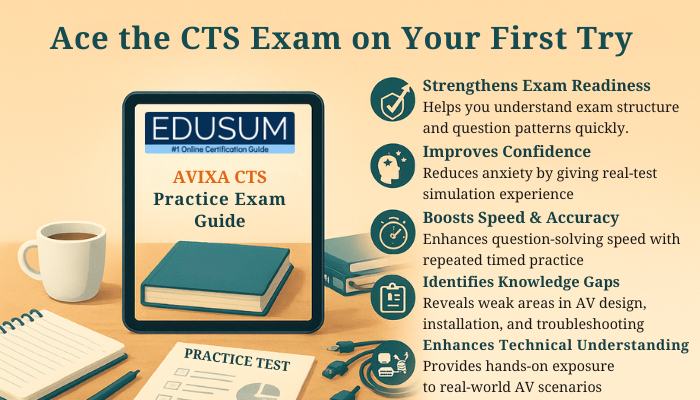 Preparing for the AVIXA Certified Technology Specialist exam is one of the smartest steps an AV or IT professional can take when building credibility, advancing into technical roles, or positioning for cybersecurity and IT audit careers where strong systems knowledge is valued. Many candidates worry about the difficulty of the CTS exam, the design-heavy problem-solving questions, and the technical depth required to score well above the passing mark. Yet thousands of professionals score 800+ on their first attempt, and it is never by accident. High scorers follow a structured process, rely on the right learning materials, practice with real exam-style questions, and approach the exam with confidence.
This guide gives you that same playbook. Built for aspiring Certified Technology Specialists and AV/IT practitioners, it distills expert strategies, career-oriented insight, and practical steps you can use to strengthen your readiness. You will also find direct references to the official AVIXA CTS outline, learning resources, and vetted practice materials such as EduSum’s CTS practice tests, which mirror the exam’s question depth and difficulty.
Whether you're transitioning from IT to AV engineering, adding formal credentials to your cybersecurity background, or aiming for roles that require a better understanding of integrated AV systems, this comprehensive guide is designed to help you reach a top-tier score.
What Is the AVIXA CTS Certification?
The Certified Technology Specialist certification from AVIXA is a globally recognized credential for professionals who design, implement, and support audiovisual technologies. It verifies that a candidate understands the full lifecycle of AV systems, including needs analysis, solution design, installation, integration, support, and servicing. According to the official AVIXA certification page, CTS holders demonstrate proven technical capability aligned with industry standards and recommended practices.
The CTS certification is not limited to AV technicians. Today, cybersecurity analysts, IT auditors, systems engineers, SOC professionals, and infrastructure specialists increasingly pursue the credential because modern AV systems interlink with enterprise networks, cloud services, control servers, and identity-managed infrastructure. With AV systems becoming IoT-enabled, network-connected, and remote-controlled, the convergence between AV and IT is now unavoidable.
✔️ Key Exam Details
-
Exam Name: AVIXA Certified Technology Specialist (CTS)
-
Exam Code: CTS
-
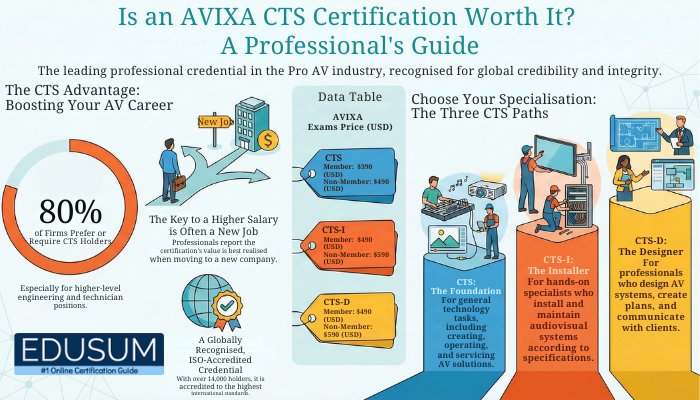
Member Price: $390 USD
-
Non-Member Price: $490 USD
-
Duration: 150 minutes
-
Number of Questions: 110
-
Passing Score: 350 / 500
This means that scoring above 800 on EduSum’s 1000-point scaled practice exam equivalents places you far above the minimum threshold, showing strong mastery across exam domains.
✔️ CTS Exam Audience
The exam is a strong fit for:
-
AV engineers, technicians, and system designers
-
Cybersecurity professionals working with AV-over-IP systems
-
IT auditors assessing audiovisual or conference systems
-
Network engineers supporting enterprise AV infrastructure
-
System integrators and AV project managers
-
Career changers entering the AV field
-
Students and early professionals seeking credibility
-
Employers wanting standardized technical validation
If you’re evaluating which certification is best — whether CTS or another variant — check out our detailed comparison of three leading Certified Technology Specialist certifications before making your decision.
CTS Exam Blueprint: Domains You Must Master
According to the official AVIXA CTS Exam Content Outline, the test covers four major duties. Every question aligns with these domains, and your final score depends on how well you master each.
Below is the exact breakdown:
✔️ Duty A: Creating AV Solutions – 35 percent
This section evaluates your ability to translate stakeholder needs into technical AV designs. It covers:
1. Conducting Customer Needs Analysis (7 percent)
You must understand how to gather requirements from clients and internal teams. This includes determining:
-
Functional requirements
-
User expectations
-
Budget considerations
-
Performance criteria
-
Environmental constraints
-
Accessibility and compliance factors
This domain mirrors skills highly valued in IT audit, where understanding user requirements and verifying system controls are core responsibilities.
2. Conducting Site Surveys (9 percent)
You will assess and document elements such as:
-
Lighting and acoustics
-
Ambient noise
-
Seating layout
-
Room geometry
-
Cable routing paths
-
Network accessibility
-
Power and emergency systems
Strong observational and analytical skills are critical. Questions often include diagrams, room layouts, or environmental descriptions.
3. Developing an AV Project Scope (9 percent)
Expect questions about:
-
Defining system boundaries
-
Listing required components
-
Clarifying deliverables
-
Managing assumptions and constraints
-
Identifying networking and control system dependencies
Much like audit scoping, clarity and completeness are essential.
4. Designing AV Solutions (10 percent)
You will be tested on:
-
Signal flow
-
System drawings and schematics
-
Line-of-sight considerations
-
Equipment placement
-
Display calculations
-
Audio coverage
-
Bill of materials creation
This is the most design-heavy area of the CTS exam.
✔️ Duty B: Implementing AV Solutions – 30 percent
This section tests the actual build and integration skills used during system deployment.
1. Integrating the AV Solution (15 percent)
Questions may involve:
-
Mounting hardware
-
Handling cables
-
Verifying system performance
-
Configuring AV-over-IP components
-
Understanding device compatibility
Knowing installation standards and safety procedures is useful.
2. Managing AV Integration (15 percent)
Key topics include:
-
Documentation and schematics
-
Warranty and maintenance plans
-
Tester and calibration tools
-
Training end-users
-
As-built drawings
-
Operational workflows
This aligns closely with IT audit responsibilities related to documentation completeness.
✔️ Duty C: Supporting AV System Operation – 15 percent
This domain evaluates real-world troubleshooting, live support, and incident handling.
Topics include:
-
Diagnosing signal issues
-
Providing remote support
-
Supporting live events
-
Maintaining system uptime
-
Training users on daily operation
Candidates with technical support experience often score well in this section.
✔️ Duty D: Servicing AV Solutions – 20 percent
This area covers long-term system health and performance:
1. Supervising AV Operations (4 percent)
Addresses operational oversight and routine monitoring.
2. Conducting Maintenance Activities (8 percent)
Includes:
-
Preventative maintenance
-
Firmware updates
-
Equipment lifecycle planning
3. Troubleshooting and Repair (8 percent)
Expect scenario-based questions about:
-
Analog vs digital signals
-
Break/fix response
-
Root-cause analysis
-
Service workflows
A solid grasp of AV signal flow is important for all tasks in this domain.
How to Score 800+ on Your AVIXA CTS Exam
High scores on the CTS exam require more than theoretical understanding. Successful candidates follow a disciplined, exam-focused preparation strategy.
As an experienced IT auditor and cybersecurity practitioner, I can say with confidence that the CTS exam rewards three core strengths:
1. Strong analytical reasoning
Many questions require interpreting diagrams, schematics, or room layouts.
2. Practical understanding of AV systems
This includes signal flow, device behavior, and onsite installation logic.
3. Repeated exposure to exam-style questions
Your brain must be conditioned to recognize recurring patterns.
These strengths are best developed through structured study materials and quality practice tests. EduSum’s CTS practice exams are particularly effective because they simulate real exam depth and style while giving a performance benchmark that helps determine readiness.
✔️ What High Scorers Always Do
-
Focus on duty-based mastery instead of reading every AV standard word-for-word
-
Practice with at least 500+ real-style CTS exam questions
-
Analyze mistakes deeply rather than memorizing answers
-
Spend more time on weak domains
-
Use exam-day strategies such as time-blocking
-
Practice reading fast without losing context
By applying the right approach, scoring 800+ becomes a practical goal rather than a hopeful attempt.
Step-by-Step Strategy for High Scorers
The following system is based on proven methods used by candidates who achieve top-tier scores on their first attempt. It blends practical AV expertise, IT systems reasoning, and exam analytics.
✔️ Step 1: Start With the Official CTS Exam Outline
Begin with the official CTS content outline available on the AVIXA certification page. This document defines every task and competency the exam assesses. High performers study only what is in scope.
This ensures:
-
No wasted time
-
Focus on the most-tested tasks
-
Correct alignment with scoring domains
✔️ Step 2: Build a Duty-Based Study Notebook
Create a notebook with four sections:
-
Creating AV Solutions
-
Implementing AV Solutions
-
Supporting AV Operations
-
Servicing AV Solutions
Under each, record:
-
Concepts
-
Definitions
-
Formula-like rules
-
Diagrams
-
Real-world examples
This structured organization boosts recall during the exam.
✔️ Step 3: Study 90 Minutes per Day With Rotation Cycles
Do not study all domains at once. Instead:
-
Day 1: Duty A topics
-
Day 2: Duty B topics
-
Day 3: Duty C topics
-
Day 4: Duty D topics
-
Repeat
This cycle strengthens long-term memory and conceptual integration.
✔️ Step 4: Use CTS Practice Exams Weekly
High-scoring candidates use practice tests not as a final step but as a diagnostic tool. Aim for:
-
Two full-length practice exams per week
-
Minimum goal: 80 percent on each section
EduSum’s CTS practice exam and CTS sample questions are excellent for identifying blind spots early. You should focus especially on question types that repeat across practice sessions.
✔️ Step 5: Master Signal Flow and AV Troubleshooting
More questions relate to signal identification and troubleshooting than most candidates expect. You should know:
-
Analog vs digital characteristics
-
Resolution and bandwidth concepts
-
Switcher and matrix behavior
-
Signal path ordering
-
Compression vs uncompressed signals
Strong understanding here also helps cybersecurity and IT professionals bridge AV systems with enterprise networks.
✔️ Step 6: Practice With Diagram-Based Questions
Many diagrams require visual analysis. Practice interpreting:
-
Speaker coverage
-
Projection angles
-
Rack layout
-
Cable routing
-
Equipment placement
This skill improves speed and accuracy on exam day.
✔️ Step 7: Practice Time Management
You have 110 questions in 150 minutes. Use the 3-pass technique:
Pass 1
Answer only the questions you are 90 percent sure about.
Pass 2
Return to moderately difficult items.
Pass 3
Handle the time-consuming scenario questions.
This prevents you from getting stuck early.
2-Week CTS Exam Revision Plan
If you are 14 days from your exam date, follow this accelerated revision schedule. It is designed for candidates who have already studied once and now need to sharpen scoring potential.
✔️ Week 1: Concept Reinforcement and Diagnostics
Day 1
-
Review Duty A tasks
- Take 50 Duty A practice questions
Day 2
-
Review Duty B tasks
-
Take 50 Duty B practice questions
Day 3
-
Review Duty C and D
-
Take 60 mixed questions
Day 4
-
Take a full-length CTS practice exam on EduSum
-
Review your weak areas thoroughly
Day 5
-
Revisit diagrams and system drawings
-
Practice 30 diagram-based questions
Day 6
-
Reinforce troubleshooting skills
-
Test yourself on 40 troubleshooting scenarios
Day 7
-
Rest and light review
✔️ Week 2: Final Exam Conditioning
Day 8
-
Take a full-length CTS practice exam
Day 9
-
Fix weak topics with the highest error count
Day 10
-
Study system behavior topics
-
Review signal flow, AV-over-IP, and room acoustics
Day 11
-
Practice 100 mixed CTS practice questions
Day 12
-
Take your final full-length mock exam
-
Score target: 800+
Day 13
-
Light review of formulas, definitions, and notations
Day 14
-
Relax, hydrate, sleep well
-
Avoid heavy studying
By the end of this plan, your readiness should align tightly with high-scoring exam expectations.
Expert Tips to Maximize Your CTS Score
These are insights drawn from real-world IT, cybersecurity, and AV engineering experience. They address exam psychology, retention, and cognitive performance.
✔️ Tip 1: Do Not Study Without Practice Questions
Your brain needs pattern recognition to score high. Practice questions expose you to:
-
Recurrent question structures
-
AV terminology
-
Problem interpretation patterns
-
Weak regions requiring more focus
EduSum’s cts practice exam pdf and exam simulator provide structured question banks aligned with actual exam depth.
✔️ Tip 2: Use a Mixed Learning Strategy
You should combine:
-
Reading
-
Diagram analysis
-
Hands-on equipment use when possible
-
Practice testing
-
Micro-learning
This increases comprehension and real-world relevance.
✔️ Tip 3: Focus on High-Weight Domains
-
Duty A and Duty B combined represent 65 percent of your score. Prioritize them heavily.
✔️Tip 4: Develop Fast Diagram Interpretation Skills
-
This alone can earn you 50 to 70 extra points.
✔️ Tip 5: Review Wrong Answers Every Time
The goal is not just passing but scoring 800+. This requires:
-
Fixing root-cause mistakes
-
Reviewing every wrong answer
-
Tracking error categories
✔️ Tip 6: Improve Your Theoretical Foundations
Use external, non-competing authority references such as:
-
National Institute of Standards and Technology (NIST) for system performance principles
-
IEEE for signal transmission fundamentals
-
Wikipedia AV standards pages
-
Education-focused institutions (.edu) offering acoustics and electronics fundamentals
-
Professional quality engineering resources such as ASQ
These help build deeper confidence, which is critical to top scoring.
✔️ Tip 7: Simulate Test Conditions
-
Perform at least two timed, full-length simulations to condition your mind for pacing and endurance.
FAQs
Q1. What is the passing score for the AVIXA CTS exam?
-
The passing score is 350 out of 500. Scoring above 800 on scaled practice tests indicates strong readiness.
Q2. How many questions are on the CTS exam?
-
The exam consists of 110 multiple-choice questions completed within 150 minutes.
Q3. How hard is the CTS certification exam?
-
The difficulty is moderate to high. It requires strong understanding of AV design, implementation, troubleshooting, and system operation.
Q4. How do I prepare for the CTS exam effectively?
-
Study the official outline, use a duty-based study plan, and practice with high-quality CTS practice tests from EduSum.
Q5. How long should I study for the CTS exam?
-
Most candidates study 4 to 8 weeks. With focused preparation and consistent practice tests, scoring 800+ becomes achievable.
Q6. Are CTS practice exams necessary?
-
Yes. Practice exams help build familiarity with question patterns, identify weak areas, and increase scoring potential.
Q7. Does AVIXA provide sample questions?
-
AVIXA provides a limited set, but most candidates rely on EduSum’s CTS sample questions and full practice exam sets.
Q8. What are the main topics on the CTS exam?
-
The exam covers creating AV solutions, implementing AV systems, supporting ongoing AV operations, and servicing AV solutions.
Q9. Can I pass CTS without AV experience?
-
Yes, but consistent practice testing, strong study habits, and understanding the exam blueprint are essential.
Q10. How much does the exam cost?
-
The cost is $390 USD for AVIXA members and $490 USD for non-members.
Final Thoughts on Your CTS Exam Success
Achieving 800+ on your AVIXA Certified Technology Specialist exam is not about luck. It requires structured preparation, repeated exposure to realistic CTS exam questions, and the discipline to follow proven study methods. Thousands of IT and cybersecurity professionals succeed because the CTS exam rewards analytic mindset, system thinking, and practical problem-solving. With consistent practice, proper revision strategy, and high-quality resources such as EduSum’s CTS practice exams, you can confidently aim far above the passing score.
Your journey toward CTS certification is more than an exam goal—it is a strategic career investment. Whether you’re elevating your technical credibility, transitioning roles, or strengthening cross-domain expertise, this certification positions you for long-term career growth.
Commit to the process, stay consistent, use professional-grade resources, and your first-attempt success is well within reach.
- AVIXA Certified Technology Specialist (CTS) |
- CTS Online Test |
- CTS Questions |
- CTS Quiz |
- CTS |
- CTS Certification Mock Test |
- AVIXA CTS Certification |
- CTS Practice Test |
- CTS Study Guide |
- AVIXA CTS Question Bank |
- AVIXA Certification |
- CTS - General |
- CTS - General Mock Exam |
- CTS Syllabus |
- CTS Books |
- CTS Certification Syllabus |
- AVIXA CTS Training |
- AVIXA Audiovisual Systems (AV) Certification |
- AVIXA CTS Books |
- CTS - General Certification Cost |
- AVIXA CTS - General Books |
- AVIXA CTS - General Certification |
- CTS Sample Questions |
- AVIXA CTS Practice Test Free |
- CTS - General Certification Sample Questions |
- CTS-I Online Test |
- CTS-I Questions |
- CTS-I Quiz |
- CTS-I |
- CTS-D Online Test |
- CTS-D Questions |
- CTS-D Quiz |
- CTS-D |
- CTS-D Certification Mock Test |
- InfoComm International Certified Technology Specialist (CTS) |
- AVIXA CTS Questions |
- CTS Mock Exam


