
Your AAIA Exam Preparation Blueprint: Step-by-Step Success
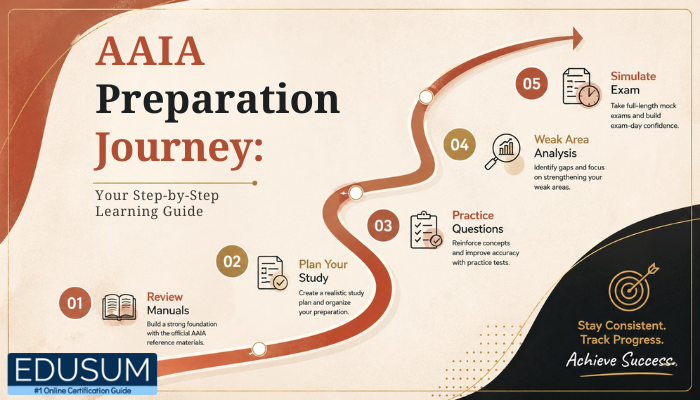
The ISACA Advanced in AI Audit (AAIA) certification empowers audit and assurance professionals with the specialized knowledge and skills required to navigate the complex landscape of artificial intelligence (AI) systems. This credential from ISACA validates expertise in auditing AI initiatives, ensuring governance, risk management, and ethical considerations are effectively addressed throughout the AI lifecycle. Aimed at experienced auditors, IT professionals, and assurance practitioners, the AAIA certification demonstrates a capability to provide independent assurance over AI systems, protecting organizational value and mitigating inherent risks. This comprehensive guide will walk you through a detailed preparation strategy, helping you master the AAIA exam content and confidently achieve certification.
Establishing Your AAIA Preparation Foundation
Embarking on the ISACA AAIA certification journey requires a clear understanding of the exam's purpose and the foundational knowledge it expects. The AAIA certification focuses on critical aspects of auditing AI, including governance, risk management, operational oversight, and the application of specific auditing tools and techniques. This credential is crucial for professionals who need to assess AI systems for accuracy, fairness, transparency, and compliance with emerging regulations and ethical guidelines. Building a strong foundation involves familiarizing yourself with these core principles before diving into specific study materials.
Defining the ISACA AAIA Professional
The ideal candidate for the AAIA certification is an experienced professional who possesses a solid background in auditing, risk management, or information technology, coupled with a keen interest in artificial intelligence. This includes internal and external auditors, IT auditors, risk managers, compliance officers, and consultants who are increasingly faced with the task of evaluating AI deployments within their organizations or for their clients. The certification enhances their ability to critically assess AI models, data pipelines, and operational frameworks.
Understanding the Exam's Value Proposition
Earning the AAIA certification offers significant benefits, positioning you as a trusted expert in AI audit. This credential boosts your professional credibility, demonstrating your commitment to continuous learning and your ability to address cutting-edge technological challenges. It can unlock new career opportunities in a rapidly evolving field, allowing you to take on more specialized roles within your organization or as a consultant. Furthermore, the certification helps organizations build trust in their AI systems by ensuring they are developed and operated responsibly and ethically, aligning with the strategic imperatives of modern enterprises. For more insights into the certification's relevance, consider exploring the comprehensive AAIA details available online.
Unpacking the AAIA Certification Details
Before you dive deep into your study materials, it's essential to grasp the fundamental mechanics of the ISACA Advanced in AI Audit (AAIA) exam. Knowing the structure, duration, pricing, and scoring methodology allows you to set realistic expectations and plan your study efforts more effectively. This section provides a clear overview of the examination's logistical aspects, which are vital for a successful preparation strategy.
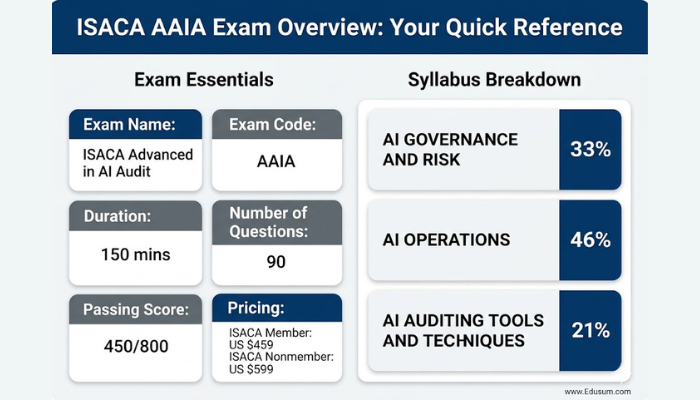
The AAIA exam is designed to be a comprehensive assessment of a candidate's proficiency in auditing AI systems. Here are the key details:
| Exam Name | ISACA Advanced in AI Audit (AAIA) |
| Exam Code | AAIA |
| Exam Price |
ISACA Member: US $459 ISACA Nonmember: US $599 |
| Duration | 150 minutes |
| Number of Questions | 90 multiple-choice questions |
| Passing Score | 450 out of 800 |
Understanding these elements helps candidates mentally prepare for the exam environment and manage their time efficiently during the actual test. The 150-minute duration for 90 questions means you have approximately 1 minute and 40 seconds per question, emphasizing the need for quick recall and efficient problem-solving.
Deconstructing the AAIA Certification Syllabus
The ISACA Advanced in AI Audit (AAIA) exam evaluates a candidate's understanding across three key domains. A thorough knowledge of these areas and their respective weightings is paramount for directing your study efforts and ensuring comprehensive coverage of all examinable topics. Each domain represents a critical aspect of auditing AI systems, from governance to operational practices and the tools used in assessment. You can review the official AAIA syllabus for detailed information.
| AAIA Exam Domain | Weight |
|---|---|
| AI Governance and Risk | 33% |
| AI Operations | 46% |
| AI Auditing Tools and Techniques | 21% |
AI Governance and Risk (33%)
This domain, accounting for a significant portion of the exam, focuses on establishing and maintaining effective governance frameworks for AI, as well as identifying and managing the associated risks. Auditors must understand how to assess an organization's AI strategy, policies, and ethical guidelines. Key topics include:
-
AI governance principles and frameworks
-
Ethical implications of AI and responsible AI guidelines
-
Risk assessment and management for AI systems (e.g., bias, privacy, security, explainability)
-
Regulatory and legal compliance considerations for AI
-
Establishing audit scope and objectives for AI initiatives
Proficiency in this domain requires more than just technical knowledge; it demands an understanding of the broader organizational context in which AI operates, including its impact on stakeholders and adherence to corporate values.
AI Operations (46%)
As the largest domain, AI Operations covers the practical aspects of managing and monitoring AI systems throughout their lifecycle, from development to deployment and maintenance. Auditors need to assess the operational effectiveness, reliability, and security of AI applications. This includes:
-
AI system development lifecycle (SDLC) and MLOps (Machine Learning Operations)
-
Data management for AI (collection, quality, security, privacy)
-
Model training, validation, and testing procedures
-
Deployment strategies and ongoing performance monitoring of AI models
-
Incident response and recovery planning for AI failures
-
Assessing the controls over AI infrastructure and environments
This section demands a deep dive into the technical processes and controls surrounding AI systems, requiring candidates to understand how these systems are built, managed, and sustained in an operational environment. For a more granular view of the topics, refer to the ISACA content outline.
AI Auditing Tools and Techniques (21%)
This domain, while smaller in weighting, is crucial for the practical application of AI audit principles. It focuses on the specific tools and techniques auditors employ to assess AI systems effectively. This includes knowledge of various audit methodologies and the ability to interpret analytical findings. Topics covered are:
-
Audit methodologies applicable to AI systems (e.g., continuous auditing, performance auditing)
-
Data analytics techniques for auditing AI (e.g., anomaly detection, pattern analysis)
-
Tools for model explainability (XAI) and interpretability
-
Techniques for detecting and mitigating AI bias
-
Reporting audit findings and communicating recommendations for AI systems
Candidates should not only understand what these tools and techniques are but also how they are applied in real-world AI audit scenarios to gather evidence and form conclusions.
Formulating Your Strategic Study Blueprint
Successful AAIA exam preparation extends beyond merely memorizing facts; it involves adopting a methodical and strategic approach to learning. Given the exam's comprehensive nature and the intricate details of AI audit, a well-structured study plan is indispensable. This blueprint outlines a step-by-step strategy designed to optimize your learning, reinforce your knowledge, and build the confidence needed to pass the certification.
Phase 1: Comprehensive Content Immersion
Begin by acquiring the official ISACA study materials, including the AAIA Review Manual and any recommended ISACA publications. These resources are specifically tailored to the exam content outline and provide the authoritative information you need. Read through these materials diligently, making notes, highlighting key concepts, and cross-referencing information where necessary. Focus on understanding the "why" behind each principle and process, rather than just the "what."
-
Review ISACA’s Official Manuals: The AAIA Review Manual is your primary textbook. Go through each chapter thoroughly, ensuring you grasp the core concepts of AI governance, operations, and audit techniques.
-
Consult Additional Resources: Supplement your reading with reputable articles, whitepapers, and industry reports on AI ethics, risk, and compliance. Staying updated on the latest developments in AI audit will be beneficial.
-
Create Detailed Study Notes: Summarize complex topics in your own words. This active learning technique aids retention and allows for quick review later. Consider using flashcards for definitions and key terms.
Phase 2: Reinforcing Understanding with Practice
Once you have covered the content, the next crucial step is to test your understanding through practice questions. This phase helps solidify your knowledge, identify weak areas, and familiarize yourself with the exam's question style and format. Regular practice is key to turning theoretical knowledge into practical application.
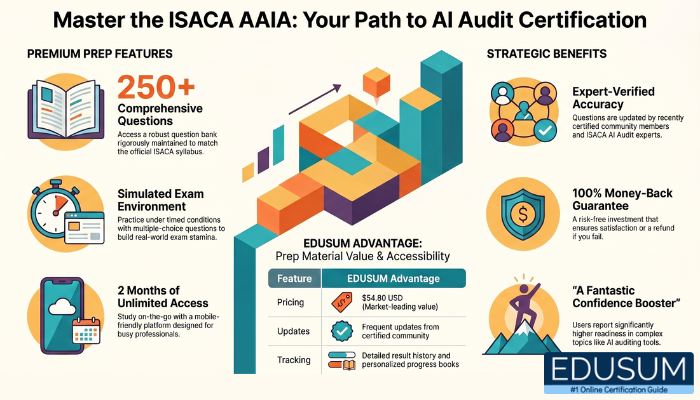
Engaging with a variety of practice questions is essential for successful exam preparation. It allows you to gauge your comprehension and refine your test-taking skills.
-
Utilize Practice Question Banks: Access reliable practice question sets that simulate the actual exam. Focus on understanding the rationale behind both correct and incorrect answers. Edusum offers AAIA sample questions that can be highly beneficial for this purpose.
-
Simulate Exam Conditions: As you get closer to the exam date, practice answering questions under timed conditions. This helps improve your speed and endurance, preparing you for the 150-minute exam duration.
-
Review Performance Analytics: Many practice platforms provide analytics that pinpoint your strengths and weaknesses across different domains. Use this feedback to revisit specific syllabus areas that require more attention.
Overcoming Challenges in AAIA Exam Preparation
The path to AAIA certification can present various challenges, especially given the technical depth of AI topics and the breadth of auditing principles involved. Recognizing and addressing these hurdles early on can significantly enhance your chances of success. This section focuses on common difficulties candidates face and offers practical strategies to overcome them, ensuring your study journey is as smooth as possible.
Tackling Complex AI Concepts
Many candidates find the technical terminology and underlying concepts of artificial intelligence daunting. From machine learning algorithms to neural networks and data science methodologies, the sheer volume of new information can be overwhelming. Instead of getting bogged down in minute technical details, focus on understanding the implications of these technologies for audit and governance. For instance, rather than becoming a data scientist, understand how data quality affects AI model fairness and reliability.
-
Leverage Visual Aids: Use diagrams, flowcharts, and infographics to visualize complex AI architectures and processes.
-
Seek Explanations from Peers: Engage with study groups or online forums like the ISACA professional community to discuss challenging topics and gain different perspectives.
-
Relate to Real-World Scenarios: Connect abstract AI concepts to practical audit situations. How would you audit an AI system that processes loan applications for bias?
Managing Your Time Effectively
For working professionals, carving out dedicated study time can be a significant challenge. The AAIA exam requires consistent effort over several months, making effective time management crucial. Create a realistic study schedule and stick to it, even if it means small, regular study sessions rather than sporadic long ones. Consistency is more important than intensity.
A well-planned schedule ensures balanced coverage of all domains without burnout.
-
Develop a Detailed Study Plan: Allocate specific hours each week for studying and review. Break down your study goals into manageable chunks for each domain.
-
Prioritize Based on Weighting: Dedicate more study time to domains with higher percentages, such as AI Operations (46%), without neglecting the others.
-
Incorporate Regular Breaks: Short, frequent breaks can prevent mental fatigue and improve concentration during study sessions.
Maximizing Your Exam Day Performance
The final phase of your AAIA preparation culminates on exam day. Performing optimally requires more than just knowledge; it demands a strategic approach to managing time, handling questions, and maintaining a positive mindset. This section provides critical tips to help you navigate the exam environment effectively, ensuring you translate your hard work into a passing score.
Strategic Question Management
With 90 questions to answer in 150 minutes, effective question management is crucial. Do not dwell too long on a single question. If you are unsure, make your best guess, mark the question for review, and move on. Returning to difficult questions later can save valuable time and prevent mental blocks. Always aim to answer every question, as there is no penalty for incorrect answers.
-
Read Questions Carefully: Pay close attention to keywords such as "most," "least," "primary," or "except." These words often change the entire meaning of a question.
-
Eliminate Obvious Wrong Answers: Use the process of elimination to narrow down the choices. This increases your chances of selecting the correct answer even if you're not entirely certain.
-
Trust Your Initial Instinct: Often, your first answer choice is correct. Only change an answer if you find a compelling reason or realize a clear error in your initial reasoning.
Maintaining Mental and Physical Readiness
Your physical and mental state on exam day significantly impacts your performance. Ensure you get adequate sleep the night before, eat a nutritious meal, and arrive at the testing center well in advance to avoid any last-minute stress. A calm and focused mind is your best asset.
Beyond academic preparation, personal well-being plays a critical role in exam success.
-
Prioritize Rest: A well-rested mind can recall information more efficiently and think more clearly under pressure.
-
Stay Hydrated and Fuelled: Bring a water bottle and a light snack if permitted by the testing center, to maintain energy levels throughout the exam.
-
Practice Mindfulness: If you feel overwhelmed during the exam, take a few deep breaths to calm your nerves and regain focus.
Remember that the ISACA AAIA certification is a marathon, not a sprint. Consistent, disciplined preparation combined with smart exam-taking strategies will pave your way to success. Visit the official ISACA page for the latest exam information and updates.
Charting Your Career Trajectory with AAIA Certification
The ISACA Advanced in AI Audit (AAIA) certification is more than just a credential; it's a strategic investment in your professional future, opening doors to advanced roles and leadership opportunities in the burgeoning field of AI assurance. By validating your expertise in auditing AI systems, the AAIA credential positions you at the forefront of a critical and evolving domain. This section explores how this certification can significantly enhance your career prospects and professional standing.
Expanding Your Professional Scope
The AAIA certification enables you to broaden your professional horizons beyond traditional auditing roles. As organizations increasingly adopt AI, the demand for auditors who can assess AI's unique risks, ensure compliance, and provide assurance over its ethical implementation will skyrocket. With AAIA, you can transition into specialized positions such as AI Audit Specialist, AI Risk Manager, or Responsible AI Advisor, becoming an invaluable asset to any organization navigating the complexities of artificial intelligence. Your skills will be essential in shaping resilient and trustworthy AI ecosystems.
Enhancing Your Marketability and Earning Potential
In a competitive job market, certifications like AAIA differentiate you from your peers. Employers actively seek professionals who possess verified expertise in niche, high-demand areas. The AAIA credential signals to potential employers that you are not only capable of auditing complex IT systems but also proficient in the specialized governance and operational aspects of AI. This enhanced marketability often translates into higher earning potential and access to more challenging and rewarding projects. It demonstrates a proactive approach to professional development and a commitment to staying current with technological advancements.
Becoming a Trusted AI Advisor
Earning the AAIA certification solidifies your role as a trusted advisor capable of guiding organizations through the ethical and operational challenges of AI adoption. You will be equipped to advise management on best practices for AI governance, help implement robust risk management frameworks, and ensure that AI initiatives align with organizational values and regulatory requirements. This advisory capacity is crucial for building public trust in AI technologies and ensuring their responsible deployment. Your expertise can help prevent costly mistakes and reputational damage associated with poorly governed or biased AI systems, making you a cornerstone in responsible AI innovation.
Frequently Asked Questions
1. What specific skills does the ISACA AAIA certification validate?
Ans.: The ISACA AAIA certification validates an auditor's ability to assess AI governance, manage AI-related risks, audit AI operations throughout its lifecycle, and apply specialized auditing tools and techniques for AI systems. It ensures professionals can provide assurance over the ethical, compliant, and effective deployment of AI.
2. Who is the target audience for the AAIA certification?
Ans.: The AAIA certification is primarily aimed at experienced audit and assurance professionals, IT auditors, risk managers, compliance officers, and consultants who are involved in evaluating, designing, or overseeing AI systems within their organizations.
3. How long is the AAIA certification valid, and what are the maintenance requirements?
Ans.: ISACA certifications are typically valid for three years. To maintain the AAIA certification, professionals generally need to earn Continuing Professional Education (CPE) hours and pay an annual maintenance fee, demonstrating ongoing commitment to professional development in AI audit. Specific requirements can be found on ISACA’s official website.
4. Are there any prerequisites for taking the ISACA Advanced in AI Audit exam?
Ans.: While there are no strict educational or experiential prerequisites to sit for the AAIA exam, ISACA recommends candidates have a foundational understanding of AI concepts and general auditing principles. However, to officially become AAIA certified, candidates typically need to have five or more years of experience in audit, assurance, risk, or security, with a minimum of two years focused on AI-related work.
5. What kind of resources are best for AAIA exam preparation?
Ans.: The best resources for AAIA exam preparation include the official ISACA AAIA Review Manual, practice question databases, online review courses, and study groups. Supplementing these with whitepapers and industry articles on AI governance and ethics can also be highly beneficial.
Conclusion
Achieving the ISACA Advanced in AI Audit (AAIA) certification is a testament to your expertise and dedication in the specialized field of AI assurance. This comprehensive blueprint has outlined a strategic pathway, from understanding the exam's foundational elements and syllabus domains to practical study methodologies and crucial exam-day tactics. By meticulously following these steps, you are well-equipped to approach your AAIA exam preparation with confidence and a clear direction.
The journey to certification is a demanding yet highly rewarding endeavor that elevates your professional profile and empowers you to navigate the complex landscape of AI with authority. Embrace the challenge, commit to a structured study plan, and leverage the available resources to ensure your success. Your expertise will be instrumental in fostering trust and integrity in the rapidly expanding world of artificial intelligence.
To further bolster your preparation and gain familiarity with the exam format, consider leveraging ISACA Advanced in AI Audit practice questions that can provide valuable insights into the types of questions you might encounter. Consistent practice and a solid understanding of the core concepts will be your greatest allies in achieving this prestigious certification.
- ISACA Advanced in AI Audit (AAIA) |
- AAIA Online Test |
- AAIA Questions |
- AAIA Quiz |
- AAIA |
- ISACA AAIA Certification |
- AAIA Practice Test |
- AAIA Study Guide |
- ISACA AAIA Question Bank |
- Advanced Audit-Specific Artificial Intelligence Mock Exam |
- ISACA Advanced Audit-Specific Artificial Intelligence Questions |
- Advanced Audit-Specific Artificial Intelligence |
- ISACA Advanced Audit-Specific Artificial Intelligence Practice Test |
- AAIA Syllabus |
- AAIA Books |
- AAIA Certification Syllabus |
- ISACA AI Audit Certification |
- ISACA AAIA Books |
- ISACA AAIA Training |
- Advanced Audit-Specific Artificial Intelligence Certification Cost |
- ISACA Advanced Audit-Specific Artificial Intelligence Books |
- ISACA Advanced Audit-Specific Artificial Intelligence Certification |
- AAIA Sample Questions |
- ISACA AAIA Practice Test Free |
- Advanced Audit-Specific Artificial Intelligence Certification Sample Questions


