
IBM C1000-179: Why Quantum Isn't Just for Geniuses

The IBM Certified Quantum Computation using Qiskit v2.X Developer - Associate certification, IBM C1000-179, establishes a foundational understanding of quantum computing principles and their practical application using the Qiskit framework. This credential is specifically designed for developers and engineers aiming to validate their skills in programming quantum circuits, utilizing quantum primitives, and analyzing results on IBM Quantum systems. This article provides a comprehensive overview of the IBM C1000-179 exam study guide, detailing its structure, syllabus topics, preparation strategies, and the career advantages it offers, making quantum computing accessible to a broader audience beyond theoretical physicists.
Understanding the IBM C1000-179 Exam Framework
The IBM C1000-179 certification serves as a robust benchmark for individuals demonstrating proficiency in developing quantum applications using Qiskit. This associate-level examination validates a candidate's ability to create, run, and interpret quantum circuits, effectively bridging theoretical quantum mechanics with practical, hands-on development. Earning this credential showcases a critical skill set in an emerging technological field, signifying a commitment to innovation and cutting-edge development.
For those considering this valuable certification, understanding its logistical components is essential:
| Exam Detail | Information |
|---|---|
| Exam Name | IBM Certified Quantum Computation using Qiskit v2.X Developer - Associate |
| Exam Code | C1000-179 |
| Exam Price | $200 (USD) |
| Duration | 90 minutes |
| Number of Questions | 68 |
| Passing Score | 69% |
These details provide a clear roadmap for what to expect on exam day. For further details regarding the exam and its registration process, candidates are encouraged to visit the official IBM certification page.
Dissecting the Quantum Curriculum: IBM C1000-179 Syllabus Explained
The IBM C1000-179 exam objectives encompass a range of core competencies vital for any quantum developer. Each section of the syllabus is carefully weighted to reflect its importance in practical quantum application development, providing a structured approach to your Qiskit v2.X Developer certification training. A detailed understanding of these areas is paramount for successful preparation and demonstrating a comprehensive skill set.
Fundamental Quantum Operations (16%)
This section focuses on the basic building blocks of quantum computation. Candidates must be proficient in applying single-qubit gates (like Hadamard, Pauli-X, Y, Z, and phase gates) and two-qubit gates (such as CNOT, CZ, and SWAP). Understanding how these gates manipulate quantum states is crucial for constructing any quantum algorithm or circuit. The ability to express these operations within Qiskit is a primary requirement.
Visualizing Quantum Circuits, Measurements, and States (11%)
Effective visualization is key to debugging and understanding quantum programs. This topic covers the techniques to graphically represent quantum circuits, plot measurement outcomes, and visualize quantum states using tools like Bloch spheres and Q-sphere representations. Proficiency here ensures developers can clearly communicate and interpret the behavior of their quantum systems.
Creating Quantum Circuits (18%)
The largest weighted section, circuit creation involves constructing complex quantum circuits from individual gates and operations. This includes understanding circuit composition, conditional operations, and quantum registers. Candidates are expected to build circuits that implement various quantum algorithms or subroutines efficiently and accurately using Qiskit's programmatic interface.
Running Quantum Circuits (15%)
Once a circuit is created, it needs to be executed on a quantum backend, whether a simulator or actual quantum hardware. This section covers selecting appropriate backends, managing job execution, and understanding the differences between simulation and hardware execution environments. It also involves configuring run options and retrieving results effectively from the IBM Quantum Experience platform.
Leveraging Quantum Primitives: Sampler and Estimator (12% each)
Qiskit introduces two powerful primitives, Sampler and Estimator, that simplify common tasks in quantum computation. The Sampler primitive allows users to sample quasi-probability distributions from quantum circuits, useful for problems like VQE and QAOA. The Estimator primitive is designed for estimating observable expectation values, crucial for applications involving energy calculations or machine learning models. Mastery of both is critical for modern quantum application development.
Retrieving and Analyzing Quantum Circuit Results (10%)
After running circuits, interpreting the raw output is essential. This topic involves understanding result objects, extracting relevant data like counts and quasi-probabilities, and performing post-processing analysis. Debugging circuits based on observed results and optimizing for performance are also key skills. For those looking to delve deeper into the foundational aspects of quantum information, exploring resources for foundational quantum learning can provide supplementary knowledge.
Operating with OpenQASM (6%)
OpenQASM (Open Quantum Assembly Language) is a low-level quantum programming language often used to represent quantum circuits. While Qiskit abstracts much of this, understanding OpenQASM syntax, converting circuits to and from OpenQASM, and its role in quantum hardware interaction is beneficial for advanced debugging and hardware-level insights.
Cultivating Quantum Expertise: Who Should Pursue IBM C1000-179?
The IBM C1000-179 certification is ideally suited for a diverse group of professionals and aspiring technologists eager to engage with the rapidly expanding field of quantum computing. It validates practical skills rather than purely theoretical knowledge, making it highly relevant for those directly involved in development or research. This certification caters to individuals who seek to differentiate themselves in the tech landscape and contribute to next-generation computing.
Software Developers and Engineers
For existing software developers, especially those with Python experience, this certification provides a structured pathway into quantum programming. It equips them with the tools and knowledge to incorporate quantum solutions into existing classical workflows or develop entirely new quantum applications. The ability to program with Qiskit v2.X is a highly sought-after skill.
Data Scientists and Machine Learning Specialists
Quantum computing holds immense promise for optimizing complex data problems and enhancing machine learning algorithms. Data scientists and ML specialists can leverage this certification to explore quantum machine learning, quantum optimization, and advanced data analysis techniques, opening new avenues for innovation in their respective fields.
Researchers and Academics
While often involved in theoretical aspects, researchers and academics benefit from a hands-on understanding of practical quantum development. This certification helps bridge the gap between theoretical research and experimental implementation, enabling them to translate concepts into executable quantum code and utilize IBM's quantum systems effectively.
Students and Recent Graduates
For students and recent graduates in computer science, physics, mathematics, or engineering, the IBM C1000-179 offers a significant head start in a nascent industry. It demonstrates a proactive approach to learning emerging technologies and provides a tangible credential to showcase expertise to potential employers in the quantum computing ecosystem. Achieving this certification can significantly boost early career prospects and prepare individuals for the demands of the future workforce. Developing a strong grasp of mastering Qiskit programming is a vital step in this journey.
Building Competence: Skills Validated by IBM C1000-179
The IBM C1000-179 certification specifically validates a set of practical, developer-centric skills critical for working with quantum computers. These skills revolve around the ability to use Qiskit v2.X effectively, transforming theoretical quantum concepts into functional code. Successful candidates demonstrate a comprehensive understanding of the quantum development lifecycle, from circuit design to result interpretation.
Quantum Circuit Design and Implementation
Candidates prove their ability to construct quantum circuits using Qiskit, applying various quantum gates (single-qubit, two-qubit) to manipulate qubits. This includes designing circuits for specific tasks, managing quantum registers, and understanding the sequential nature of quantum operations. Proficiency in this area is fundamental to all quantum programming.
Execution of Quantum Programs
The certification validates skills in executing quantum circuits on both simulators and actual IBM Quantum hardware. This involves selecting appropriate backends, managing job submissions, and configuring runtime options. Understanding the nuances of running on different systems, including error mitigation considerations, is also covered.
Quantum State and Measurement Analysis
Interpreting the outcomes of quantum experiments is crucial. Certified professionals can analyze measurement results, extract classical information from quantum states, and visualize quantum states using appropriate representations like Bloch spheres. This skill ensures accurate understanding and debugging of quantum algorithms.
Application of Qiskit Primitives (Sampler and Estimator)
A key focus of Qiskit v2.X is the use of Sampler and Estimator primitives. The certification confirms a candidate's ability to effectively use these tools to extract meaningful information from quantum circuits, whether sampling quasi-probability distributions or estimating observable expectation values. This streamlines the development of algorithms like VQE, QAOA, and other quantum-classical hybrid applications.
Familiarity with OpenQASM
While Qiskit provides a high-level interface, an understanding of OpenQASM allows developers to work closer to the hardware layer when necessary. The certification implies a basic grasp of OpenQASM syntax and its role in defining quantum circuits, which can be invaluable for advanced tasks or debugging.
Strategic Preparation: Your IBM C1000-179 Exam Journey
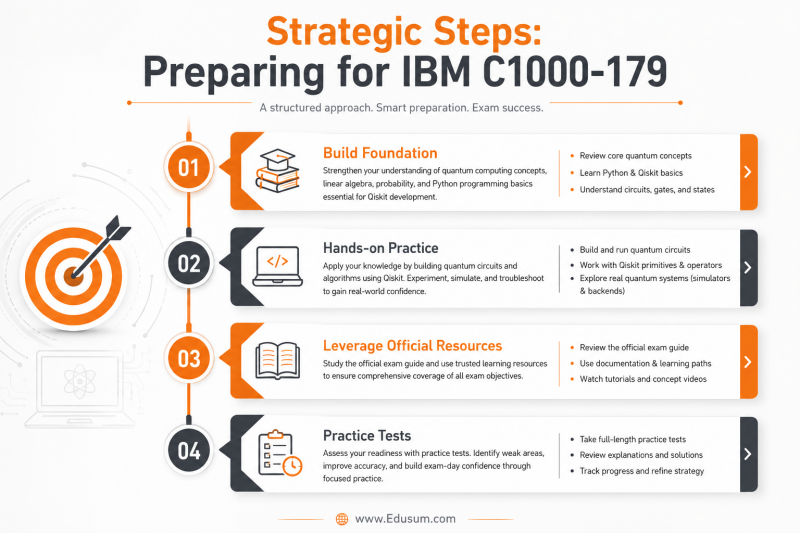
Preparing for the IBM C1000-179 exam requires a structured and consistent approach. Given the technical depth of quantum computing and Qiskit, a combination of theoretical study and practical application is essential. This section outlines effective strategies and recommends the best resources for IBM Fundamentals of Quantum Computing to help you achieve certification success.
Building a Strong Foundation
Start by mastering the core concepts of quantum mechanics relevant to computing, such as superposition, entanglement, and quantum gates. While the exam focuses on application, a solid theoretical base will deepen your understanding of why and how Qiskit operations work. Utilize online courses, textbooks, and IBM's extensive documentation and tutorials for Qiskit.
Hands-on Qiskit v2.X Practice
The exam is highly practical. Spend significant time coding in Qiskit v2.X. Experiment with building various quantum circuits, implementing different quantum gates, and exploring the Sampler and Estimator primitives. The IBM Quantum Experience platform offers free access to quantum simulators and real quantum hardware, providing an invaluable environment for hands-on learning.
Leveraging Official IBM Resources
IBM provides numerous resources, including the official IBM C1000-179 exam guide which details the syllabus and provides sample questions. Enrolling in official IBM training courses or studying materials associated with the "Basics of Quantum Information" badge quiz can also prove highly beneficial.
Implementing an Effective Study Plan
Create a study schedule that allocates dedicated time for each syllabus domain. Focus more on areas where your understanding is weaker or those with higher weighting. Regularly review concepts to reinforce learning and ensure retention.
-
Review Qiskit Documentation: The official Qiskit documentation is comprehensive and constantly updated.
-
Utilize Interactive Tutorials: Websites like IBM Quantum Learning provide interactive labs and tutorials.
-
Join Quantum Communities: Engage with other learners and experts in forums or online communities to clarify doubts and share insights.
-
Practice with Sample Questions: To assess your readiness and identify knowledge gaps, practice with realistic questions. Edusum offers reliable practice tests for the IBM C1000-179 exam, helping you familiarize yourself with the exam format and question types, and is a valuable component of your C1000-179 exam preparation materials.
Crucially, candidates should always prioritize ethical study practices. Relying on "exam dumps" or unauthorized materials undermines the value of certification and can lead to a lack of genuine understanding. Focus on building real skills and knowledge for long-term success.
Elevating Your Career: The IBM Quantum Computing Developer Path
The benefits of IBM Fundamentals of Quantum Computing certification extend far beyond merely passing an exam. This credential positions you at the forefront of a transformative technology, signaling to employers your readiness to tackle complex, future-oriented challenges. It's a significant step in shaping an impactful IBM Quantum Computing developer career path.
Enhanced Marketability and Job Opportunities
As quantum computing transitions from theoretical research to practical application, the demand for skilled developers is rapidly growing. Holding the IBM C1000-179 certification makes you a highly attractive candidate for roles in quantum software development, research, and consulting. It demonstrates a verified skill set in a niche area, opening doors to pioneering companies and research institutions.
Validation of Core Competencies
The certification objectively validates your proficiency in Qiskit v2.X, the most widely used open-source framework for quantum computing. This assurance of competence builds confidence, both for you as a professional and for potential employers who can trust your ability to contribute effectively from day one.
Foundation for Advanced Quantum Roles
The C1000-179 serves as a foundational certification, paving the way for more specialized or advanced quantum roles. It provides the essential understanding needed to delve into specific quantum algorithms, hardware-software co-design, or quantum application architecture. This initial credential can be a stepping stone towards leadership in the quantum domain.
Contribution to a Revolutionary Field
By becoming a certified quantum developer, you join a community actively contributing to the development of a technology poised to revolutionize industries ranging from pharmaceuticals and materials science to finance and artificial intelligence. This offers a unique opportunity for intellectual engagement and significant professional impact.
Industry Recognition and Credibility
IBM is a leading innovator in quantum computing. An IBM certification carries significant weight and credibility within the tech industry. It not only signifies your technical skills but also your alignment with industry-standard practices and tools.
Frequently Asked Questions
-
What is the IBM C1000-179 certification?
The IBM C1000-179 is the IBM Certified Quantum Computation using Qiskit v2.X Developer - Associate certification, validating a candidate's foundational skills in quantum computing development using the Qiskit framework.
-
Who is the ideal candidate for the IBM C1000-179 exam?
The ideal candidate is a developer, engineer, data scientist, researcher, or student with programming experience, particularly in Python, who seeks to apply and validate their skills in quantum computing using Qiskit v2.X.
-
What kind of career opportunities does the IBM C1000-179 certification unlock?
This certification enhances marketability for roles such as Quantum Software Developer, Quantum Applications Engineer, and Quantum Research Assistant in emerging quantum tech companies and research institutions, signifying expertise in a cutting-edge field.
-
How should one prepare for the IBM C1000-179 exam?
Preparation should involve a combination of theoretical study of quantum fundamentals, extensive hands-on practice with Qiskit v2.X on the IBM Quantum Experience, utilization of official IBM documentation, and practicing with reliable sample questions or practice tests.
-
Is the IBM C1000-179 exam suitable for beginners in quantum computing?
Yes, while some programming experience (preferably Python) is recommended, the exam is designed for an associate-level developer and covers fundamentals. It provides a clear entry point for those new to quantum computing but serious about practical application.
Conclusion
The IBM C1000-179: IBM Certified Quantum Computation using Qiskit v2.X Developer - Associate certification is more than just an exam; it's an investment in your future within the quantum realm. It demystifies quantum computing, proving that with dedication and the right resources, anyone can master its fundamentals and become a proficient quantum developer. From understanding circuit mechanics to deploying solutions with Qiskit, this certification equips you with the essential skills to navigate this exciting technological frontier.
Embrace the challenge of quantum computing. Start your preparation today to secure your place in this groundbreaking field. For detailed exam information and to begin your journey, explore comprehensive study materials and practice your quantum skills. Your future in quantum innovation awaits.
- IBM Quantum Developer Certification |
- Quantum Developer Practice Test |
- Quantum Developer Study Guide |
- Quantum Developer Certification Mock Test |
- IBM Qiskit Developer Questions |
- IBM Qiskit Developer Practice Test |
- Quantum Developer Books |
- Quantum Developer Certification Syllabus |
- IBM Quantum Developer Training |
- IBM Qiskit Developer Books |
- IBM Qiskit Developer Certification |
- Quantum Developer Sample Questions |
- IBM Quantum Certification |
- IBM Certified Quantum Computation using Qiskit v2.X Developer - Associate |
- C1000-179 Quantum Developer |
- C1000-179 Online Test |
- C1000-179 Questions |
- C1000-179 Quiz |
- C1000-179 |
- IBM C1000-179 Question Bank |
- C1000-179 Syllabus |
- IBM C1000-179 Books |
- IBM C1000-179 Practice Test Free |
- Qiskit Developer Mock Exam |
- Qiskit Developer |
- Qiskit Developer Certification Cost |
- Qiskit Developer Certification Sample Questions


