
D-PEXE-OE-00 Exam: The Weighting You Didn't Know About
The Dell Technologies D-PEXE-OE-00 exam, officially known as the Dell Technologies Certified PowerEdge XE Operate certification, validates a professional's expertise in managing, operating, and troubleshooting Dell PowerEdge XE servers. This crucial credential targets IT professionals and system administrators responsible for ensuring the optimal performance and continuity of these specialized PowerEdge systems. Achieving this certification signifies a candidate's proficiency in critical operational tasks, from routine maintenance and firmware updates to complex system monitoring and troubleshooting. This article provides an analytical breakdown of the exam's structure and, more importantly, delves into the specific weighting of its syllabus topics, illuminating the areas that demand focused study for successful certification.
Assessing the D-PEXE-OE-00 Certification Framework
Understanding the foundational elements of the Dell Technologies D-PEXE-OE-00 exam is the first step toward effective preparation. This certification is designed to equip IT professionals with the verified skills necessary to manage Dell PowerEdge XE servers efficiently, ensuring system stability and operational excellence in demanding environments. It serves as a benchmark for competency in advanced server administration and operational best practices unique to the PowerEdge XE series.
The core details of the exam are structured to evaluate a candidate's practical knowledge and problem-solving abilities within a time-sensitive context.
| Exam Name: | Dell Technologies Certified PowerEdge XE Operate |
|---|---|
| Exam Code: | D-PEXE-OE-00 |
| Exam Price: | $230 (USD) |
| Duration: | 90 minutes |
| Number of Questions: | 42 |
| Passing Score: | 70% |
This framework highlights the need for a comprehensive understanding rather than superficial recall, pushing candidates to internalize operational procedures and diagnostic techniques. For those looking to strengthen their operational expertise with Dell PowerEdge XE systems, this certification offers a clear pathway to validated skills.
Unpacking the D-PEXE-OE-00 Syllabus: A Weighted Perspective
The Dell Technologies D-PEXE-OE-00 exam syllabus is strategically organized into key operational domains, each carrying a specific weight that dictates its proportional representation in the exam. Candidates should not only be familiar with the topics but also understand the emphasis placed on each area, allowing for a targeted and efficient study approach. The percentages reveal which operational aspects are considered most critical by Dell Technologies for PowerEdge XE operate professionals.
Categorizing Exam Domains by Importance
The syllabus covers a range of essential server management functions, from ensuring system continuity to deep-level troubleshooting. Each domain reflects real-world responsibilities and challenges faced by administrators.
| Scaling Solutions: | 19% |
|---|---|
| System Continuity: | 10% |
| Firmware Management: | 14% |
| System Monitoring: | 26% |
| Troubleshooting: | 26% |
| Security: | 5% |
A quick glance at these percentages immediately highlights that "System Monitoring" and "Troubleshooting" are the heaviest weighted sections, collectively accounting for over half of the exam content. This indicates a strong focus on proactive system health management and reactive problem resolution, which are cornerstones of effective server operation.
Scaling Solutions: Optimizing PowerEdge XE Performance (19%)
The "Scaling Solutions" domain, representing a significant 19% of the D-PEXE-OE-00 exam, focuses on the ability to expand and optimize Dell PowerEdge XE server environments efficiently. This area is crucial for administrators who need to ensure that server resources can grow with demand without compromising performance or stability. It delves into the architectural considerations and practical steps required to enhance server capacity and integrate new components.
Architecting for Scalability and Expansion
Candidates must grasp the principles behind designing scalable PowerEdge XE infrastructures. This involves understanding how different hardware components contribute to overall system capacity and how to strategically add or reconfigure them to meet evolving workload requirements. The exam assesses knowledge of various scaling techniques, whether it’s adding more processing power, increasing memory, or expanding storage. This also includes the operational impact of such changes and how to implement them with minimal disruption.
Implementing System Enhancements and Resource Management
This sub-topic covers the practical application of scaling solutions. It involves recognizing when and how to deploy additional resources, such as installing new CPUs, expanding RAM, or configuring additional storage arrays. Understanding the nuances of hot-swappable components versus cold-swap procedures is essential, as is the ability to plan and execute maintenance windows effectively. Effective resource management also extends to understanding virtualization concepts as they relate to maximizing server utility, ensuring that physical resources are optimally allocated to virtual machines or containers. The ability to perform these tasks correctly and understand their implications for performance and downtime is a key aspect of this domain.
Ensuring System Continuity for PowerEdge XE Servers (10%)
"System Continuity," although one of the lighter weighted sections at 10%, is absolutely critical for any server administrator. This domain assesses a candidate's knowledge of strategies and tools to minimize downtime and ensure that Dell PowerEdge XE servers remain operational, even in the face of component failures or planned maintenance. It emphasizes the importance of resilience and the ability to recover swiftly from unexpected events, which is paramount in enterprise environments.
Implementing Redundancy and High Availability Measures
This section dives into the various techniques employed to build fault-tolerant systems. Candidates are expected to understand how to configure redundant power supplies, network interfaces, and storage components to prevent single points of failure. Knowledge of RAID configurations for data protection and recovery, as well as the implementation of clustering solutions or failover mechanisms for critical services, is vital. The goal is to keep essential services running by automatically switching to backup components or servers when a primary one fails.
Disaster Recovery Planning and Data Protection
Beyond hardware redundancy, system continuity also encompasses broader disaster recovery strategies. This includes understanding backup and restore procedures specific to PowerEdge XE environments, ensuring data integrity, and establishing recovery point objectives (RPOs) and recovery time objectives (RTOs). The exam might cover various backup media, software, and methods, along with the ability to test and validate recovery plans. Professionals must be capable of outlining steps to restore a server to a functional state after a catastrophic event, including restoring operating systems, applications, and data.
Mastering Firmware Management Procedures (14%)
Firmware management, at 14% of the Dell Technologies D-PEXE-OE-00 exam, is a significant component that underscores the importance of keeping server components updated and secure. This domain assesses an administrator's ability to effectively manage BIOS, iDRAC (integrated Dell Remote Access Controller), and other crucial firmware updates for Dell PowerEdge XE servers. Proper firmware management is essential for system stability, performance optimization, and security patch application, protecting against vulnerabilities.
Executing Firmware Updates and Rollbacks
Candidates must demonstrate proficiency in performing firmware updates across various server components. This includes understanding the correct procedures for applying updates to the BIOS, iDRAC, RAID controllers, network adapters, and other peripheral devices. The exam will likely test knowledge of different update methods, such as using the iDRAC web interface, the Lifecycle Controller, or command-line tools. Equally important is the ability to plan and execute firmware rollbacks in case an update introduces unforeseen issues, ensuring system recoverability. This segment requires a meticulous approach to prevent system instability during critical maintenance operations.
Leveraging Dell Update Utilities and Best Practices
This sub-topic focuses on the specific tools and recommended methodologies provided by Dell Technologies for efficient firmware management. Professionals should be familiar with utilities like Dell Command | Update, Repository Manager, and Dell OpenManage Enterprise, and understand their roles in automating and centralizing firmware updates across multiple PowerEdge XE servers. The exam may cover best practices for creating firmware baselines, scheduling updates during low-impact windows, and validating successful installations. Adherence to these best practices helps minimize risks associated with firmware changes and ensures a consistent, secure server environment.
Optimizing System Monitoring and Performance (26%)
"System Monitoring," tied for the highest weighting at 26% in the D-PEXE-OE-00 exam, highlights its critical role in proactive server management. This domain requires candidates to demonstrate expertise in observing Dell PowerEdge XE server health, performance metrics, and alerts to prevent issues before they escalate. Effective monitoring is key to maintaining optimal operational efficiency, identifying bottlenecks, and ensuring service level agreement (SLA) compliance.
Implementing Comprehensive Monitoring Tools
This section evaluates the ability to set up and configure various monitoring solutions for Dell PowerEdge XE servers. It covers the use of the integrated Dell Remote Access Controller (iDRAC) and its features for remote monitoring, logging, and alerting. Candidates should understand how to interpret iDRAC sensor data, system event logs (SEL), and power consumption metrics. Knowledge of other Dell-specific tools, such as Dell OpenManage Enterprise or OpenManage Server Administrator (OMSA), for more centralized and granular monitoring is also crucial. The exam might also touch upon integrating PowerEdge XE monitoring data into broader enterprise monitoring platforms.
Analyzing Performance Metrics and Health Indicators
A significant part of this domain involves interpreting the data gathered from monitoring tools. Professionals must be capable of analyzing CPU utilization, memory usage, storage I/O performance, network throughput, and temperature readings to identify potential performance bottlenecks or hardware failures. Understanding normal operational baselines versus anomalous behavior is key to proactive issue detection. Candidates should also be able to configure alert thresholds and notification methods to ensure that critical events are promptly communicated to the appropriate personnel. Proficiency in reading and understanding system logs is also a fundamental skill tested here, as it provides invaluable insights into system events and errors. Further insights into readiness can be found by consulting an exam readiness checklist.
Mastering Troubleshooting and Diagnostics (26%)
Sharing the top weighting at 26%, "Troubleshooting" is arguably the most vital domain in the Dell Technologies D-PEXE-OE-00 exam. This section assesses a candidate's ability to diagnose and resolve a wide array of issues that can arise in Dell PowerEdge XE server environments. It requires a systematic approach to problem-solving, coupled with a deep understanding of server hardware, software interactions, and diagnostic tools. Proficiency in troubleshooting directly impacts system uptime and reliability.
Systematic Problem Identification and Resolution
Candidates must demonstrate a methodical approach to troubleshooting. This involves defining the problem, gathering relevant information (logs, error codes, performance data), formulating hypotheses, and systematically testing solutions. The exam will challenge understanding of common server issues, such as boot failures, connectivity problems, storage array errors, and power-related anomalies. Knowledge of POST (Power-On Self-Test) codes, diagnostic LEDs, and error messages from the iDRAC and Lifecycle Controller is essential for pinpointing the root cause of a problem.
Leveraging Dell Diagnostic Tools and Procedures
This sub-topic focuses on the practical application of Dell-specific diagnostic utilities. Professionals should be skilled in using tools like the Lifecycle Controller's built-in diagnostics, Dell SupportAssist, and the Dell DSET (Dell System E-Support Tool) to collect system information and run hardware tests. The ability to interpret diagnostic reports and utilize Dell's online support resources effectively to find solutions is also critical. The exam assesses not just the ability to run these tools, but to understand their output and formulate a remediation plan based on the findings, restoring server functionality efficiently. For comprehensive details on the exam, candidates should always refer to the official exam page.
Fortifying PowerEdge XE Security Measures (5%)
At 5%, "Security" is the smallest weighted domain in the D-PEXE-OE-00 exam, but its importance cannot be understated. This section focuses on the fundamental security practices and features relevant to Dell PowerEdge XE servers, ensuring that systems are protected against unauthorized access, data breaches, and other cyber threats. While not heavily tested quantitatively, a strong understanding of these principles is foundational for responsible server operation.
Implementing Secure Server Configurations
Candidates are expected to know how to configure Dell PowerEdge XE servers with security best practices in mind. This includes setting strong passwords for iDRAC and BIOS, enabling multi-factor authentication where available, and understanding the role of secure boot and trusted platform modules (TPM) in enhancing system integrity. The exam may cover hardening the operating system and ensuring that only necessary services are running, reducing the attack surface. Knowledge of network segmentation and firewall configurations relevant to server access is also important to prevent unauthorized network entry.
Adhering to Operational Security Protocols
Beyond initial configuration, this sub-topic addresses ongoing operational security. This involves understanding the importance of regular security updates, vulnerability scanning, and audit logging. Candidates should be familiar with the principles of least privilege, ensuring that users and services only have the minimum necessary access rights. Secure remote access methods to the server, such as SSH and VPN, along with monitoring for suspicious activity in system logs, are also key components of maintaining a robust security posture for Dell PowerEdge XE systems.
Crafting a Strategic D-PEXE-OE-00 Exam Preparation Plan
Successful navigation of the Dell Technologies D-PEXE-OE-00 exam requires more than just memorization; it demands a structured and analytical approach to preparation. Given the specific weighting of the syllabus, candidates can tailor their study efforts to maximize impact and ensure readiness for the operational challenges presented in the certification. A well-rounded plan integrates official resources, practical experience, and consistent self-assessment.
Developing an Effective Study Strategy
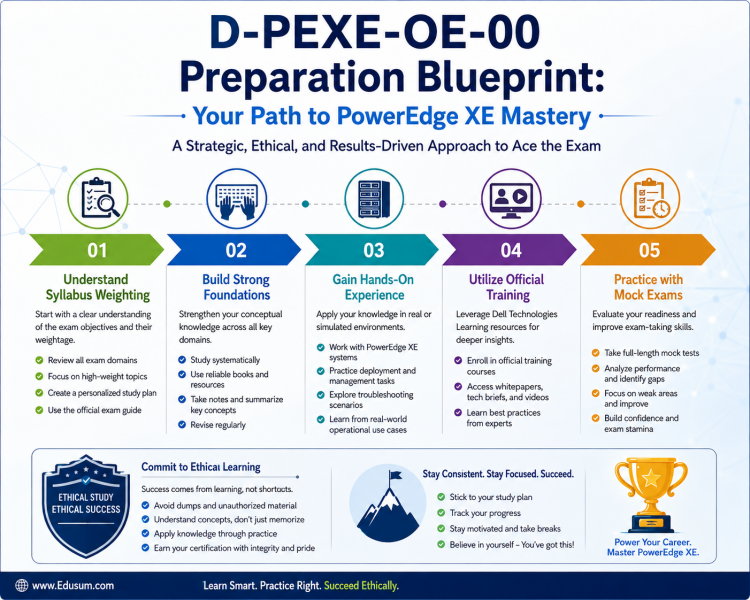
Start by thoroughly reviewing the official D-PEXE-OE-00 study guide, if available, to pinpoint specific objectives within each domain. Prioritize your study time based on the exam weighting, dedicating more effort to System Monitoring and Troubleshooting, while ensuring foundational understanding of all other sections. For PowerEdge XE server administration certification, hands-on experience is invaluable; simulate scenarios in a lab environment or utilize virtual labs to practice deployment, configuration, and troubleshooting tasks. Don't underestimate the seemingly lower-weighted sections, as fundamental flaws in security or system continuity can have critical consequences in real-world environments.
Leveraging Official Resources and Training
Dell Technologies often provides official training courses specifically designed for their certifications. Enrolling in a Dell Technologies PowerEdge XE Operate training course can offer structured learning, expert insights, and practical labs that align directly with the exam objectives. These courses are often the most direct path to grasping complex concepts and operational best practices. Supplement formal training with Dell's technical documentation, whitepapers, and knowledge base articles, which provide in-depth information on specific PowerEdge XE features and common issues.
Implementing Practice and Self-Assessment
Regularly testing your knowledge is crucial for identifying areas that require further attention. Utilize Dell D-PEXE-OE-00 practice exam questions to simulate the actual exam environment and question format. Analyze your performance on these practice tests to understand your strengths and weaknesses. Focus on the explanation behind incorrect answers, not just the right ones, to deepen your understanding. This iterative process of study, practice, and review is fundamental for solidifying your knowledge and building confidence before attempting the certification exam.
Benefits of Achieving Dell Technologies Certified PowerEdge XE Operate Status
Earning the Dell Technologies Certified PowerEdge XE Operate credential offers a multitude of advantages for IT professionals and their organizations. This certification goes beyond mere recognition; it signifies a demonstrable mastery of skills essential for managing modern server infrastructures, directly impacting career trajectory and operational efficiency. The benefits extend from individual professional growth to enhanced organizational capabilities.
Enhancing Career Prospects and Professional Credibility
For individuals, achieving the Dell Technologies Certified PowerEdge XE Operate certification significantly boosts career prospects. It positions you as an expert in Dell PowerEdge XE server operations, a valuable asset in today's data center environments. Employers recognize this credential as proof of in-depth knowledge and practical skills, often leading to better job opportunities, promotions, and increased earning potential. The certification demonstrates a commitment to professional development and validates your ability to handle complex server administration tasks with confidence and competence.
Driving Operational Efficiency and System Reliability
Organizations employing certified professionals benefit immensely from their expertise. A Dell PowerEdge XE server operational best practices approach, spearheaded by certified staff, leads to higher operational efficiency, reduced downtime, and improved system reliability. Certified administrators are better equipped to implement scalable solutions, ensure system continuity, manage firmware effectively, proactively monitor system health, and rapidly troubleshoot issues. This translates into more stable IT infrastructure, optimized performance, and ultimately, a better return on investment for Dell PowerEdge XE deployments. It also mitigates risks associated with server management, reinforcing overall IT resilience.
Conclusion: Mastering the Dell Technologies D-PEXE-OE-00 Operational Landscape
The Dell Technologies D-PEXE-OE-00 exam is a rigorous validation of a professional’s ability to expertly operate and manage Dell PowerEdge XE servers. By dissecting the exam's weighting, it becomes evident that a strong emphasis is placed on System Monitoring and Troubleshooting, reflecting the critical day-to-day responsibilities of server administrators. However, a holistic understanding of all domains - Scaling Solutions, System Continuity, Firmware Management, and Security - is indispensable for truly effective and secure server operations.
Achieving this certification not only certifies technical prowess but also underscores a commitment to maintaining high standards in mission-critical server environments. For those dedicated to excelling in Dell PowerEdge XE server administration, a focused and strategic preparation journey, informed by the syllabus weighting, will pave the way to success. Equip yourself with the knowledge and practical skills to become a certified expert in the Dell Technologies PowerEdge XE ecosystem. To further enhance your preparation and test your readiness, explore comprehensive study materials and practice tests available on the Edusum D-PEXE-OE-00 store.
Frequently Asked Questions
1. What skills does the Dell Technologies D-PEXE-OE-00 exam validate?
The Dell Technologies D-PEXE-OE-00 exam validates skills in operating, monitoring, troubleshooting, and managing Dell PowerEdge XE servers. It covers areas like scaling solutions, system continuity, firmware management, and security best practices for these specific server platforms.
2. How much emphasis should be placed on each syllabus topic for the D-PEXE-OE-00 exam?
The D-PEXE-OE-00 exam syllabus has varying weights: Scaling Solutions (19%), System Continuity (10%), Firmware Management (14%), System Monitoring (26%), Troubleshooting (26%), and Security (5%). Candidates should prioritize System Monitoring and Troubleshooting due to their higher weighting.
3. Are there any prerequisites for taking the Dell Technologies Certified PowerEdge XE Operate exam?
While Dell Technologies D-PEXE-OE-00 prerequisites are not always strict, it is highly recommended that candidates have practical experience with Dell PowerEdge XE servers, including deployment, configuration, monitoring, and troubleshooting tasks, to effectively prepare for the exam.
4. What kind of preparation materials are recommended for the D-PEXE-OE-00 certification?
Recommended preparation materials for the D-PEXE-OE-00 certification include official Dell Technologies training courses, comprehensive study guides, Dell's technical documentation, and practice exams to assess readiness and identify knowledge gaps.
5. What are the career benefits of achieving the Dell Technologies D-PEXE-OE-00 certification?
Achieving the Dell Technologies D-PEXE-OE-00 certification enhances career prospects by validating specialized expertise in PowerEdge XE server administration, leading to improved job opportunities, professional credibility, and potentially higher earning potential in IT roles focused on server operations.
- Dell Technologies Server Certification |
- Dell Technologies Certified PowerEdge XE Operate |
- D-PEXE-OE-00 PowerEdge XE Operate |
- D-PEXE-OE-00 Online Test |
- D-PEXE-OE-00 Questions |
- D-PEXE-OE-00 Quiz |
- D-PEXE-OE-00 |
- Dell Technologies PowerEdge XE Operate Certification |
- PowerEdge XE Operate Practice Test |
- PowerEdge XE Operate Study Guide |
- Dell Technologies D-PEXE-OE-00 Question Bank |
- PowerEdge XE Operate Certification Mock Test |
- PowerEdge XE Operate Simulator |
- PowerEdge XE Operate Mock Exam |
- Dell Technologies PowerEdge XE Operate Questions |
- PowerEdge XE Operate |
- Dell Technologies PowerEdge XE Operate Practice Test |
- D-PEXE-OE-00 Syllabus |
- PowerEdge XE Operate Books |
- PowerEdge XE Operate Certification Syllabus |
- Dell Technologies D-PEXE-OE-00 Books |
- Dell Technologies PowerEdge XE Operate Training |
- PowerEdge XE Operate Certification Cost |
- Dell Technologies PowerEdge XE Operate Books |
- PowerEdge XE Operate Sample Questions |
- Dell Technologies D-PEXE-OE-00 Practice Test Free


