
Best Cybersecurity Certifications for Beginners: Complete Decision Guide
Which cybersecurity certification should you get first - and does it actually matter which one you choose? The short answer is yes, it matters a lot. The wrong starting cert can waste months of study time and hundreds of dollars on an exam that employers in your target role rarely ask for. The right one opens doors within weeks of passing.
This guide walks you through the top beginner cybersecurity certifications in 2026, what each one actually proves to employers, who each one is best for, and how to decide based on your current background - not what everyone else is doing.
What you'll learn: Which cert to take first based on your background, a cost-vs-value comparison for all major beginner options, and a clear 12-month roadmap to your first cybersecurity job.
Why Does Your First Cybersecurity Certification Choice Matter?
Your first certification sets the tone for your entire career path. Entry-level hiring managers use certifications as filters. According to CompTIA's Cyberstates report, CompTIA Security+ appears in approximately 70% of entry-level cybersecurity job postings in the United States - making it the de facto baseline credential most employers expect.
But Security+ is not always the right first step. If you have zero IT background, jumping straight to Security+ can mean 6+ months of struggle with networking and systems concepts you haven't learned yet. If you already work in IT, Security+ might be exactly the right move.
Here's what the job market data says: the U.S. Bureau of Labor Statistics projects 29% job growth for information security analysts from 2024 to 2034 — roughly 10 times faster than the average occupation. Median annual salary sits at $124,910. The demand is enormous. The question is just which credential gets you in the door fastest for your specific situation.
What Is a Cybersecurity Certification — and Do You Actually Need One?
A cybersecurity certification is a vendor-neutral or vendor-specific credential that proves you understand security concepts, tools, and practices to a tested standard. Certifications are issued by organizations like CompTIA, ISC2, EC-Council, and Microsoft.
Do you need one? Practically speaking, yes — especially when you're starting out. Here's why: without a degree in computer science or years of hands-on experience, a certification is the only objective proof you can put on a resume. Recruiters scanning hundreds of applications use certifications as the first filter.
The good news is that several beginner certifications are achievable in 2–4 months of part-time study, and some are free.
Which Cybersecurity Certifications Are Best for Beginners?
The best beginner cybersecurity certifications in 2026 are the ISC2 Certified in Cybersecurity (CC), CompTIA Security+, Microsoft SC-900, Google Cybersecurity Professional Certificate, and CompTIA Network+ as a pre-requisite builder. Here's how they compare:
|
Certification |
Cost |
Difficulty |
Study Time |
Best For |
|---|---|---|---|---|
|
ISC2 CC |
Free (limited time) |
Very Low |
4–6 weeks |
True beginners, no IT background |
|
CompTIA Security+ |
~$425 |
Low–Medium |
8–12 weeks |
IT professionals entering security |
|
Microsoft SC-900 |
~$99 |
Very Low |
2–4 weeks |
Microsoft cloud/Azure professionals |
|
Google Cybersecurity Cert |
~$49/month |
Very Low |
3–6 months |
Career changers with no IT background |
|
CompTIA Network+ |
~$338 |
Low |
8–10 weeks |
Pre-Security+ for non-IT backgrounds |
Pro Tip: ISC2 launched the CC certification specifically as a free entry point for beginners. If budget is a concern, start here before investing in Security+.
What Is the ISC2 Certified in Cybersecurity (CC)?
The ISC2 Certified in Cybersecurity (CC) is ISC2's entry-level credential designed specifically for people with no prior cybersecurity experience. It's available at no cost through ISC2's "One Million Certified in Cybersecurity" initiative, though pricing may evolve — verify current availability at the ISC2 website.
Who should start here: Anyone with zero IT background, recent graduates, career changers, or anyone who wants to dip their toes in before committing to a full Security+ study plan.
What it covers:
-
Security principles
-
Business continuity, disaster recovery, and incident response
-
Access controls
-
Network security
-
Security operations
Why it works as a first cert: The CC teaches you the language of cybersecurity — the vocabulary, frameworks, and mindset you need before anything more advanced. Passing it also earns you ISC2 Associate status, which is a recognized designation on a resume.
Limitation: The CC is relatively new, so not every recruiter knows it. Follow it up with Security+ within 6–12 months for stronger job market traction.
What Is CompTIA Security+ and Is It Right for Beginners?
CompTIA Security+ is the most widely recognized entry-level cybersecurity certification in the world and appears in more job postings than any other security credential at the entry level. The current exam is SY0-701 (the V7 version).
Exam details:
-
Questions: Maximum 90 (multiple-choice + performance-based)
-
Time: 90 minutes
-
Passing score: 750 out of 900
-
Cost: ~$425 (US)
-
Recommended: CompTIA Network+ and 2 years IT experience with a security focus
Domain breakdown for SY0-701:
-
Security Operations: 28% (largest domain — focus here first)
-
Threats, Vulnerabilities, and Mitigations: 22%
-
Security Program Management and Oversight: 20%
-
Security Architecture: 18%
-
General Security Concepts: 12%
Who should get Security+ first: If you already have an IT job (helpdesk, sysadmin, network support) and want to move into security, Security+ is the right first cert. It directly leads to SOC analyst, junior security analyst, and IT security specialist roles.
Who should do something else first: If you're a complete beginner with no IT background, do CompTIA Network+ or ISC2 CC first. Jumping into Security+ without networking knowledge makes the exam significantly harder.
You can explore Security+ sample questions and study materials on EduSum to assess where you stand before committing to the exam.
What Is Microsoft SC-900 and Who Should Get It?
Microsoft SC-900 — the Microsoft Security, Compliance, and Identity Fundamentals certification — is Microsoft's entry point into their security certification stack.
Exam details:
-
Cost: ~$99 (US)
-
Domains: Security/compliance/identity concepts (10–15%), Microsoft Entra (25–30%), Microsoft Security solutions (35–40%), Microsoft compliance solutions (15–20%)
-
Passing score: 700/1000
-
Study time: 2–4 weeks for most candidates
Who should get SC-900: IT professionals already working in Microsoft environments (Azure, Microsoft 365, Teams), or anyone wanting to move into cloud security roles at Microsoft-heavy organizations.
What SC-900 does not give you: It doesn't provide broad, vendor-neutral security knowledge. Employers outside the Microsoft ecosystem rarely ask for it. Think of it as a complement to Security+, not a replacement.
Note: In 2026, Microsoft added a new AI Security Copilot domain to SC-900. If you've studied from older materials, refresh with 2026-updated resources.
What Is the Google Cybersecurity Professional Certificate?
The Google Cybersecurity Professional Certificate, available on Coursera for approximately $49/month, is a hands-on, beginner-friendly program that covers Python, Linux, SQL, and foundational security operations concepts.
Who it's best for: Complete beginners with zero IT background who need both foundational skills and a resume credential before pursuing Security+.
What employers think of it: Job postings requesting this certificate grew 34% year-over-year according to Coursera's analysis. However, it's stronger as a skills builder than a standalone hiring credential. Use it as a 3–6 month on-ramp to Security+, not as your only credential.
How Do You Decide Which Cybersecurity Certification to Start With?
Your starting certification should match your current background, not what's most popular online. Use this decision framework:
If you have no IT background at all:
→ Start with ISC2 CC (free) or Google Cybersecurity Certificate → then CompTIA Security+
If you have 1–2 years in IT (helpdesk, sysadmin, support):
→ Go directly to CompTIA Security+ (SY0-701)
If you work in Microsoft environments (Azure, M365):
→ Start with SC-900 → then SC-200 (Security Operations Analyst)
If you want an ethical hacking or offensive security path:
→ Security+ first → then CEH v13 after 2+ years of experience
If you're a student or recent graduate with a CS/IT degree:
→ Go directly to CompTIA Security+ and pursue ISC2 CC in parallel (it's free)
What Are the Entry-Level Cybersecurity Job Titles and Which Certs Get You There?
Here are the most common entry-level cybersecurity roles and the certifications that align with each:
|
Job Title |
Primary Cert |
Secondary Cert |
|---|---|---|
|
SOC Analyst (Level 1) |
CompTIA Security+ |
Microsoft SC-200 |
|
Junior Penetration Tester |
CompTIA Security+ |
CEH v13 |
|
Cloud Security Associate |
Microsoft SC-900 |
SC-200 |
|
IT Security Specialist |
CompTIA Security+ |
ISC2 CC |
|
Cybersecurity Analyst |
CompTIA Security+ |
CompTIA CySA+ |
|
GRC (Governance) Analyst |
ISC2 CC |
ISACA CISA |
The majority of entry-level cybersecurity roles start with CompTIA Security+ as the baseline. The ISC2 Cybersecurity Workforce Study consistently shows Security+ as the top-held certification among cybersecurity professionals in their first 3 years of the career.
Is It Possible to Get a Cybersecurity Job Without a Degree?
Yes. Certifications are increasingly accepted as degree substitutes by employers in cybersecurity. The U.S. government and Department of Defense accept CompTIA Security+ under DoD Directive 8140 as meeting the baseline security requirements for many IT positions — regardless of degree.
Practical routes without a degree:
-
ISC2 CC (free) + CompTIA Security+ (~$425) + home lab practice = entry-level SOC analyst in 6–12 months
-
CompTIA Network+ + Security+ + certifications = network security admin in 12–18 months
-
Google Cybersecurity Certificate + Security+ + personal projects = analyst role in 9–15 months
The home lab is the piece most beginners skip. Setting up a basic environment with tools like Kali Linux, Wireshark, and Security Onion (all free) provides the hands-on experience that turns certification knowledge into job-ready skills.
How Much Do Cybersecurity Certifications Cost — and Are They Worth It?
Here's the full cost breakdown for beginner certifications, including exam cost plus typical study materials:
|
Certification |
Exam Cost |
Study Materials |
Total Investment |
|---|---|---|---|
|
ISC2 CC |
Free |
Free (ISC2 resources) |
$0 |
|
Microsoft SC-900 |
~$99 |
$50–$100 (Udemy/LinkedIn) |
$150–$200 |
|
CompTIA A+ |
~$246 per exam (2 exams) |
$100–$150 |
$600–$650 |
|
CompTIA Network+ |
~$338 |
$100–$150 |
$450–$500 |
|
CompTIA Security+ |
~$425 |
$100–$200 |
$525–$625 |
|
Google Cert |
~$200–$300 total |
Included |
$200–$300 |
Are they worth it? For CompTIA Security+, the math is clear. A Security+ certified professional earns an average of $82,439 per year, compared to $55,000–$65,000 for uncertified IT workers in equivalent roles. The ROI on a $500–$600 total investment is realized within weeks of landing a security role.
Pro Tip: Many employers and government agencies offer tuition reimbursement for CompTIA certifications. Check your company's education benefits — you may not pay anything out of pocket.
What Cybersecurity Certification Roadmap Should You Follow in 2026?
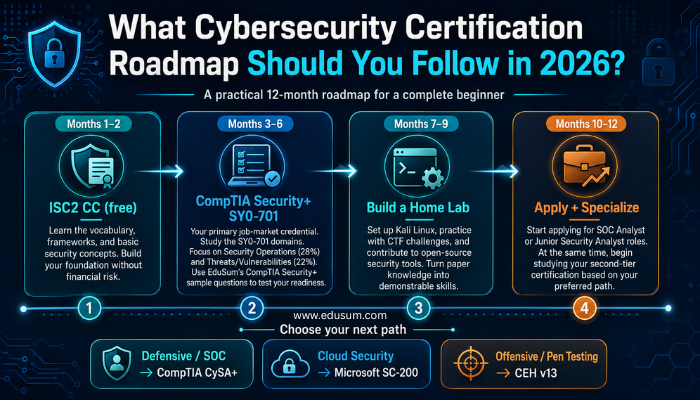
Here's a practical 12-month roadmap for a complete beginner:
Months 1–2: ISC2 CC (free) — learn the vocabulary, frameworks, and basic security concepts. This builds your foundation without financial risk.
Months 3–6: CompTIA Security+ SY0-701 — this is your primary job-market credential. Study the SY0-701 domains, focus heavily on Security Operations (28%) and Threats/Vulnerabilities (22%). Use EduSum's CompTIA Security+ sample questions to test your readiness.
Months 7–9: Build a home lab — set up Kali Linux, practice with CTF (Capture the Flag) challenges, contribute to open-source security tools. This turns your paper knowledge into demonstrable skills.
Months 10–12: Start applying for SOC Analyst or Junior Security Analyst roles. Simultaneously begin studying for your second-tier certification based on your preferred path:
-
Defensive/SOC → CompTIA CySA+
-
Cloud Security → Microsoft SC-200
-
Offensive/Pen Testing → CEH v13
Which Cybersecurity Certifications Are Free in 2026?
The following cybersecurity certifications are fully free or have free pathways:
-
ISC2 Certified in Cybersecurity (CC) — exam and study materials currently offered at no cost through ISC2's initiative
-
Microsoft certifications renewal — existing Microsoft cert holders renew at no cost through online assessments
-
CISCO Networking Academy certifications — multiple free networking and cybersecurity introductory certificates
Verify current pricing directly with ISC2 before registering. The free exam offer has been extended multiple times but may have conditions.
Frequently Asked Questions
Q: What is the easiest cybersecurity certification for beginners?
A: The ISC2 Certified in Cybersecurity (CC) is currently the easiest and cheapest beginner certification — it's available at no cost and requires no prior IT experience. For a more recognized job-market credential, CompTIA Security+ is beginner-accessible with 8–12 weeks of dedicated study.
Q: Can I get a cybersecurity job with just CompTIA Security+?
A: Yes, especially for entry-level SOC analyst and IT security specialist roles. Security+ appears in roughly 70% of entry-level cybersecurity job postings. Pair it with hands-on lab experience (home lab, CTFs, internships) to maximize your employability.
Q: How long does it take to get a cybersecurity certification?
A: ISC2 CC: 4–6 weeks. SC-900: 2–4 weeks. CompTIA Security+: 8–12 weeks (full-time study), 3–6 months (part-time). CEH v13: 4–6 months. Study time varies significantly based on existing IT background.
Q: Is CompTIA Security+ harder than it used to be?
A: The SY0-701 version (V7, current as of 2023) is generally considered comparable in difficulty to SY0-601, but with updated content including more AI/ML security topics and cloud security scenarios. Performance-based questions (PBQs) remain the hardest part of the exam.
Q: Should I get CompTIA A+ before Security+?
A: Only if you have zero IT background. If you already work in IT, skip A+ and go directly to Security+. A+ covers hardware, operating systems, and troubleshooting — valuable for helpdesk but not required for Security+.
Q: What is the difference between CompTIA Security+ and ISC2 CISSP?
A: Security+ is entry-level (0–2 years experience), while CISSP is advanced (requires 5 years of verified experience across 2+ domains). CISSP is for security managers and senior practitioners. Start with Security+; aim for CISSP 5–7 years into your career.
Q: Are free cybersecurity certifications worth anything to employers?
A: ISC2 CC is the exception — it's backed by ISC2's global reputation and is recognized in the industry. Generic "free certificates" from online platforms vary widely. Stick to certifications from recognized bodies (CompTIA, ISC2, EC-Council, Microsoft, GIAC).
Q: What cybersecurity certification should I get if I already have CompTIA A+?
A: Go directly to CompTIA Security+. Your A+ background gives you the foundational hardware and OS knowledge that makes Security+ concepts much more accessible. Alternatively, do CompTIA Network+ if your networking knowledge is weak.
Q: Is the Google Cybersecurity Certificate worth pursuing in 2026?
A: Yes, as a skills-builder and on-ramp. It teaches Python, Linux, and basic SOC workflows. But treat it as a stepping stone to Security+, not a replacement. Employers who recognize it are growing, but Security+ remains the gold standard for entry-level job applications.
Q: How do I choose between CompTIA Security+ and Microsoft SC-900 as my first cert?
A: Choose SC-900 if you work in a Microsoft environment and want to stay in cloud/Microsoft security. Choose Security+ if you want the broadest job market coverage and vendor-neutral knowledge. Security+ is recognized far more widely than SC-900 across employers.
Conclusion
The best cybersecurity certification for beginners in 2026 depends entirely on where you're starting from:
-
Zero IT background → ISC2 CC (free) then CompTIA Security+
-
Current IT professional → CompTIA Security+ directly
-
Microsoft environment → SC-900 then SC-200
-
Career changer on a budget → Google Certificate then Security+
The cybersecurity field is growing at 29% through 2034 with a median salary of $124,910. There has never been a better time to start.
Start with the ISC2 CC if cost is a barrier. If you're ready to invest in the credential that opens the most doors, CompTIA Security+ (SY0-701) remains the single best first cybersecurity certification for 2026.
Practice your CompTIA Security+ knowledge with EduSum's free sample questions and mock exams — built to match the SY0-701 exam objectives.
- ISC2 Certification |
- CompTIA Security+ |
- CompTIA Certification |
- CompTIA Security+ Certification |
- Security+ Practice Test |
- Microsoft Certification |
- Microsoft Certified - Security Compliance and Identity Fundamentals |
- SC-900 Security Compliance and Identity Fundamentals |
- SC-900 Online Test |
- SC-900 Questions |
- SC-900 Quiz |
- SC-900 |
- SY0-701 Security+ |
- ISC2 Certified in Cybersecurity (CC) |
- CC |
- CC Online Test |
- CC Questions |
- CC Quiz |
- ISC2 CC Certification |
- CC Practice Test |
- CC Study Guide |
- SC-900 Practice Test


