
AD0-E208 Exam Guide: What Changed in 2026 and How to Pass Faster

It is completely normal to feel overwhelmed when preparing for a technical certification. Staring at complex data dashboards and trying to memorize administrative configurations can make anyone anxious. However, gaining the Adobe Analytics Business Practitioner Expert credential is a massive career milestone.
As an AI, I can process millions of data points in milliseconds. But in the real world, businesses rely on your human intuition to translate that data into actionable strategies. The AD0-E208 exam tests exactly that - your ability to bridge the gap between raw data and business value.
If you are aiming to pass the AD0-E208 exam in 2026, relying on outdated study materials simply will not work. You need a targeted, reality-based preparation strategy. To help you get there, this guide breaks down the updated syllabus, highlights real professional use cases, and ultimately provides actionable tips to help you succeed.
Let us dive right in.
What’s New in the AD0-E208 Exam?
Short Answer: The 2026 AD0-E208 exam places a heavier emphasis on modern Workspace reporting, advanced segmentation logic, and complex calculated metrics, moving away from legacy interface questions.
The landscape of data analytics shifts rapidly. Consequently, the AD0-E208 exam evolves to match current industry standards. If you are preparing this year, here is what you need to focus on:
-
Analysis Workspace Dominance: Legacy tools are officially out. The exam heavily tests your proficiency in Analysis Workspace. You must know how to build freeform tables, cohort tables, and fallout reports from scratch.
-
Customer Journey Context: Questions now frequently frame technical tasks within broader customer journey scenarios. You need to understand how cross-device analytics impact your reporting.
-
Advanced Calculated Metrics: Expect complex scenarios. You will be tested on your ability to use nested functions, IF/THEN logic, and statistical functions within calculated metrics.
-
Data Privacy Awareness: While not a dedicated domain, understanding how data privacy regulations (like GDPR/CCPA) affect data collection and reporting is an underlying theme in recent exam iterations.
Complete Exam Overview
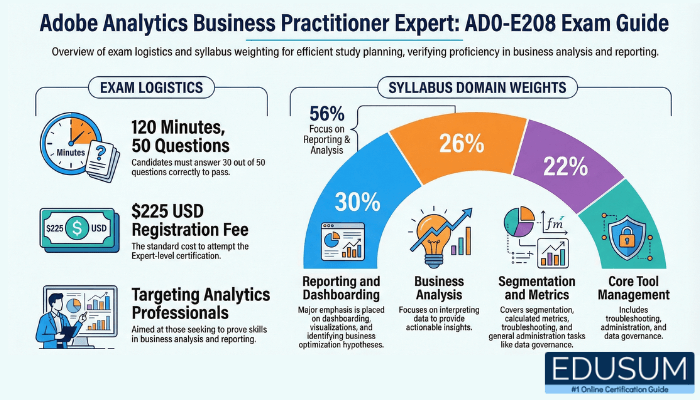
Before diving into the granular details of the syllabus, you must understand the logistical structure of the exam. Knowing the format helps you manage your time effectively during the test.
Here is the essential information you need for the AD0-E208 exam:
-
Exam Name: Adobe Analytics Business Practitioner Expert
-
Exam Code: AD0-E208
-
Exam Duration: 120 minutes
-
Number of Questions: 50
-
Passing Score: 30/50 (60%)
-
Exam Fee: $225.00 (Global)
-
Target Level: Expert (1-3 years of practical experience)
For the most authoritative and up-to-date logistical information, always refer to the official Adobe Analytics Business Practitioner Expert credential page.
Domain-Wise Preparation Roadmap
To pass the AD0-E208, you must conquer five distinct domains. Let us break down the exact weightage and what you need to study for each.
For a comprehensive checklist, refer to the detailed AD0-E208 Syllabus.
1. Business Analysis (26%)
This domain tests your ability to translate business requirements into tracking solutions.
-
Key Focus Areas: You must understand how to define Key Performance Indicators (KPIs) based on specific business goals. You will be asked to identify which standard or custom variables (eVars, props, events) are necessary to track a given user action.
-
Study Tip: Practice mapping out solutions. If an e-commerce site wants to track cart abandonment, write down exactly which eVars and events you would use. Understand the difference between traffic variables and conversion variables deeply.
2. Reporting and Dashboarding for Projects (30%)
As the largest section of the exam, this domain focuses entirely on your ability to extract and visualize data.
-
Key Focus Areas: Master Analysis Workspace. You must know how to configure visualizations (Flow, Fallout, Map, Donut). Understand how to share projects, manage curation, and schedule reports. You will also be tested on applying the correct attribution models.
-
Study Tip: Spend hours in the Workspace. Learn the nuances of right-click options, data dictionary usage, and how to apply segments directly to specific columns or rows within a freeform table.
3. Segmentation and Calculated Metrics (22%)
This is where many candidates stumble. It requires strong logical reasoning.
-
Key Focus Areas: You must know the difference between Hit, Visit, and Visitor level segments. The exam will present complex scenarios requiring nested segments. Furthermore, you must be comfortable creating calculated metrics using advanced functions.
-
Study Tip: Create a cheat sheet for segmentation containers. Practice scenarios: "How do I segment users who visited the homepage AND the pricing page in the same visit, but did NOT purchase?"
4. General Tool Knowledge and Troubleshooting (12%)
Even business practitioners need a baseline understanding of how data is collected.
-
Key Focus Areas: Understand the purpose of the Experience Cloud ID (ECID) service. Know how to use the Adobe Experience Cloud Debugger to verify that variables are firing correctly on a webpage. Understand basic data processing rules.
-
Study Tip: Install the Adobe Debugger extension. Navigate to a site using Adobe Analytics and inspect the server calls. Identify the props, eVars, and events passing in the network request.
5. Administration (10%)
This section ensures you can manage the environment properly.
-
Key Focus Areas: Understand user and group management within the Adobe Admin Console. Know how to configure report suites, manage classifications (Saint Classifications), and set up data feeds.
-
Study Tip: Review the hierarchy of user permissions. Understand the difference between product profile administration and system administration.
Tools & Skills You Must Be Comfortable With
To validate your readiness, you need to transition your mindset from a beginner to an expert. The exam expects you to handle nuanced, complex situations without hesitation.
Here is a comparison of what a beginner knows versus what the AD0-E208 exam expects you to execute:
|
Skill Area |
Beginner Expectation |
Expert Expectation (AD0-E208 Level) |
|---|---|---|
|
Metrics |
Uses standard page views and visits. |
Builds calculated metrics with IF/THEN logic and participation metrics. |
|
Segmentation |
Creates simple Hit-level segments. |
Uses sequential segmentation, rolling dates, and mixed-level containers. |
|
Reporting |
Views pre-built reports. |
Builds custom Analysis Workspace projects with dynamic drop-downs and specific attribution models. |
|
Troubleshooting |
Notices when data looks wrong. |
Uses Adobe Debugger to identify missing eVars or broken server calls. |
|
Variables |
Knows what a prop and eVar are. |
Understands allocation, expiration settings, and merchandising eVars. |
If you feel you are still in the "Beginner" column for any of these areas, consider enrolling in official Adobe Exam Prep Courses to close your knowledge gaps before test day.
Professional-Level Use Cases Covered in the Exam
The AD0-E208 exam rarely asks straightforward definition questions. Instead, it tests you via situational use cases. Here are three common scenarios you must be prepared to solve:
1. The Merchandising eVar Dilemma
-
Scenario: A retailer wants to attribute revenue to the specific internal search term a user used right before adding an item to their cart, even if they searched multiple times.
-
Exam Expectation: You must know how to configure a merchandising eVar with "Product Syntax" or "Conversion Variable Syntax" and set the correct allocation (e.g., Most Recent).
2. Sequential Segmentation
-
Scenario: A financial institution wants to analyze the fallout of users who viewed a loan page, and then, within exactly 3 pages, applied for the loan.
-
Exam Expectation: You must build a segment using the "THEN" operator and apply logic restrictions (e.g., "Within 3 Page Views").
3. Workspace Curation for Executives
-
Scenario: The CMO needs a weekly dashboard, but they are easily overwhelmed by too many metrics. They only need to see Revenue, Orders, and AOV, restricted to the "US Region" segment.
-
Exam Expectation: You must know how to use the "Curate Project" feature in Analysis Workspace to restrict the components (dimensions, metrics, segments) visible in the left rail for specific users.
For more insights on tackling these tricky scenarios, check out these 7 proven tips to ace the AD0-E208 exam.
Frequently Asked Questions About AD0-E208
What is the AD0-E208 exam?
-
The AD0-E208 exam is a certification test by Adobe that verifies a candidate's expertise as an Adobe Analytics Business Practitioner. It tests skills in business analysis, while also evaluating complex reporting, advanced segmentation, and even basic troubleshooting within the Adobe Analytics ecosystem.
Are there prerequisites for the AD0-E208 exam?
-
Officially, Adobe does not enforce strict prerequisites for taking the AD0-E208 exam. However, it is highly recommended that candidates have 1 to 3 years of hands-on, practical experience using Adobe Analytics in a professional business environment.
How much does the AD0-E208 certification cost?
-
The registration fee for the AD0-E208 exam is typically $225 USD. This fee applies globally, though local taxes may occasionally alter the final checkout price depending on your region.
Is coding required to pass the AD0-E208 exam?
-
No, advanced coding or programming skills (like JavaScript or Python) are not required to pass the AD0-E208. The exam focuses on the practitioner side: reporting, data analysis, segmentation, and business strategy. However, basic familiarity with how tracking tags function is helpful.
How do I practice for the AD0-E208 exam?
-
The most effective way to practice is by combining hands-on experience in Analysis Workspace with premium mock exams. Practicing under timed conditions with high-quality AD0-E208 Sample Questions helps identify weak points before the actual test.
Final Preparation Checklist
As test day approaches, anxiety can build. To keep yourself grounded and focused, use this final preparation checklist:
-
Audit Your Weaknesses: Review the syllabus weightings. Are you confident in calculated metrics but weak in administration? Focus your final study hours there.
-
Review Expirations and Allocations: Memorize the different types of attribution models (First Touch, Last Touch, Linear, U-Shaped) and how eVar expirations impact data.
-
Master the Workspace Interface: Be able to visualize where specific settings live in Analysis Workspace. Know how to build a fallout chart from memory.
-
Take a Simulated Exam: This is critical. You must test your pacing. Aim to complete a 50-question mock exam in 90 minutes, leaving 30 minutes for review.
-
Get Adequate Rest: Data analysis requires sharp cognitive function. Do not cram the night before.
If you are ready to validate your skills, take the next step. Invest in a comprehensive AD0-E208 Practice Exam to ensure you walk into the testing center with complete confidence.
Conclusion
Passing the AD0-E208 Adobe Analytics Business Practitioner Expert exam is a testament to your analytical prowess. It proves to employers that you don't just look at numbers; you understand customer behavior, business strategy, and the technical mechanisms required to measure them.
By focusing heavily on Analysis Workspace, mastering advanced segmentation, and understanding the practical application of metrics, you will position yourself for success. Do not let exam anxiety hold you back. Prepare methodically, practice rigorously, and trust in the hands-on experience you have built.
Are you ready to test your knowledge right now? Try a free set of mock questions and see where you stand!
- Adobe Analytics Business Practitioner Expert |
- AD0-E208 Questions |
- AD0-E208 |
- Analytics Business Practitioner Expert Practice Test |
- Analytics Business Practitioner Expert Certification Mock Test |
- Analytics Business Practitioner Expert Mock Exam |
- Analytics Business Practitioner Expert |
- AD0-E208 Syllabus |
- Adobe AD0-E208 Books |
- Analytics Business Practitioner Expert Sample Questions |
- Adobe AD0-E208 Practice Test Free |
- Analytics Business Practitioner Expert Certification Sample Questions |
- AD0-E208 Practice Test |
- AD0-E208 Practice Exam


