
Why AZ-900 Microsoft Azure Fundamentals Elevates Your Resume

The Microsoft Certified - Azure Fundamentals (AZ-900) certification serves as an essential stepping stone for anyone looking to understand cloud services and how Microsoft Azure delivers them. This foundational credential validates a candidate’s basic knowledge of cloud concepts, core Azure services, and Azure management and governance. Designed for individuals from both technical and non-technical backgrounds, the AZ-900 exam provides a comprehensive overview necessary to embark on a cloud-centric career path or simply to gain a working understanding of modern cloud computing environments. This article will delve into why the AZ-900 certification is increasingly relevant today, its key objectives, preparation strategies, and how it can significantly boost a tech career.
Establishing Cloud Competency with AZ-900
Microsoft Azure, as one of the leading cloud platforms, continues to expand its global footprint, making a fundamental understanding of its services highly valuable across industries. The AZ-900 certification is specifically designed to validate this foundational knowledge, ensuring professionals can confidently discuss and work with cloud concepts. It addresses the growing demand for individuals who can navigate the complexities of cloud computing, offering a clear entry point into the vast world of Azure.
Bridging the Knowledge Gap
For many, the transition to cloud technology can seem daunting due to its breadth and rapid evolution. The AZ-900 acts as a crucial bridge, simplifying complex cloud principles into understandable components. It demystifies concepts like scalability, elasticity, agility, and fault tolerance, providing a common language for technical and business discussions within a cloud context. This certification helps standardize basic cloud literacy, which is vital for effective team collaboration and project execution in cloud environments.
Understanding Universal Cloud Concepts
While the AZ-900 focuses on Azure, a significant portion of its curriculum is dedicated to universal cloud concepts that apply across all major cloud providers. This includes foundational topics such as public, private, and hybrid cloud models, as well as core services like Infrastructure as a Service (IaaS), Platform as a Service (PaaS), and Software as a Service (SaaS). Earning this certification equips individuals with a transferable skill set that is relevant far beyond the Microsoft ecosystem, making it a truly versatile credential.
Unveiling the AZ-900 Examination Details
The AZ-900: Microsoft Azure Fundamentals exam offers a structured assessment of foundational Azure knowledge. Understanding its specific parameters is key for effective preparation and managing expectations.
Key Information at a Glance
The examination is designed to be accessible while still rigorously testing core competencies. Here are the essential details prospective candidates should be aware of:
| AZ-900 Exam Detail | Information |
|---|---|
| Exam Name | Microsoft Certified - Azure Fundamentals |
| Exam Code | AZ-900 |
| Exam Price | $99 (USD) |
| Duration | Candidates are allotted 65 minutes to complete the exam. |
| Number of Questions | The exam typically features between 40 to 60 questions, covering a range of formats. |
| Passing Score | To achieve certification, a score of 700 out of 1000 is required. |
These details provide a clear framework for candidates planning their study schedule and understanding the commitment involved in pursuing this fundamental Azure certification. Knowing these specifics helps in tailoring a more focused and efficient preparation strategy for the AZ-900.
Navigating the AZ-900 Exam Objectives
The AZ-900 certification syllabus is meticulously structured to ensure candidates possess a well-rounded understanding of Azure’s foundational elements. Each domain carries a specific weight, guiding test-takers on where to focus their study efforts. A comprehensive study guide is available from Microsoft, offering detailed insights into each objective, which can be invaluable for preparation. For an in-depth look, candidates can explore the official study guide on the Microsoft learning platform.
Cloud Concepts Explained
This section forms the bedrock of the AZ-900 exam, covering 25-30% of the total questions. It is crucial for understanding the fundamental principles that underpin all cloud services. Candidates are expected to grasp various aspects, including:
- Defining cloud computing and its core benefits, such as high availability, scalability, elasticity, agility, and disaster recovery.
- Understanding the differences between Capital Expenditure (CapEx) and Operational Expenditure (OpEx) in a cloud context.
- Distinguishing between public, private, and hybrid cloud deployment models and their respective use cases.
- Explaining the consumption-based model inherent to cloud services.
- Identifying the key service types: Infrastructure as a Service (IaaS), Platform as a Service (PaaS), and Software as a Service (SaaS), along with typical scenarios for each.
A solid understanding of these concepts is vital not only for the exam but also for effectively communicating about cloud solutions in any professional setting.
Azure Architecture and Services Unpacked
This domain carries the largest weight, ranging from 35-40%, highlighting its importance in the AZ-900 exam. It focuses on the specific services and architectural components unique to Microsoft Azure. Key areas include:
- Core Azure Architectural Components: Describing regions, availability zones, resource groups, Azure Resource Manager, and subscriptions.
- Core Azure Compute and Networking Services: Understanding virtual machines, containers (Azure Container Instances, Azure Kubernetes Service), Azure App Service, Azure Virtual Network, VPN Gateway, and ExpressRoute.
- Core Azure Storage Services: Explaining Azure Blob Storage, Azure Disk Storage, Azure File Storage, and storage tiers.
- Azure Identity, Access, and Security: Covering Azure Active Directory (Azure AD), multi-factor authentication, Conditional Access, and Role-Based Access Control (RBAC).
- Azure Database Services: Introducing Azure SQL Database, Azure Cosmos DB, Azure Database for MySQL, and Azure Database for PostgreSQL.
- Azure Analytics Services: Discussing Azure Synapse Analytics, Azure HDInsight, and Azure Databricks.
- Azure AI and Machine Learning: Briefly touching on Azure Machine Learning and Azure Cognitive Services.
- Serverless Computing: Understanding Azure Functions and Azure Logic Apps.
- Internet of Things (IoT): Highlighting Azure IoT Hub and Azure IoT Central.
Mastering this section provides a practical grasp of what Azure offers and how its components interact to build robust cloud solutions.
Managing Azure Resources
Comprising 30-35% of the exam, this section focuses on the operational aspects of managing and governing Azure resources. It’s about ensuring efficient, secure, and compliant use of the platform. Important topics include:
- Monitoring and Cost Management: Explaining Azure Monitor, Azure Service Health, and cost management features, including budgets and resource tags.
- Azure Governance: Describing Azure Policy, resource locks, Azure Blueprints, and management groups.
- Privacy, Compliance, and Data Protection Standards: Understanding the Shared Responsibility Model, Azure Trust Center, Azure compliance offerings, and privacy features.
- Azure Support Plans: Identifying various support options available through Microsoft.
- Service Level Agreements (SLAs): Understanding how SLAs apply to Azure services and how to interpret them.
This segment is crucial for anyone involved in managing or making decisions about cloud resource utilization, as it covers the practicalities of cloud administration and responsible governance.
Who Benefits from AZ-900 Certification
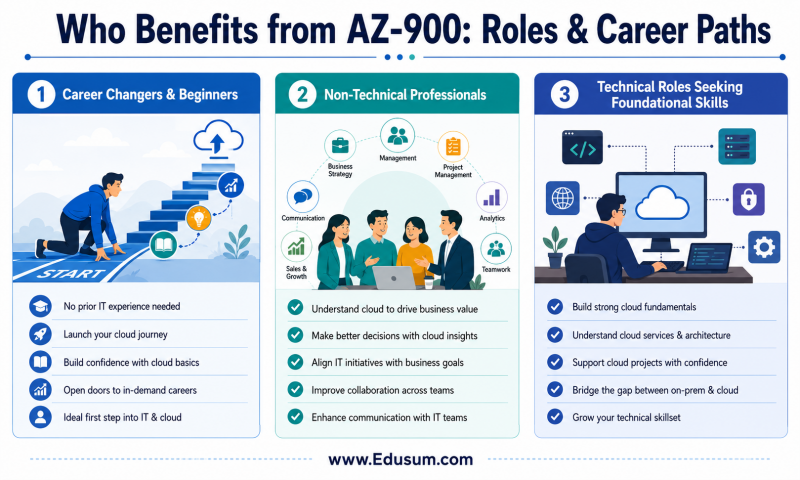
The AZ-900: Microsoft Azure Fundamentals certification is broadly applicable, appealing to a diverse range of professionals. Its foundational nature makes it ideal for anyone seeking an entry point into cloud computing or a clear understanding of Azure. This credential is an excellent choice for a variety of roles and career stages.
Career Changers and Beginners
For individuals new to IT or transitioning from non-technical roles, the AZ-900 offers a structured introduction to cloud concepts without requiring prior technical expertise. It provides the essential vocabulary and understanding needed to participate in cloud-related discussions and projects, making it easier to pivot into cloud support, sales, or entry-level technical roles. The certification validates a commitment to learning new technologies, which is highly valued by employers.
Non-Technical Professionals
Sales and marketing professionals, project managers, business analysts, and even legal or financial experts who work with technology solutions can significantly benefit from the AZ-900. Understanding cloud fundamentals and Azure’s capabilities allows them to better communicate with technical teams, understand product roadmaps, and articulate the business value of cloud solutions. This enhanced understanding fosters better collaboration and more informed decision-making across an organization.
Technical Roles Seeking Foundational Skills
Even experienced IT professionals, such as developers, system administrators, or network engineers, can find value in the AZ-900. It ensures they have a standardized understanding of Azure's core services and architectural components, providing a common baseline for more advanced certifications. For those specializing in other platforms, it offers a quick and efficient way to cross-train and broaden their skill set into the Azure ecosystem.
Advantages of Earning AZ-900 Credential
Obtaining the AZ-900 certification delivers tangible benefits that extend beyond simply passing an exam. It’s an investment in professional development that can significantly impact one’s career trajectory and perception within the tech industry.
Enhanced Job Prospects
In today's cloud-first world, employers actively seek candidates with demonstrable cloud knowledge. The AZ-900 certification serves as a recognized badge, signaling to recruiters and hiring managers that you possess a fundamental understanding of Azure, a critical skill for many entry-level and even some mid-level positions. This can differentiate you in a competitive job market, opening doors to new opportunities in cloud support, cloud administration, or cloud sales roles. Professionals with this certification often find themselves with increased marketability.
Foundation for Advanced Certifications
The AZ-900 is explicitly designed as the first step in the Microsoft Azure certification path. It lays a solid groundwork for pursuing more specialized and advanced credentials, such as the Azure Administrator Associate (AZ-104), Azure Developer Associate (AZ-204), or Azure Solutions Architect Expert (AZ-305). By mastering the fundamentals, candidates build the confidence and knowledge necessary to tackle complex topics, making the journey to higher-level certifications smoother and more achievable. This structured progression helps in long-term career planning within the Azure ecosystem.
Demonstrating Core Competency
Beyond resume enhancement, the certification validates a practical understanding of cloud concepts and Azure services. It proves that an individual can discuss cloud architecture, identify core Azure services, and understand basic management and governance principles. This competency is invaluable in day-to-day operations, allowing certified professionals to contribute more effectively to cloud projects, engage in informed discussions, and troubleshoot basic cloud-related issues with confidence. It transforms theoretical knowledge into a verifiable skill.
Mastering AZ-900 Exam Preparation
Effective preparation is paramount for successfully passing the AZ-900 exam. Given its fundamental nature, a structured approach focusing on understanding core concepts rather than memorization will yield the best results. A wealth of resources is available to aid candidates in their journey.
Official Microsoft Learning Paths
Microsoft provides comprehensive and free learning paths specifically tailored for the AZ-900 exam. These modules cover each exam objective in detail through interactive lessons, quizzes, and hands-on exercises. Utilizing these official resources ensures alignment with the exam content and fosters a deep understanding of Azure fundamentals. Candidates should dedicate sufficient time to work through each module thoroughly, reinforcing learning with practical application. The official learning path can be found on the Microsoft Learn platform.
Leveraging Practice Tests
Practice tests are indispensable tools for AZ-900 exam preparation. They simulate the actual exam environment, helping candidates become familiar with the question formats, time constraints, and overall structure. More importantly, practice tests help identify knowledge gaps, allowing for targeted study on weaker areas. It's crucial to choose reputable practice tests that offer detailed explanations for both correct and incorrect answers, transforming errors into learning opportunities. Edusum provides a valuable set of AZ-900 Microsoft Azure Fundamentals practice test questions to aid in this process.
Online Training Courses
Many online platforms offer structured AZ-900 training courses, often including video lectures, labs, and supplementary materials. These courses can be particularly beneficial for visual learners or those who prefer guided instruction. When selecting a course, look for one that is up-to-date with the latest exam objectives and taught by experienced Azure professionals. Such courses often include practical demonstrations that bring abstract cloud concepts to life, enhancing retention and application.
Community and Study Groups
Engaging with the cloud community through forums, social media groups, or local meetups can provide invaluable support. These platforms offer opportunities to ask questions, discuss challenging concepts, and share study tips with peers. Collaborative learning can clarify doubts and expose candidates to different perspectives, enriching the learning experience. Study groups can also help maintain motivation and accountability, crucial elements in a long-term study plan.
Overcoming Preparation Obstacles for AZ-900
While the AZ-900 is considered a fundamental exam, candidates may still encounter certain challenges during their preparation. Recognizing these common hurdles and adopting effective strategies to overcome them is key to a smooth and successful study journey.
Deciphering Technical Jargon
Cloud computing is replete with acronyms, technical terms, and specialized vocabulary that can initially feel overwhelming, especially for beginners. The sheer volume of new terms related to Azure services, architectural components, and management practices can be a significant barrier.
- Solution: Create a glossary of terms as you study. Regularly review definitions of key Azure services (e.g., VM, Blob Storage, Azure AD), cloud concepts (IaaS, PaaS, SaaS), and architectural components (regions, availability zones). Utilize flashcards or digital quizzing tools to reinforce memorization and understanding. Focus on understanding the purpose and function of each service rather than just its name.
Balancing Study with Daily Commitments
Many AZ-900 candidates are working professionals, students, or individuals with various personal commitments. Finding dedicated time for study amidst a busy schedule can be a major challenge, leading to burnout or inconsistent progress.
- Solution: Develop a realistic study schedule and stick to it. Break down study sessions into manageable chunks (e.g., 30-60 minutes daily) rather than long, infrequent marathon sessions. Utilize commute times, lunch breaks, or early mornings/late evenings for focused study. Consider using productivity techniques like the Pomodoro Technique to maintain focus and prevent exhaustion. Consistency, even in small doses, is more effective than sporadic, intense study periods.
Impact of AZ-900 in the Evolving Job Market
The AZ-900 certification holds significant weight in today's rapidly changing job market, characterized by an increasing demand for cloud proficiency. It's not just a certificate; it's a statement of foundational knowledge that aligns with industry trends and employer needs.
Entry-Level Role Advantages
For those aspiring to entry-level cloud roles, the AZ-900 acts as a powerful differentiator. Positions such as Cloud Support Specialist, Junior Cloud Administrator, or Cloud Sales Associate often benefit greatly from candidates who can demonstrate a basic grasp of Azure. The certification assures employers that a candidate can understand cloud terminology, navigate the Azure portal, and grasp core service offerings, reducing the training burden for new hires. This makes certified individuals more attractive to companies building out their cloud teams.
Broadening Career Horizons
Beyond direct cloud roles, the AZ-900 certification can broaden career horizons for professionals in various other fields. For instance, data analysts can better understand how their data is stored and processed in Azure, while project managers can effectively oversee cloud migration projects. The certification makes professionals more versatile and adaptable, enabling them to pursue opportunities in hybrid IT environments and roles that require interaction with cloud infrastructure, even if their primary function isn't purely cloud-focused. It signals adaptability and a forward-thinking mindset.
Sustaining Professional Growth Beyond AZ-900
Earning the AZ-900 certification is a significant achievement, but it's crucial to view it as the beginning, not the end, of your cloud learning journey. The cloud landscape is dynamic, requiring continuous learning and adaptation.
Stepping Stone to Specialization
The AZ-900 provides the foundational vocabulary and conceptual framework for all subsequent Azure certifications. After validating your fundamental knowledge, you can begin to explore more specialized paths within Azure, aligning with your career interests. This might include becoming an Azure Administrator (AZ-104), an Azure Developer (AZ-204), or an Azure Data Engineer (DP-203), among many others. Each step builds upon the last, deepening your expertise and opening doors to more advanced roles and responsibilities.
Leveraging Microsoft Learn and Community Resources
Microsoft Learn continues to be an invaluable resource for ongoing education, offering free modules for advanced certifications and specialized topics. Beyond formal certifications, engaging with the broader Azure community through blogs, forums, and events can help you stay current with new services and best practices. Attending webinars, participating in hackathons, and contributing to open-source projects can further solidify your skills and expand your professional network, ensuring your knowledge remains relevant and cutting-edge in the ever-evolving cloud domain. Staying informed is a continuous process in cloud technology.
Frequently Asked Questions
1. What is the AZ-900 certification about?
The AZ-900: Microsoft Azure Fundamentals certification validates foundational knowledge of cloud concepts, core Azure services, and Azure management and governance. It's designed for individuals beginning their journey into cloud computing and Microsoft Azure.
2. Is the AZ-900 certification suitable for non-technical individuals?
Yes, the AZ-900 is highly suitable for non-technical individuals, including sales, marketing, and project management professionals. It provides them with a common understanding of cloud terminology and Azure capabilities, facilitating better communication with technical teams.
3. How long does it typically take to prepare for the AZ-900 exam?
Preparation time for the AZ-900 varies depending on prior experience with IT and cloud concepts. Beginners might need 2-4 weeks of focused study, while those with some IT background might prepare in 1-2 weeks by dedicating a few hours daily.
4. What kind of job roles can benefit from an AZ-900 certification?
Many entry-level roles benefit, such as Cloud Support Specialist, Junior Cloud Administrator, and Cloud Sales Associate. It also helps existing professionals like project managers, business analysts, and developers to better understand cloud infrastructure.
5. Is the AZ-900 a prerequisite for other Azure certifications?
While not strictly a mandatory prerequisite for all other Azure certifications, the AZ-900 is strongly recommended as a foundational starting point. It provides the essential understanding needed before pursuing more advanced role-based certifications like Azure Administrator or Azure Developer.
Conclusion
The AZ-900: Microsoft Azure Fundamentals certification stands out as a pivotal credential for anyone aiming to establish a strong presence in the technology sector. It not only solidifies your understanding of essential cloud principles but also specifically details Microsoft Azure's core services and management capabilities. From enhancing job prospects to serving as the essential gateway for advanced Azure certifications, the AZ-900 provides a robust foundation, making cloud concepts accessible and empowering professionals across diverse roles.
For individuals seeking to validate their initial grasp of cloud technology or to officially begin their journey into the Microsoft Azure ecosystem, the AZ-900 offers clear benefits. Preparing for this exam instills confidence and equips you with the fundamental knowledge demanded by today’s employers. Begin your path to Azure mastery and unlock new professional possibilities. Explore comprehensive study materials and prepare for your AZ-900 certification today by visiting AZ-900 exam materials.
- Microsoft Certified - Azure Fundamentals |
- AZ-900 Azure Fundamentals |
- AZ-900 Online Test |
- AZ-900 Questions |
- AZ-900 Quiz |
- AZ-900 |
- Microsoft Azure Fundamentals Certification |
- Azure Fundamentals Practice Test |
- Azure Fundamentals Study Guide |
- Microsoft AZ-900 Question Bank |
- Azure Fundamentals Mock Exam |
- Microsoft Azure Fundamentals Questions |
- Azure Fundamentals |
- Microsoft Azure Fundamentals Practice Test |
- AZ-900 Syllabus |
- Azure Fundamentals Books |
- Azure Fundamentals Certification Syllabus |
- Microsoft AZ-900 Books |
- Microsoft Azure Fundamentals Training |
- Azure Fundamentals Certification Cost |
- Microsoft Azure Fundamentals Books |
- Azure Fundamentals Sample Questions |
- Microsoft AZ-900 Practice Test Free |
- Azure Fundamentals Certification Sample Questions |
- MCF Azure Mock Exam |
- MCF Azure Certification Cost |
- Microsoft MCF Azure Books |
- Microsoft MCF Azure Questions


