
LPIC Certification Guide: Complete LPIC-1 (101-500 & 102-500) Exam Questions, Practice Tests & Study Tips
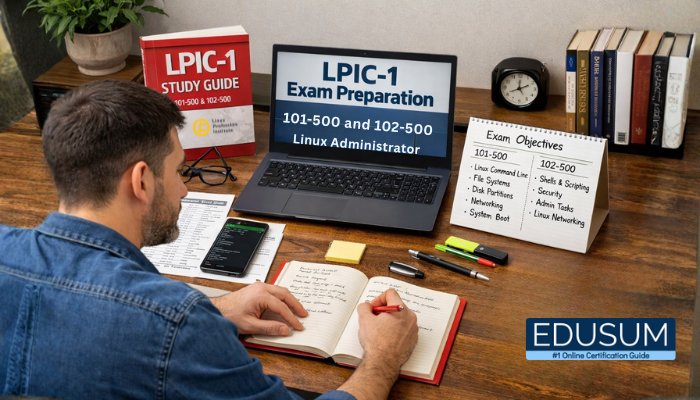
Mastering the Linux command line is often the "make-or-break" moment for modern IT professionals, separating those who simply use technology from those who truly control it. As an experienced IT auditor who has spent years dissecting secure system architectures, I’ve observed that the LPIC certification acts as a universal gold standard, proving you possess the technical depth to manage the complex environments that power today’s global enterprises. Whether you are an aspiring cybersecurity expert or a career changer, obtaining the Linux Professional LPIC-1 credential is your definitive signal to employers that you are ready to handle the rigors of professional Linux administration with confidence and precision.
What Is LPIC Certification and Why It Matters for Linux Professionals
The LPIC-1 certification is the first tier in the LPI’s multi-level Linux professional certification program, designed to validate a candidate's ability to perform maintenance on the command line, install and configure a computer running Linux, and configure basic networking. In 2026, where cloud-native environments and automated infrastructures dominate, having a vendor-neutral certification is more critical than ever. Unlike vendor-specific certs, LPIC-1 demonstrates your proficiency across various distributions, including Debian, Ubuntu, and Red Hat-based systems.
For an IT Auditor or Cybersecurity Analyst, this certification is proof of foundational technical competence. It ensures you understand the underlying file structures and permissions that govern system security. According to the Linux Professional Institute (LPI), this credential is built on real-world job task analysis, making it highly relevant to the current needs of global employers.
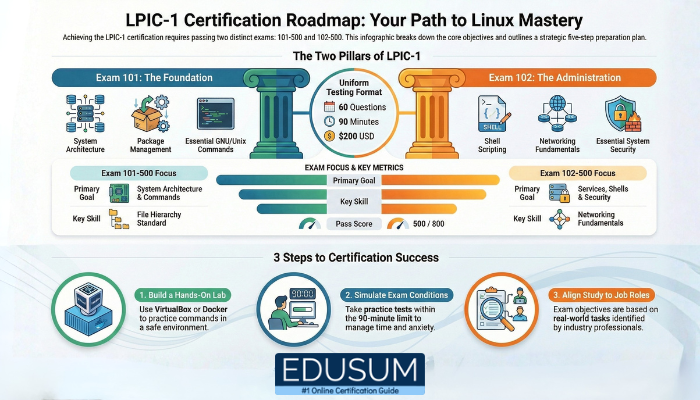
Overview of LPIC-1 Linux Administrator Certification (101-500 & 102-500)
To achieve the Linux Professional LPIC-1 status, candidates must pass two distinct exams: 101-500 and 102-500. These exams are designed to be complementary, covering the full spectrum of junior-level Linux administration.
LPIC-1 Exam 101-500 Summary:
-
Exam Name: LPIC-1 Linux Administrator (Part 1)
-
Duration: 90 minutes
-
Number of Questions: 60 (Multiple-Choice and Fill-in-the-blank)
-
Passing Score: 500 / 800
-
Core Focus: System Architecture, Installation, Package Management, and GNU/Unix commands.
LPIC-1 Exam 102-500 Summary:
-
Exam Name: LPIC-1 Linux Administrator (Part 2)
-
Duration: 90 minutes
-
Number of Questions: 60 (Multiple-Choice and Fill-in-the-blank)
-
Passing Score: 500 / 800
-
Core Focus: Customization, Shell Scripting, Security, and Networking.
Both exams are priced at approximately $200 USD each, depending on your region. Passing both is a prerequisite for receiving your official certificate, which remains valid for five years.
LPIC-1 Exam (101-500 & 102-500) Structure and Key Exam Domains Explained
The exams are meticulously weighted to reflect the importance of each topic in a real-world environment. Understanding these weights helps you prioritize your study time effectively.
101-500 Exam Syllabus Topics:
-
System Architecture (Weight: 8): Focuses on hardware settings, boot processes, and runlevels.
-
Linux Installation and Package Management (Weight: 12): Includes disk partitioning, boot managers (GRUB), and managing shared libraries using Debian (apt) or RPM (yum/dnf) tools.
-
GNU and Unix Commands (Weight: 25): The heaviest section. You must master command-line processing, text filters, and file management.
-
Devices, Linux Filesystems, Filesystem Hierarchy Standard (Weight: 14): Covers mounting filesystems, managing file permissions, and maintaining system integrity.
102-500 Exam Syllabus Topics:
-
Shells and Shell Scripting (Weight: 10): Customizing the shell environment and writing basic bash scripts.
-
User Interfaces and Desktops (Weight: 4): Understanding X11 and accessibility.
-
Administrative Tasks (Weight: 12): Managing user/group accounts and scheduling jobs via cron or at.
-
Essential System Services (Weight: 16): Managing system time, logging (syslog), and Mail Transfer Agents (MTA).
-
Networking Fundamentals (Weight: 14): Configuring IPv4/IPv6, DNS, and basic troubleshooting.
-
Security (Weight: 13): Hardening systems, managing file permissions, and using SSH/GPG.
What is the difference between LPIC-1 101 and 102
| Feature | LPIC-1 101-500 Exam | LPIC-1 102-500 Exam |
|---|---|---|
| Exam Focus | System Foundations & Operations | Administrative Tasks & Services |
| Heaviest Domain | GNU and Unix Commands (25%) | Essential System Services (16%) |
| Key Objective | Managing files, boot process, and packages. | Scripting, networking, and system security. |
| Command Focus | grep, sed, ls, chmod, apt, yum | bash, crontab, ifconfig, ssh, iptables |
| System Level | Hardware and Kernel interaction. | User interface and Network interaction. |
| Practice Resource | 101-500 Prep Path | 102-500 Prep Guide |
Why Understanding the Distinction Matters
-
From an IT audit perspective: 101-500 exam proves you understand how the system starts and stays organized, whereas the 102-500 exam proves you know who can access it and how it communicates.
-
For those focusing on the lpic-1 101-500 path, you are essentially learning the "DNA" of the OS. When you move to the lpic-1 102-500, you are learning how to defend and automate that OS.
LPIC-1 Exam Questions (101-500 & 102-500): What to Expect in the Real Test
Stepping into the testing center for your LPIC certification requires more than just theoretical knowledge; you need to be prepared for the specific format and rigor of the LPI assessment style. Unlike entry-level exams that rely solely on simple multiple-choice patterns, the linux lpic 1 exam questions are designed to simulate real-world administrative decision-making.
The LPI exams utilize a mix of question types that force you to think like a sysadmin rather than a student. Here is a breakdown of what you will encounter during your 90-minute session:
-
Diverse Question Formats: While you will see standard multiple-choice questions, the real challenge lies in the fill-in-the-blank items. These require you to type exact command names, options, or full file paths without the luxury of "Tab-completion."
-
Precision and Syntax: In the lpic 101-500 exam questions, there is a heavy focus on command-line utility syntax. You might be asked to provide the specific flag for grep, sed, or find that performs a case-insensitive search or deletes files older than a certain date. A single typo can be the difference between a pass and a fail.
-
Scenario-Based Troubleshooting: The lpic-1 102-500 exam often moves into the realm of "what would you do?" scenarios. For example, you may be presented with a situation where a user cannot reach a remote server. The question will require you to identify the correct configuration file within /etc/network/ or /etc/sysconfig/ that is causing the bottleneck.
-
Configuration File Paths: Expect to be tested on the exact locations of system files. You won't just be asked what a file does, but where it lives in the Filesystem Hierarchy Standard (FHS).
-
Realistic Difficulty Levels: To ensure you aren't caught off guard by the phrasing, reviewing lpi lpic-1 101-500 certification sample questions is essential. These samples offer a realistic preview of the complexity and the "distractor" answers LPI uses to test your true depth of knowledge.
By simulating the environment with an lpic 1 practice test, you can alleviate the anxiety of the unknown and build the muscle memory needed to type commands accurately under pressure.
How to Pass LPIC-1 101-500 and 102-500 on the First Attempt
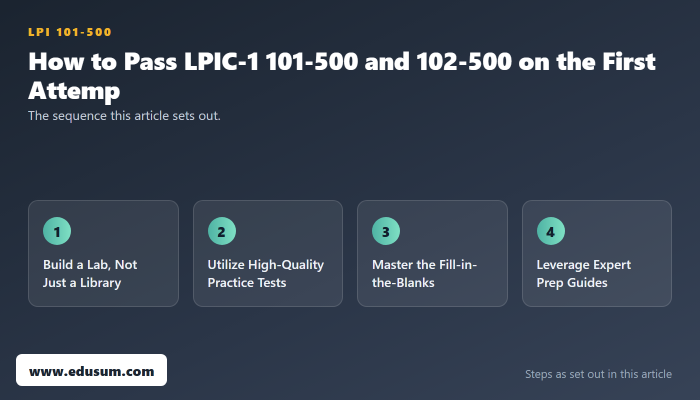
Success in the LPIC-1 journey is 40% theory and 60% muscle memory. Here is a battle-tested strategy:
1. Build a Lab, Not Just a Library
-
Don't just read about fdisk or chmod; execute them. Use a virtual machine (VM) or a cloud instance to practice. If you break it, you learn how to fix it—a skill that is invaluable for the linux lpic 1 exam questions.
2. Utilize High-Quality Practice Tests
-
One of the most common mistakes is overconfidence. Taking an lpic 1 practice test helps you identify "blind spots" in your knowledge. Use resources like the 102-500 lpic-1 exam syllabus to ensure you aren't skipping the low-weight but tricky topics like accessibility or SQL basics.
3. Master the Fill-in-the-Blanks
-
Since the exam requires precise command input, practice typing commands without the help of "tab completion." Memorize absolute paths for configuration files (e.g., /etc/resolv.conf, /etc/passwd).
4. Leverage Expert Prep Guides
-
For a deep dive into structured learning, I recommend checking out this lpi linux administrator 102-500 exam complete prep guide. It breaks down complex networking concepts into digestible chunks. Similarly, understanding the career roadmap with the lpic-1 linux administrator 101-500 path can keep you motivated when the study gets tough.
LPIC-1 vs Other Linux Certifications
In the competitive landscape of 2026, choosing the right certification is about ROI. How does LPIC-1 stack up?
| Feature | LPIC-1 (LPI) | CompTIA Linux+ | RHCSA (Red Hat) |
|---|---|---|---|
| Primary Focus | Vendor-Neutral / Multi-Distro | Vendor-Neutral / Foundational | Red Hat Enterprise Linux (RHEL) |
| Exam Format | Multiple Choice & Fill-in-the-blank | Multiple Choice & Performance-Based | 100% Hands-on Lab Environment |
| Difficulty | Intermediate (Heavy Syntax) | Intermediate (Generalist) | Advanced (Practical Execution) |
| Validity | 5 Years | 3 Years | 3 Years |
| Exams Required | Two (101-500 & 102-500) | One (XK0-005) | One (EX200) |
| Best For | IT Auditors & Career Changers | Aspiring Admins & Helpdesk | Senior Enterprise Admins |
Frequently Asked Questions
Q1. How difficult is the LPIC-1 exam for a beginner?
-
The LPIC-1 exam is considered a mid-level challenge. While it is accessible for beginners, it requires a significant amount of hands-on practice. You cannot pass by just memorizing lpic-1 sample questions; you must understand the "why" behind the commands to handle the fill-in-the-blank sections effectively.
Q2. How much time should I dedicate to preparing for LPIC-1?
-
Most successful candidates spend between 3 to 5 months preparing if they are studying part-time. This includes roughly 60–80 hours of study per exam (101 and 102). Using a structured lpic 1 practice exam can significantly reduce this time by focusing your efforts on weak areas.
Q3. What is the retake policy for LPI exams?
-
If you do not pass the exam on your first attempt, you must wait seven days before retaking it. If you fail a second time, the waiting period increases to 30 days. This makes using an lpic 101 exam questions simulator crucial to ensure you are ready before paying the $200 fee again.
Q4. Is the LPIC-1 certification worth it for a cybersecurity career?
-
Absolutely. In cybersecurity, Linux is the backbone of most servers and security tools (like Kali Linux). Understanding the LPIC certification objectives, such as file permissions and network security, is foundational for anyone looking to become a penetration tester or security auditor in 2026.
Q5. How useful are practice tests for passing the 101-500 and 102-500?
-
Practice tests are vital. They simulate the 90-minute pressure and the specific wording of lpic 101-500 exam questions. They help you get used to the "distractor" answers that LPI often uses, ensuring you can distinguish between similar-looking commands and flags under pressure.
Q6. Can I find the LPIC-1 exam questions in PDF format for offline study?
-
Many students look for an lpic-1 exam questions pdf to study on the go. While PDFs are great for quick review, ensure you supplement them with interactive lpic-1 practice exams to get a feel for the live testing environment provided by platforms like Pearson VUE.
CONCLUSION
The journey to obtaining your LPIC certification is more than just a credential on your LinkedIn profile; it’s a commitment to mastering the open-source world. As the tech landscape shifts toward more specialized roles in AI and DevSecOps, the foundational knowledge provided by Linux Professional LPIC-1 remains the bedrock of a stable and high-paying IT career.
Don't let the complexity of the lpic-1 101-500 or lpic-1 102-500 syllabus intimidate you. With the right tools to comprehensive practice tests you can join the ranks of elite Linux administrators worldwide.
- LPIC-1 Linux Administrator |
- LPI LPIC-1 Certification |
- LPIC-1 Practice Test |
- LPIC-1 Study Guide |
- LPI Certification |
- LPIC-1 Books |
- LPIC-1 Certification Syllabus |
- 101-500 LPIC-1 |
- 101-500 Online Test |
- 101-500 Questions |
- 101-500 Quiz |
- LPI 101-500 Question Bank |
- 101-500 Syllabus |
- LPI 101-500 Books |
- 102-500 LPIC-1 |
- 102-500 Online Test |
- 102-500 Questions |
- 102-500 Quiz |
- LPI 102-500 Question Bank |
- 102-500 Syllabus |
- LPI 102-500 Books |
- LPI Linux Professional Certification


