
C1000-200 Certification Guide: Study Plan, Syllabus, and Proven Exam Success Tips

Enterprise messaging systems are the central nervous system of modern business operations. When message delivery fails or latency spikes, the financial and operational impact is immediate. For IT professionals tasked with maintaining these critical environments, the IBM Certified MQ v9.4 Administrator - Professional (C1000-200) certification is the gold standard of validation.
Achieving this credential proves you possess the technical proficiency to plan, install, configure, and troubleshoot IBM MQ v9.4 solutions. However, the path to passing the C1000-200 exam requires more than just years of experience; it demands a structured approach, a deep understanding of the updated syllabus, and rigorous practice. This guide provides the blueprint you need to navigate this journey and come out successful.
Understanding the C1000-200 Exam Structure
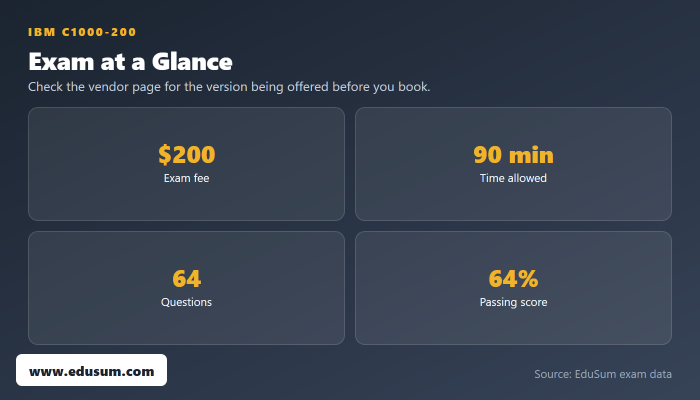
Before diving into technical manuals, you must understand the "rules of the game." The C1000-200 Certification is designed to test professional-level skills. It doesn't just ask "what" a feature is; it asks "how" and "why" you would implement it in a production environment.
|
Exam Detail |
Specifications |
|---|---|
|
Exam Name |
IBM Certified MQ v9.4 Administrator - Professional |
|
Exam Code |
C1000-200 |
|
Duration |
90 Minutes |
|
Number of Questions |
64 |
|
Passing Score |
64% |
|
Exam Fee |
$200 USD |
Knowing these metrics helps you pace your preparation. With 64 questions in 90 minutes, you have roughly 84 seconds per question. This underscores the need for not just accuracy, but speed - something only achieved through familiarity with the exam format.
The C1000-200 exam balances time and complexity. Success depends on a combination of theoretical knowledge and the ability to apply it under pressure.
Decoding the C1000-200 Syllabus: A Domain-by-Domain Analysis
The C1000-200 syllabus is divided into seven distinct sections. Each carries a specific weight, signaling where you should focus your heaviest study efforts. Let’s break down what IBM expects you to master in each domain.
1. Architecture, Planning, and Availability (16%)
This domain focuses on the "big picture." You must understand how to design an MQ environment that is both scalable and resilient.
-
High Availability (HA): Familiarize yourself with Replicated Data Queue Managers (RDQM) and multi-instance queue managers.
-
Disaster Recovery: Understand the mechanisms for data replication and recovery across geographical sites.
-
Uniform Clusters: Study how v9.4 handles intelligent workload balancing across clusters to ensure zero-downtime application connectivity.
2. Installation and Configuration (17%)
Administration begins with a solid foundation. You are expected to know the nuances of deploying IBM MQ on various operating systems.
-
Installation Methods: Know the difference between interactive and silent installations.
-
Migration: Understand the path from older versions (like v9.2 or v9.3) to v9.4, including the prerequisites and potential pitfalls.
-
Default Objects: Be able to configure queue managers, queues, and namelists from scratch using MQSC commands.
3. Messaging Concepts and Connectivity (17%)
This is the core of MQ operations. It covers how data moves from Point A to Point B.
-
Channel Types: Master the configuration of Sender, Receiver, Cluster-Sender, and Cluster-Receiver channels.
-
Distributed Queuing: Understand how queue managers communicate across networks.
-
Client Connectivity: Learn to manage client-connection and server-connection definitions, particularly for containerized or cloud-native applications.
4. Security (12%)
Security is a non-negotiable skill for modern administrators. The C1000-200 Exam tests your ability to lock down the messaging environment.
-
Object Authority Manager (OAM): Know how to grant and revoke permissions for users and groups.
-
TLS/SSL: Understand how to implement certificate-based encryption for data in transit.
-
Channel Authentication (CHLAUTH): Master the rules that control which IP addresses or users can access specific channels.
5. Performance Monitoring and Observability (17%)
How do you know the system is healthy? This section focuses on tools and metrics.
-
Resource Monitoring: Use MQ Explorer or command-line tools to monitor queue depths and CPU usage.
-
Observability: v9.4 emphasizes better logging and streaming. Understand how to use the REST API for monitoring and how to integrate with external tools like Prometheus or Grafana.
6. Troubleshooting and Tuning (14%)
When things go wrong, the administrator is the first responder.
-
Log Analysis: Be proficient in reading error logs and FDC files.Dead Letter Queues (DLQ): Know how to handle messages that cannot be delivered.
-
Tuning: Understand how to adjust buffer sizes, log file sizes, and persistent message settings to optimize throughput.
7. Optional Components (7%)
While smaller in weight, these topics can be the difference between a pass and a fail.
-
Managed File Transfer (MFT): Basic configuration and management of file-to-message transfers.
-
Advanced Message Queuing Protocol (AMQP): Understanding how MQ interacts with lightweight messaging protocols.
Focus on the "Connectivity" and "Installation" sections first. Together with "Performance Monitoring," they account for over 50% of the exam content. Refer to the official IBM certification page for the most current documentation updates.
Building a Structured 6-Week Study Plan
One of the biggest mistakes candidates make is "cramming." Technical certifications like the C1000-200 Certification require time for concepts to settle. Here is a proven 45-day structured plan.
Week 1: Foundations and Installation
-
Focus: Architecture and Installation domains.
-
Tasks: Install IBM MQ v9.4 in a lab environment. Practice side-by-side installations and version migrations.
Review the IBM MQ v9.4 Professional Learning Path.
Week 2: Connectivity and Messaging
-
Focus: Distributed queuing and clusters.
-
Tasks: Create a cluster of three queue managers. Practice moving messages between them using different channel types.
-
Tip: Use MQSC commands (runmqsc) rather than the GUI to build "muscle memory" for the exam.
Week 3: Security Hardening
-
Focus: OAM, TLS, and CHLAUTH.
-
Tasks: Configure a secure channel using self-signed certificates. Test how CHLAUTH rules block unauthorized access.
Review the detailed IBM MQ syllabus breakdown for specific security sub-topics.
Week 4: Performance and Observability
-
Focus: Monitoring tools and tuning.
-
Tasks: Simulate a "full queue" scenario and practice clearing the DLQ. Use the MQ REST API to pull performance metrics.
Week 5: Advanced Topics and Troubleshooting
-
Focus: Tuning, MFT, and Troubleshooting.
-
Tasks: Practice reading FDC files. Learn to identify the common "Return Codes" (e.g., 2035 - Not Authorized, 2085 - Unknown Object Name).
Week 6: Practice and Polish
-
Focus: Simulation and speed.
-
Tasks: Take full-length C1000-200 Practice Tests. Focus on areas where you consistently miss questions.
Utilize C1000-200 Sample Questions to gauge your readiness.
Why Practice Exams Are Your Secret Weapon
You can read every manual in the IBM Redbook library, but the exam environment is a different beast. C1000-200 Practice Tests serve several critical functions that traditional reading cannot match.
-
Simulating the Pressure: A 90-minute timer changes how you think. Practice tests help you manage "exam anxiety" by making the format feel routine.
-
Identifying Knowledge Gaps: You might think you understand TLS, but a practice question about "CipherSpec compatibility" might reveal a blind spot.
-
Understanding Question Phrasing: IBM often uses "scenario-based" questions. Practice exams teach you how to parse these scenarios to find the actual technical requirement being asked.
-
Improving Retention: The act of recalling information to answer a question creates stronger neural pathways than passive reading.
For the most realistic experience, the C1000-200 premium practice exam on EduSum is highly recommended. It provides a platform that mirrors the actual exam interface, ensuring no surprises on test day.
Career Opportunities: Why This Certification Matters
Is the $200 investment and weeks of study worth it? In the current IT landscape, the answer is a resounding yes.
-
Global Demand: IBM MQ is the backbone of the banking, insurance, and retail sectors. Companies are constantly looking for certified professionals to manage these high-stakes environments.
-
Salary Growth: Certified Administrators often command significantly higher salaries than their uncertified counterparts. According to industry surveys, IBM certification can increase earning potential by 15-20%.
-
Professional Authority: Having "IBM Certified" on your LinkedIn profile immediately establishes you as a subject matter expert. It provides stakeholders with confidence in your ability to manage their infrastructure.
Frequently Asked Questions (FAQ)
Q: What is the passing score for the C1000-200 exam?
A: To pass the C1000-200 exam, you must achieve a score of at least 64%. This translates to correctly answering roughly 41 out of the 64 questions.
Q: Can I take the C1000-200 exam online?
A: Yes, IBM certifications are typically offered through Pearson VUE, which provides both in-person testing at authorized centers and online proctored exams.
Q: Does the C1000-200 certification expire?
A: IBM certifications generally do not have a hard expiration date. However, as new versions of software are released (e.g., v10.x), the relevance of the v9.4 certification may decrease, and professionals are encouraged to upgrade.
Q: How much does the C1000-200 exam cost?
A: The standard fee for the IBM Certified MQ v9.4 Administrator - Professional exam is $200 USD, though prices may vary slightly by region and local taxes.
Q: What are the best resources for C1000-200 preparation?
A: The best resources include the Official IBM Study Guide, hands-on lab experience with MQ v9.4, and verified C1000-200 Practice Tests from EduSum.
Conclusion: Your Success Starts Here
The C1000-200 Certification is more than just a piece of paper; it is a testament to your dedication and technical mastery of IBM MQ v9.4. By following a structured C1000-200 Study Plan, deeply engaging with the syllabus, and validating your knowledge through practice, you can approach your exam date with absolute confidence. Don't leave your career progression to chance. Start your journey today by setting up your lab, reviewing the documentation, and testing your skills. Your future as a certified IBM professional is just 64 questions away.
- IBM Certified MQ v9.4 Administrator - Professional |
- C1000-200 MQ Administrator Professional |
- C1000-200 Online Test |
- C1000-200 Questions |
- C1000-200 Quiz |
- C1000-200 |
- IBM MQ Administrator Professional Certification |
- MQ Administrator Professional Practice Test |
- MQ Administrator Professional Study Guide |
- IBM C1000-200 Question Bank |
- MQ Administrator Professional Certification Mock Test |
- MQ Administrator Professional Mock Exam |
- IBM MQ Administrator Professional Questions |
- IBM MQ Administrator Professional Practice Test |
- C1000-200 Syllabus |
- MQ Administrator Professional Books |
- MQ Administrator Professional Certification Syllabus |
- IBM C1000-200 Books |
- IBM MQ Administrator Professional Training |
- MQ Administrator Professional Certification Cost |
- IBM MQ Administrator Professional Books |
- MQ Administrator Professional Sample Questions |
- IBM C1000-200 Practice Test Free |
- MQ Administrator Professional Certification Sample Questions


