
PCES Certification: The New Benchmark for Entry-Level Security

The Python Institute Certified Entry-Level Security Specialist with Python (PCES) certification stands as a critical credential for individuals embarking on a cybersecurity career, particularly those leveraging the versatility of Python. This certification, offered by the Python Institute, validates foundational knowledge in cybersecurity alongside practical Python scripting skills essential for security operations and secure development. For employers seeking to staff their security teams with competent and immediately impactful entry-level talent, the PCES offers a reliable benchmark. This article delves into the core value proposition of the PCES for hiring managers, exploring its comprehensive coverage, the practical skills it validates, and the strategic advantages of integrating PCES-certified professionals into modern security infrastructures. Further details on the Python Institute PCES certification are available on the Python Institute PCES certification overview page.
Validating Foundational Cybersecurity Expertise with PCES
The cybersecurity landscape demands a blend of theoretical understanding and practical application, a gap the Python Institute PCES certification aims to bridge at the entry level. This credential signifies that a candidate possesses not only a basic grasp of security principles but also the ability to apply Python for crucial security tasks. For organizations, this means hiring individuals who can contribute from day one, equipped with a relevant and in-demand skill set that directly addresses contemporary security challenges. The PCES acts as a pre-screening mechanism, assuring employers of a candidate's readiness for roles requiring hands-on problem-solving in a security context.
The certification underscores the importance of a structured approach to learning cybersecurity, moving beyond mere theoretical concepts to practical, tool-agnostic capabilities. It instills confidence in employers that certified professionals understand the operational aspects of security, including identifying vulnerabilities, implementing basic protections, and contributing to incident response efforts. This foundational validation is key in a market often saturated with applicants lacking demonstrable skills.
Bridging Theory and Practical Application
The PCES curriculum is designed to equip candidates with a solid theoretical foundation in security essentials, covering concepts like risk management, cryptography basics, and network security. More importantly, it integrates the practical application of these concepts through Python programming. This dual focus ensures that professionals are not just aware of security threats but are also capable of scripting solutions, automating tasks, and analyzing security data effectively.
For employers, this translates into a workforce that can:
- Implement basic security controls: Understand and apply fundamental safeguards.
- Automate routine security tasks: Leverage Python to streamline repetitive processes, freeing up senior staff for more complex issues.
- Perform initial incident analysis: Use scripting to collect and analyze data during security incidents.
- Contribute to secure code development: Identify and mitigate common coding vulnerabilities.
These immediate capabilities make PCES-certified individuals highly valuable additions to any security team, reducing the need for extensive initial training.
Understanding the PCES Certification Framework
The Python Institute Certified Entry-Level Security Specialist with Python (PCES) examination is structured to thoroughly assess an individual's readiness for an entry-level security role. Knowing the specifics of the exam helps employers appreciate the rigor involved in achieving this credential. The exam focuses on a balanced evaluation of cybersecurity theory and Python application.
The PCES exam is a timed assessment, designed to be challenging yet fair for entry-level candidates. It ensures that those who pass have a practical, working knowledge of the subject matter, making them valuable assets to any organization's security posture. For comprehensive details, the official certification page provides further insights.
Examination Structure and Requirements
The PCES examination follows a defined structure, which includes:
| Exam Detail | Information |
|---|---|
| Exam Name | Python Institute Certified Entry-Level Security Specialist with Python (PCES) |
| Exam Code | PCES |
| Exam Price | $69 (USD) |
| Duration | 60 minutes |
| Number of Questions | 45 |
| Passing Score | 75% |
This structure indicates a focused assessment, requiring candidates to be efficient and accurate in their responses across a variety of topics. The relatively short duration combined with a significant number of questions suggests a need for rapid recall and practical problem-solving skills, rather than extensive deep dives into complex theoretical scenarios.
Core Areas of Evaluation in PCES
The syllabus for the PCES exam covers four key domains, each weighted to reflect its importance in an entry-level security role. These domains ensure that certified professionals have a well-rounded understanding of the security landscape and Python's place within it. Employers can review the official syllabus breakdown for a full understanding.
The weighted distribution of topics is as follows:
| Domain | Weight | Description |
|---|---|---|
| Security Essentials | 22% | This section covers fundamental cybersecurity concepts, including threat types, vulnerabilities, basic security principles, and common attack vectors. It establishes the baseline knowledge required to understand the broader security context. |
| IT Systems Security | 27% | Focuses on securing various components of IT infrastructure, such as operating systems, networks, and applications. Topics include access control, authentication, network protocols, and firewalls, offering practical insights into protecting digital assets. |
| Python for Security Operations | 29% | This is a core domain emphasizing the direct application of Python in cybersecurity. It includes scripting for automation, data parsing, log analysis, network scanning basics, and simple penetration testing tools, showcasing practical security scripting abilities. |
| Secure Development and Implementation in Python | 22% | This domain highlights the importance of secure coding practices. It covers common Python vulnerabilities (e.g., injection, deserialization issues), best practices for writing secure Python code, and the use of security libraries, ensuring candidates can build more resilient applications. |
This balanced approach confirms that PCES-certified individuals have both the contextual knowledge and the technical skills to contribute to a secure environment.
Empowering Security Operations Through Python Skills
The integration of Python into daily security operations is no longer a luxury but a necessity. The PCES certification explicitly validates a professional's ability to harness Python for enhancing an organization's security posture. This includes automating repetitive tasks, performing basic data analysis, and developing simple security tools, all of which are crucial for efficient security management. For employers, this means reduced manual effort, faster response times, and the ability to scale security capabilities without proportional increases in human resources.
PCES-certified individuals bring a unique blend of coding proficiency and security awareness, enabling them to contribute meaningfully to various operational aspects. Their skills allow for more dynamic and adaptive security practices, moving away from static, reactive approaches towards proactive and automated defense mechanisms. This proficiency is particularly valuable in environments where security teams are often understaffed and overburdened by routine tasks.
Automating Routine Security Workflows
Many security tasks are repetitive and time-consuming, diverting valuable human resources from more strategic initiatives. PCES-certified professionals can use Python to automate these workflows, leading to significant operational efficiencies. Examples include:
- Log Parsing and Analysis: Scripting to automatically parse large volumes of log data, extract relevant information, and identify anomalies or potential threats.
- Vulnerability Scanning Automation: Developing scripts to automate the execution of basic vulnerability scans and process their outputs, providing quicker insights into system weaknesses.
- Configuration Management: Writing scripts to enforce security configurations across multiple systems, ensuring consistency and compliance.
- Threat Intelligence Feeds Integration: Automating the collection and integration of threat intelligence from various sources, enhancing proactive defense capabilities.
Such automation not only saves time but also reduces the likelihood of human error, leading to more robust and consistent security operations.
Leveraging Python for Data-Driven Security
Python's strength in data manipulation and analysis makes it an invaluable tool for security teams. PCES-certified professionals can apply these skills to interpret security data, identify trends, and make informed decisions. This capability is critical in today's data-rich security environments, where understanding patterns is key to identifying sophisticated threats.
The certification emphasizes practical applications such as:
- Incident Response Data Collection: Quickly gathering data from compromised systems using Python scripts to aid in forensic analysis.
- Network Traffic Analysis: Developing custom scripts to analyze network packet captures for suspicious activities or policy violations.
- Malware Analysis Support: Using Python to automate the extraction of metadata from malware samples or to facilitate dynamic analysis environments.
- Security Reporting: Automating the generation of custom security reports based on collected data, providing stakeholders with timely and relevant information.
These skills allow for a more analytical approach to cybersecurity, moving beyond alert fatigue to actionable intelligence.
Strategic Benefits of Hiring PCES-Certified Professionals
The decision to hire Python Institute PCES-certified professionals offers multiple strategic advantages for organizations striving to enhance their cybersecurity posture. From ensuring a baseline of competence to fostering innovation in security practices, the credential provides tangible value. Employers gain a reliable indicator of foundational skill and a commitment to professional development, essential traits in rapidly evolving tech environments.
Beyond the immediate technical capabilities, these certified individuals contribute to a culture of security awareness and continuous improvement within a team. Their validated skills mean less time spent on remedial training and more time on active defense and threat mitigation. This efficiency is a direct return on investment for any organization prioritizing robust cybersecurity.
Reduced Onboarding and Training Overhead
One of the most significant benefits for employers is the reduced time and cost associated with onboarding and training new security hires. PCES certification acts as a pre-validated skill badge, confirming a candidate's readiness for entry-level tasks. This means:
- Faster Time to Contribution: New hires can begin contributing to projects and operational tasks much sooner, accelerating team productivity.
- Lower Training Costs: Less need for extensive foundational training as core concepts and Python application are already covered.
- Consistent Skillset: Assurance that all PCES-certified individuals meet a standardized level of competency, simplifying team integration.
This efficiency allows organizations to deploy resources more effectively, focusing training efforts on specialized tools and advanced methodologies rather than basic principles.
Enhanced Security Posture and Proactive Defense
PCES-certified professionals contribute directly to strengthening an organization's overall security posture. Their understanding of security essentials, combined with Python scripting, enables them to participate in developing and maintaining proactive defense mechanisms. This includes identifying potential vulnerabilities, assisting in the implementation of security controls, and contributing to threat hunting efforts.
Their capabilities foster an environment where:
- Vulnerabilities are Addressed Proactively: Python skills can be used for rapid prototyping of defensive measures or for automating vulnerability checks, moving from reactive patching to proactive prevention.
- Incident Response is More Agile: The ability to quickly write scripts for data collection or analysis during an incident enhances response speed and effectiveness.
- Security Measures are Scalable: Automated solutions built with Python can be scaled across the enterprise, providing consistent protection without manual intervention.
- Compliance is Streamlined: Python can be leveraged to automate compliance checks and reporting, simplifying adherence to regulatory requirements.
By integrating these professionals, organizations can build a more resilient and responsive security framework, as detailed in the detailed exam syllabus.
Cultivating a Secure Software Development Lifecycle
Beyond direct security operations, the PCES certification places significant emphasis on secure development practices using Python. This aspect is increasingly vital as software forms the backbone of modern businesses, and vulnerabilities introduced during development can have catastrophic consequences. Hiring PCES-certified individuals means integrating security awareness into the software development lifecycle (SDLC) from the ground up, moving security left in the development process.
These professionals understand that security is not an afterthought but an integral part of every development phase, from design to deployment. Their Python skills enable them to implement secure coding standards, perform code reviews for common vulnerabilities, and contribute to building more robust and resilient applications. This proactive approach significantly reduces the risk and cost of addressing security flaws post-deployment.
Integrating Security into Development Workflows
PCES-certified specialists are trained to identify and mitigate common vulnerabilities that arise during the software development process. They can leverage Python to implement security best practices directly into code, perform automated security checks, and contribute to secure architecture design. This integration is crucial for building applications that are secure by design.
Their contributions include:
- Writing Secure Python Code: Applying secure coding guidelines and principles from the outset, minimizing the introduction of common vulnerabilities.
- Performing Code Reviews for Security: Assisting in reviewing Python codebases to identify potential security flaws like injection vulnerabilities, insecure deserialization, or weak authentication mechanisms.
- Utilizing Security Libraries and Frameworks: Understanding and implementing Python security libraries and frameworks to enhance application protection.
- Participating in Threat Modeling: Contributing to the process of identifying potential threats and vulnerabilities in system designs before development begins.
By having such expertise embedded within development teams, organizations can build stronger, more trustworthy applications, reducing long-term security debt.
Approaching Preparation for the Python Institute PCES Exam
Aspiring cybersecurity professionals considering the Python Institute PCES certification must embark on a structured and disciplined preparation journey. The exam demands not only a grasp of theoretical security concepts but also practical proficiency in Python scripting for security tasks. A well-planned study regimen, focusing on official resources and hands-on practice, is crucial for success. This proactive approach ensures candidates are truly ready for the challenges of an entry-level security role.
Effective preparation involves more than just memorizing facts; it requires understanding how to apply Python to solve real-world security problems. Therefore, candidates should prioritize practical exercises and projects that reinforce theoretical knowledge. This readiness significantly benefits employers, as it confirms a candidate’s commitment to mastering necessary skills and adhering to professional standards.
Effective Study Strategies for PCES Success
Candidates for the PCES exam should adopt a multifaceted study approach to cover the broad syllabus effectively. This includes reviewing theoretical concepts, extensive Python practice, and familiarizing themselves with common security tools.
Key strategies include:
- Mastering Python Fundamentals: A strong foundation in Python programming is non-negotiable, particularly for scripting, data manipulation, and basic networking functions relevant to security.
- Reviewing Security Concepts: Thoroughly understanding the core principles of cybersecurity, IT systems security, and secure development as outlined in the exam objectives.
- Hands-on Practice: Engaging in practical labs, coding challenges, and small security projects that apply Python to scenarios like log parsing, network scanning, or simple vulnerability detection.
- Leveraging Official Resources: Utilizing any study guides, documentation, or practice tests provided or recommended by the Python Institute to align with the exam's focus.
Consistent practice and incremental learning are more effective than last-minute cramming, ensuring deep understanding and retention of complex topics. Candidates should also consult the official testing policies for crucial exam rules and guidelines.
Avoiding Unethical Preparation Methods
In the pursuit of certification, some candidates might be tempted by "exam dumps" or unauthorized study materials. However, ethical preparation is paramount for both the individual's long-term career success and the integrity of the certification. Relying on such unethical resources undermines the learning process, provides a false sense of security, and can lead to disqualification or revocation of the certification.
Organizations value candidates who achieve certifications through legitimate effort, demonstrating true competence and integrity. Employers view certifications as indicators of reliable skills, and this trust is compromised when unethical practices are involved. Focus on understanding the material and developing genuine skills, which will serve you well throughout your professional journey. Ethical preparation builds a foundation of knowledge that withstands scrutiny and adapts to evolving threats.
Career Trajectories for PCES Certified Specialists
Achieving the Python Institute PCES certification opens doors to various entry-level cybersecurity roles, providing a strong foundation for a specialized career path. This credential signals to employers that an individual possesses the fundamental knowledge and practical Python skills necessary for contributing to security teams. Certified professionals are well-positioned for roles that require initial threat analysis, vulnerability assessment support, and the automation of security tasks, laying the groundwork for significant career growth within the cybersecurity domain.
The PCES acts as a launchpad, enabling professionals to specialize further in areas such as security analysis, incident response, penetration testing, or secure software development. Its broad coverage of security principles, combined with a practical programming focus, makes it highly relevant across the industry. Employers recognize this versatility, seeing PCES holders as adaptable and trainable assets who can evolve with the dynamic threat landscape.
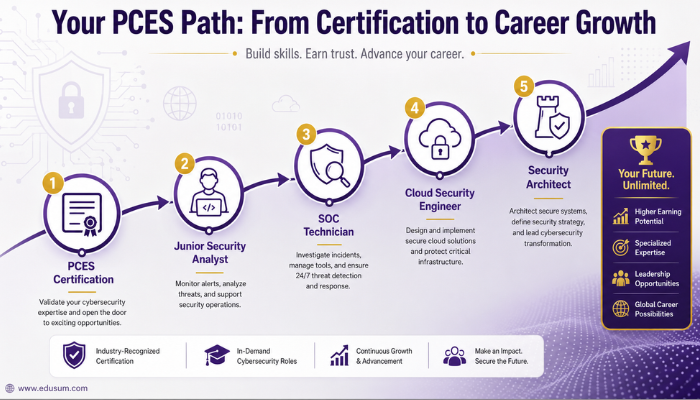
Entry-Level Roles Benefiting from PCES Certification
PCES certification is particularly valuable for individuals targeting specific entry-level positions where Python proficiency and basic security understanding are key requirements. These roles are critical for supporting larger security teams and for building out robust defense mechanisms.
Some common roles include:
- Junior Security Analyst: Assisting in monitoring security systems, analyzing logs, and contributing to incident detection and initial response efforts. Python skills are crucial for automating log analysis and data correlation.
- Security Operations Center (SOC) Technician: Performing tier-1 incident triage, basic vulnerability scanning, and implementing security policies. Scripting helps in streamlining repetitive monitoring tasks.
- Associate Penetration Tester: Supporting senior testers by automating reconnaissance tasks, writing simple scripts for vulnerability identification, and assisting in report generation.
- Junior Security Developer: Focusing on integrating security into software development, reviewing code for vulnerabilities, and developing secure components with Python.
- Cybersecurity Intern: Providing support across various security functions, often tasked with scripting for automation, data collection, or research purposes.
These roles offer practical experience and a pathway to more advanced cybersecurity specializations, with the PCES serving as a strong starting point.
Advancing in Cybersecurity with a Python Foundation
The skills validated by PCES are foundational and transferable, enabling certified professionals to build upon their expertise and pursue advanced certifications and roles. A solid understanding of Python in a security context is a competitive advantage for long-term career progression.
Career advancement opportunities include:
- Specialized Security Roles: Transitioning into roles focused on cloud security, application security, or network security, where Python remains a critical automation and analysis tool.
- Higher-Level Certifications: Pursuing more advanced certifications from the Python Institute or other vendors, building on the PCES foundation.
- Leadership Positions: Over time, gaining experience and expertise can lead to roles as lead security engineers, security architects, or even CISO positions, where strategic automation and secure development practices are paramount.
The PCES certification ensures that professionals start their careers with a highly relevant and future-proof skill set, enabling continuous learning and adaptation in the dynamic field of cybersecurity.
Conclusion
The Python Institute PCES certification emerges as a vital credential for entry-level cybersecurity professionals, meticulously validating a potent blend of foundational security knowledge and indispensable Python scripting skills. For organizations, this means access to a talent pool capable of immediate contributions, skilled in automating security tasks, assisting in threat detection, and fostering secure development practices. Investing in PCES-certified individuals directly translates to enhanced operational efficiency, a more robust security posture, and a proactive approach to mitigating cyber threats.
Embracing PCES-certified talent allows companies to build resilient and adaptable security teams, equipped to face the complexities of today's digital threats. It underscores a commitment to practical, relevant skills that drive real-world security outcomes.
For those looking to bolster their security teams with competent and future-ready professionals, exploring the PCES certification as a benchmark is a strategic imperative. To further understand the caliber of skills validated by this exam and to assess candidate readiness, consider exploring comprehensive PCES practice questions available to guide your hiring and training strategies.
Frequently Asked Questions
1. What is the Python Institute PCES certification designed for?
The Python Institute PCES certification is designed for entry-level cybersecurity professionals, validating their foundational knowledge in security principles and practical skills in applying Python for security operations and secure development.
2. How does PCES benefit employers in hiring decisions?
For employers, PCES acts as a benchmark, indicating that candidates possess a verified blend of cybersecurity theory and practical Python scripting. This reduces onboarding time, ensures a baseline of competence, and supports immediate contribution to security teams.
3. What core skills does the PCES exam validate?
The PCES exam validates skills across security essentials, IT systems security, Python for security operations (e.g., automation, analysis), and secure development and implementation in Python.
4. Is Python knowledge crucial for passing the PCES exam?
Yes, Python knowledge is crucial. A significant portion of the PCES exam focuses on the practical application of Python for cybersecurity tasks and secure development, making it a central component of the certification.
5. What kind of career opportunities can PCES certification open?
PCES certification can open doors to entry-level roles such as Junior Security Analyst, SOC Technician, Associate Penetration Tester, and Junior Security Developer, providing a solid foundation for career growth in cybersecurity.
- Python Institute Certified Entry-Level Security Specialist with Python (PCES) |
- PCES Entry-Level Security Specialist with Python |
- PCES Online Test |
- PCES Questions |
- PCES Quiz |
- PCES |
- Python Institute Entry-Level Security Specialist with Python Certification |
- Entry-Level Security Specialist with Python Practice Test |
- Entry-Level Security Specialist with Python Study Guide |
- Python Institute PCES Question Bank |
- Entry-Level Security Specialist with Python Certification Mock Test |
- PCES-30-01 Mock Exam |
- Python Institute PCES-30-01 Questions |
- PCES-30-01 |
- Python Institute PCES-30-01 Practice Test |
- PCES Syllabus |
- Entry-Level Security Specialist with Python Books |
- Entry-Level Security Specialist with Python Certification Syllabus |
- Python Institute Security Certification |
- Python Institute PCES Books |
- Python Institute Entry-Level Security Specialist with Python Training |
- PCES-30-01 Certification Cost |
- Python Institute PCES-30-01 Books |
- Python Institute Certification


