
Is CompTIA SecAI+ Your Next Career Move?

CompTIA SecAI+ (CY0-001) emerges as a pivotal certification for cybersecurity professionals looking to integrate artificial intelligence (AI) and machine learning (ML) into their security operations and strategies. This credential validates a candidate's ability to secure AI systems, leverage AI for enhanced security, and manage AI-related governance, risk, and compliance within an enterprise. It is ideally suited for security analysts, engineers, and architects who are keen to develop expertise in defending against AI-driven threats and utilizing AI as a powerful security tool. This comprehensive article delves into the core aspects of CompTIA SecAI+, its career implications, preparation strategies, and why it might be the critical next step in your professional journey.
Grasping the CompTIA SecAI+ Certification Purpose
The CompTIA SecAI+ certification is designed to bridge the growing gap between advanced AI technologies and the critical need for robust cybersecurity. As organizations increasingly adopt AI and machine learning for various operations, securing these complex systems becomes paramount. This certification addresses the unique security challenges posed by AI, from data poisoning and model evasion to ensuring the ethical and compliant deployment of AI within a security framework. It signifies a professional's readiness to tackle both securing AI models and using AI tools to fortify traditional cybersecurity defenses. The goal is to equip practitioners with the advanced skills necessary to operate at the intersection of AI and cybersecurity, a domain rapidly expanding in importance.
Why AI Skills Matter in Cybersecurity
The landscape of cyber threats is evolving at an unprecedented pace, driven partly by the sophistication of AI-powered attacks and the sheer volume of data involved in modern systems. Traditional rule-based security solutions often struggle to keep up with polymorphic malware, zero-day exploits, and intelligent adversaries. Possessing AI skills enables cybersecurity professionals to develop, implement, and manage next-generation security tools capable of adaptive threat detection, automated response, and predictive analytics. This expertise is no longer a luxury but a fundamental requirement for building resilient security postures. Professionals with these skills can proactively identify vulnerabilities in AI models and build robust defenses.
Validated Competencies for Security Professionals
Achieving the CompTIA SecAI+ certification signifies that an individual possesses a distinct set of capabilities crucial for today's dynamic threat environment. It validates the understanding and application of concepts such as:
-
AI System Security: Implementing safeguards for AI/ML models against adversarial attacks, ensuring data integrity, and protecting model intellectual property.
-
AI-Assisted Security Operations: Deploying AI tools for tasks like anomaly detection, threat intelligence correlation, security orchestration, automation, and response (SOAR).
-
Data Privacy & Ethics: Addressing privacy concerns related to AI training data and ensuring AI systems adhere to ethical guidelines and regulatory standards.
-
Risk Management: Identifying and mitigating risks associated with AI deployment, including bias, transparency, and accountability issues in security applications.
These competencies are vital for anyone involved in designing, managing, or auditing AI-integrated security solutions, positioning them as valuable assets in any organization.
Dissecting the CompTIA SecAI+ Exam (CY0-001) Structure
Understanding the format and specifics of the CompTIA SecAI+ (CY0-001) exam is the first step towards effective preparation. This certification exam is designed to rigorously test a candidate's practical knowledge and theoretical understanding across various critical domains of AI in cybersecurity. Familiarity with these details helps candidates mentally prepare for the examination experience and allocate study time efficiently. Knowing what to expect on exam day reduces anxiety and allows for better performance under pressure, ensuring candidates can fully demonstrate their acquired expertise.
Key Examination Specifications
The CompTIA SecAI+ exam, identified by the code CY0-001, features a structured format designed to assess a broad range of AI and cybersecurity competencies within a specific timeframe.
-
Exam Price: The cost to take the exam is $298 (USD), which is a standard investment for specialized IT certifications.
-
Duration: Candidates are allotted 60 minutes to complete the exam, emphasizing the need for efficient time management and quick problem-solving skills.
-
Number of Questions: The exam consists of 60 questions, covering diverse topics from basic AI concepts to advanced governance.
-
Passing Score: A scaled score of 600 out of a possible 900 is required to pass, indicating a strong mastery of the subject matter.
These parameters underscore the exam's focus on both breadth of knowledge and the ability to apply concepts under timed conditions.
Understanding the Assessment Approach
The CompTIA SecAI+ exam primarily uses multiple-choice questions, which may include single-response, multiple-response, or performance-based items that simulate real-world scenarios. This diverse question format ensures that candidates are tested not just on recall, but also on their ability to analyze situations and apply the most appropriate solutions. Performance-based questions, in particular, require candidates to interact with a simulated environment, demonstrating their practical skills in securing or leveraging AI systems. For more detailed insights into the exam, consider exploring the CY0-001 exam information directly from official resources.
Exploring the CompTIA SecAI+ Syllabus Domains
The CompTIA SecAI+ (CY0-001) syllabus is meticulously structured into four core domains, each with a specific weightage, reflecting the multifaceted nature of integrating AI into cybersecurity. These domains cover the foundational knowledge of AI, securing AI systems themselves, using AI to enhance existing security measures, and the crucial aspects of governance, risk, and compliance. A thorough understanding of each domain and its objectives is essential for comprehensive preparation and achieving success on the exam. Professionals must prioritize their study efforts according to these domain weightages to maximize their chances of passing.
Core AI Concepts in Cybersecurity
This foundational domain covers 17% of the exam, focusing on the basic understanding of AI and machine learning principles as they relate to cybersecurity contexts. It includes:
-
Understanding various AI/ML models such as supervised, unsupervised, and reinforcement learning.
-
Key AI terminology and concepts like neural networks, deep learning, natural language processing (NLP), and computer vision.
-
The lifecycle of AI models, from data collection and training to deployment and monitoring.
-
Fundamental AI security considerations, setting the stage for more advanced topics.
A solid grasp here ensures candidates can speak the language of AI and understand its inherent mechanisms.
Securing AI Systems: A Critical Domain
Comprising a substantial 40% of the exam, this domain dives deep into the methodologies for protecting AI and machine learning systems from various threats. Topics include:
-
Identifying and mitigating adversarial attacks, such as evasion, poisoning, and inference attacks, targeting AI models.
-
Implementing secure coding practices for AI development and deployment.
-
Ensuring data integrity and confidentiality throughout the AI pipeline.
-
Securing the infrastructure supporting AI, including cloud environments and edge devices.
-
Applying ethical AI principles to prevent unintended bias or misuse in security applications.
This area emphasizes proactive measures to safeguard the integrity and reliability of AI.
Leveraging AI for Enhanced Security Operations
This domain, accounting for 24% of the exam, focuses on how AI and machine learning can be effectively utilized to improve and automate cybersecurity functions. Key areas covered are:
-
Using AI for advanced threat detection, including anomaly detection and behavioral analytics.
-
Implementing AI-driven security automation and orchestration, improving response times.
-
Applying machine learning for malware analysis and reverse engineering.
-
Leveraging AI for vulnerability management and penetration testing.
Candidates will learn to deploy AI as a force multiplier for security teams.
Navigating AI Governance, Risk, and Compliance
The final domain, making up 19% of the exam, addresses the crucial non-technical aspects of AI deployment in security. It focuses on the frameworks and regulations governing AI use. This includes:
-
Developing and implementing AI governance policies and ethical guidelines.
-
Identifying and managing risks associated with AI, such as privacy breaches, data leakage, and regulatory non-compliance.
-
Understanding relevant regulations (e.g., GDPR, CCPA) and their impact on AI systems in cybersecurity.
-
Establishing auditing and accountability mechanisms for AI-driven decisions.
This segment ensures professionals can navigate the complex legal and ethical landscape of AI in security. You can review the full official exam objectives for a comprehensive breakdown.
Who Benefits from CompTIA SecAI+?
The CompTIA SecAI+ certification is not just another addition to a resume; it is a strategic investment for professionals who recognize the inevitable convergence of AI and cybersecurity. This credential targets individuals poised to lead and innovate in securing the digital frontier, making them indispensable in an era dominated by data and intelligent systems. It formalizes a unique skill set that few possess, distinguishing certified professionals in a competitive job market. If your role involves safeguarding digital assets or integrating cutting-edge technology, understanding its target audience is crucial.
Ideal Candidates for AI in Security
The ideal candidates for the CompTIA SecAI+ certification typically have a foundational understanding of cybersecurity concepts, perhaps holding certifications like CompTIA Security+ or CySA+. They are often professionals in roles such as:
-
Security Analysts: Those responsible for monitoring, detecting, and analyzing security incidents, seeking to enhance their capabilities with AI-driven tools.
-
Security Engineers: Individuals involved in designing, building, and maintaining secure systems, aiming to incorporate AI into security architecture.
-
Security Architects: Professionals who plan and oversee complex security infrastructures, looking to integrate AI solutions at a strategic level.
-
Incident Response Specialists: Those who want to use AI to speed up detection, analysis, and containment of breaches.
-
Compliance and Risk Managers: Professionals needing to understand AI's impact on regulatory compliance and risk profiles.
These roles are increasingly tasked with managing AI-related security challenges and opportunities.
Career Paths Enhanced by SecAI+
The CompTIA SecAI+ certification opens doors to specialized and high-demand career paths within the cybersecurity industry. As AI adoption accelerates, organizations require experts who can manage its security implications. Professionals holding this certification are well-positioned for roles such as:
-
AI Cybersecurity Analyst: Focused on identifying and mitigating threats specific to AI systems.
-
Machine Learning Security Engineer: Specializing in securing ML models and data pipelines.
-
Security AI Architect: Designing robust security architectures for AI-enabled environments.
-
AI Governance and Compliance Specialist: Ensuring AI deployments adhere to legal and ethical standards.
These roles often come with competitive salaries and significant opportunities for advancement, reflecting the specialized expertise they require. Individuals can also gain valuable insights by checking CompTIA SecAI+ sample questions to gauge the depth of knowledge expected.
Strategic Preparation for CompTIA SecAI+ Success
Effective preparation is the cornerstone of passing any certification exam, and the CompTIA SecAI+ (CY0-001) is no exception. Given its specialized nature, combining traditional cybersecurity knowledge with AI concepts, a structured and comprehensive study plan is critical. Rushing through the material or relying solely on prior experience without addressing the exam's specific objectives can lead to suboptimal results. A strategic approach involves understanding the content, hands-on practice, and consistent self-assessment to identify and strengthen weak areas.
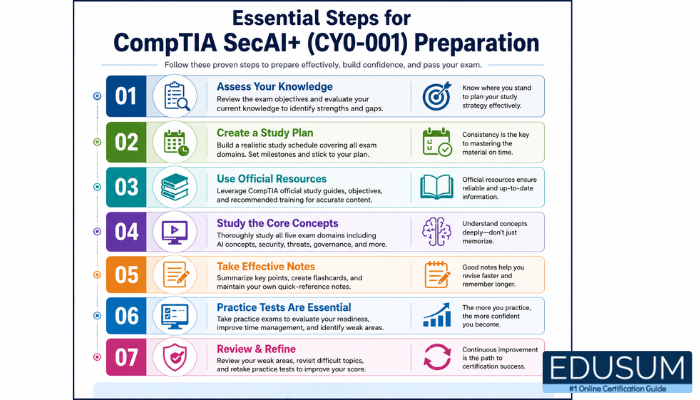
Crafting Your Study Plan
A personalized study plan tailored to your existing knowledge and learning style is paramount. Begin by reviewing the official CompTIA SecAI+ exam objectives thoroughly to understand the breadth and depth of topics covered.
-
Assess Current Knowledge: Start with a self-assessment to identify areas where you are strong and those requiring more attention.
-
Allocate Time: Dedicate specific study blocks each week, ensuring consistency. Prioritize domains with higher weightage, such as 'Securing AI Systems'.
-
Gather Resources: Collect official CompTIA study guides, reputable textbooks on AI and cybersecurity, and online courses.
-
Mix Learning Methods: Combine reading with video lectures, hands-on labs (if available for AI security tools), and discussion forums to reinforce learning.
Regularly revisit challenging topics to solidify your understanding.
Utilizing Official CompTIA Resources
CompTIA provides a range of official resources specifically designed to aid candidates in their preparation for the SecAI+ exam. These resources are invaluable as they directly align with the exam objectives and are often developed by subject matter experts involved in creating the exam itself.
-
CompTIA Study Guides: These comprehensive guides cover all exam domains in detail, providing explanations, examples, and practice questions.
-
CompTIA CertMaster Learn: An interactive online learning platform that offers lessons, videos, and performance-based questions.
-
CompTIA CertMaster Practice: Designed to help you prepare for the exam with practice questions and simulated tests.
Leveraging these official materials ensures you are studying the most accurate and relevant information for the CY0-001 exam. Further general resources from CompTIA can be found at CompTIA resources.
Value of Practice Exams
Beyond theoretical knowledge, the ability to apply concepts under exam conditions is crucial. Practice tests serve as an excellent tool for this, helping candidates:
-
Identify Knowledge Gaps: Reveal areas where understanding is weak, guiding further study.
-
Improve Time Management: Simulate the timed environment, helping you pace yourself effectively.
-
Familiarize with Question Styles: Get comfortable with the types of questions asked, including performance-based items.
-
Build Confidence: Experience success in a simulated environment, reducing pre-exam anxiety.
Platforms like Edusum offer practice tests that can provide realistic exam simulations, allowing you to gauge your readiness before attempting the actual CompTIA SecAI+ exam. Remember, the goal is to understand the concepts, not just memorize answers.
Advancing Your Career with CompTIA SecAI+
The CompTIA SecAI+ certification offers a distinct competitive advantage in the rapidly evolving cybersecurity landscape. As AI adoption becomes mainstream across industries, the demand for professionals who can secure these intelligent systems and leverage them for defense is skyrocketing. This credential signifies more than just technical aptitude; it marks an individual as forward-thinking, adaptable, and equipped to handle the challenges of future cyber threats. It’s an investment that can significantly accelerate career progression and open doors to specialized, high-impact roles.
Enhancing Your Professional Profile
Earning CompTIA SecAI+ distinguishes your resume, signaling to employers that you possess specialized skills in a niche but highly critical area. This is particularly valuable in an industry where many cybersecurity professionals lack formal training in AI security. The certification demonstrates:
-
Forward-Thinking Expertise: You are abreast of emerging technologies and their security implications.
-
Problem-Solving Acumen: You can address complex security challenges unique to AI systems.
-
Strategic Value: You can contribute to developing resilient and future-proof security architectures.
This makes you a more attractive candidate for employers seeking innovative solutions to evolving cyber threats, as evidenced by various cybersecurity case studies.
Market Demand for AI-Integrated Cybersecurity Roles
The convergence of AI and cybersecurity is creating entirely new job categories and elevating existing ones. Organizations across sectors, from finance and healthcare to government and technology, are seeking professionals who can navigate this complex intersection. Roles like AI Security Architect, Machine Learning Security Analyst, and AI Ethics and Compliance Officer are becoming increasingly vital. The demand for these skills often outstrips supply, leading to:
-
Higher Salary Potential: Specialized skills in AI security command premium compensation.
-
Increased Job Opportunities: Access to a broader range of advanced positions.
-
Leadership Prospects: Opportunities to lead initiatives in AI security and innovation.
CompTIA SecAI+ positions you at the forefront of this critical demand, making you an invaluable asset in the global workforce.
Demystifying CompTIA SecAI+ Exam Difficulty and Passing Scores
Many aspiring candidates often wonder about the perceived difficulty of a certification exam and what it takes to pass. The CompTIA SecAI+ (CY0-001) exam, while specializing in advanced topics, is structured to be challenging but attainable for professionals with relevant experience and dedicated study. It is not designed to be a gatekeeper but rather a thorough validation of a unique skill set. Understanding the scoring mechanism and what constitutes a passing performance can help candidates approach the exam with a clearer strategy and mindset.
Assessing the CY0-001 Challenge
The difficulty of the CompTIA SecAI+ exam stems from its interdisciplinary nature, combining core cybersecurity principles with intricate AI/ML concepts. Candidates might find it challenging if they lack:
-
Foundational AI Knowledge: A basic understanding of AI concepts, models, and lifecycles is crucial.
-
Practical Experience: The ability to apply theoretical knowledge to real-world security scenarios involving AI.
-
Time Management: The 60-minute duration for 60 questions requires efficient processing of information.
However, with a focused study plan that includes both theoretical learning and practical application, the exam is manageable. The exam aims to test understanding, not just rote memorization.
Achieving the Required Score
The CompTIA SecAI+ exam employs a scaled scoring system, where a score of 600 on a scale of 100-900 is required to pass. This scaled score accounts for varying question difficulties and ensures fairness across different exam versions. It's important to remember that simply answering 60% of the questions correctly does not guarantee a pass due to this scaling. The key is to achieve a strong overall performance across all domains. Prioritize studying the higher-weighted domains, but do not neglect any section, as a balanced understanding is essential for reaching the passing threshold. Consistent practice and mock exams are vital to gauge your readiness against this scoring model.
Maintaining Your CompTIA SecAI+ Certification
Earning the CompTIA SecAI+ certification is a significant achievement, but the journey doesn't end there. In the fast-paced world of cybersecurity and AI, skills and knowledge must be continually updated to remain relevant and effective. CompTIA's continuing education program ensures that certified professionals stay current with the latest advancements, threats, and best practices in the field. Understanding the renewal requirements is crucial for preserving the validity and value of your credential over time.
Certification Renewal Requirements
CompTIA certifications, including SecAI+, typically have a validity period of three years. To renew the certification, professionals need to participate in CompTIA's Continuing Education (CE) program. This involves earning a specified number of CEUs (Continuing Education Units) within the three-year cycle.
Common ways to earn CEUs include:
-
Completing Higher Certifications: Earning another CompTIA certification or a relevant industry certification.
-
Participating in Training: Attending approved courses, webinars, or workshops.
-
Professional Activities: Engaging in activities like teaching, mentoring, or developing relevant content.
-
Passing the Latest Exam Version: Retaking and passing the current version of the SecAI+ exam.
It is essential to track your CE activities and submit them through your CompTIA certification account to ensure timely renewal.
Continuing Professional Development
Beyond formal renewal requirements, ongoing professional development is imperative for anyone operating in the AI and cybersecurity domain. The pace of technological change necessitates a commitment to lifelong learning. This might involve:
-
Reading industry publications and research papers on AI security.
-
Attending conferences and seminars focused on AI and cybersecurity trends.
-
Experimenting with new AI security tools and platforms.
-
Engaging with professional communities and forums.
Proactive engagement in these activities not only helps with certification renewal but also ensures that your skills remain sharp, relevant, and in high demand. Maintaining a competitive edge in this rapidly evolving field requires continuous investment in your knowledge base. For further information, visit the CompTIA SecAI+ details page.
Frequently Asked Questions
Que.1. What does the CompTIA SecAI+ certification validate?
Ans.: The CompTIA SecAI+ certification (CY0-001) validates a professional's ability to secure AI systems, utilize AI for advanced cybersecurity operations, and manage the governance, risk, and compliance aspects associated with AI deployment in security contexts.
Que.2. Is prior AI experience required to take the CompTIA SecAI+ exam?
Ans.: While formal AI experience is not strictly required, a foundational understanding of basic AI and machine learning concepts is highly beneficial. The exam covers AI fundamentals, so candidates without prior exposure should dedicate study time to these areas.
Que.3. How long is the CompTIA SecAI+ certification valid?
Ans.: The CompTIA SecAI+ certification is typically valid for three years. To maintain its active status, certified professionals must participate in CompTIA's Continuing Education (CE) program by earning the required Continuing Education Units (CEUs) within this period.
Que.4. What kind of jobs can I get with CompTIA SecAI+?
Ans.: CompTIA SecAI+ can open doors to specialized roles such as AI Cybersecurity Analyst, Machine Learning Security Engineer, Security AI Architect, and AI Governance and Compliance Specialist, which are in high demand across various industries.
Que.5. Are there any prerequisites for the CompTIA SecAI+ (CY0-001) exam?
Ans.: CompTIA recommends, but does not strictly require, candidates to have experience in cybersecurity roles or other cybersecurity certifications, such as CompTIA Security+ or CySA+. A strong background in general cybersecurity principles is highly beneficial for understanding the advanced topics covered.
Final Thoughts
The CompTIA SecAI+ (CY0-001) certification is more than just a credential; it's a strategic pathway to becoming a leader in the next generation of cybersecurity. By validating skills in securing AI systems, leveraging AI for defense, and navigating the complexities of AI governance, it positions professionals at the forefront of innovation. For those ready to elevate their career and tackle the most advanced challenges in digital security, CompTIA SecAI+ represents a powerful statement of expertise and commitment to the future.
If you are prepared to invest in a certification that directly addresses the future of cybersecurity, the CompTIA SecAI+ offers a clear advantage. Take the initiative to thoroughly review the exam objectives, commit to a comprehensive study plan, and utilize quality preparation resources. Start your journey today to secure your place in the specialized field of AI-integrated cybersecurity. For a detailed overview and to explore preparation options, visit Edusum's CompTIA SecAI+ resources.
- CompTIA SecAI+ |
- CY0-001 SecAI+ |
- CY0-001 Online Test |
- CY0-001 Questions |
- CY0-001 Quiz |
- CY0-001 |
- CompTIA SecAI+ Certification |
- SecAI+ Practice Test |
- SecAI+ Study Guide |
- CompTIA CY0-001 Question Bank |
- SecAI+ Certification Mock Test |
- SecAI Plus Mock Exam |
- CompTIA SecAI Plus Questions |
- SecAI Plus |
- CompTIA SecAI Plus Practice Test |
- CompTIA SecAI Plus Certification |
- SecAI+ Sample Questions |
- CompTIA CY0-001 Practice Test Free |
- SecAI Plus Certification Sample Questions


