
The Hidden Mistakes Most Make on the GCIL Practice Exam
The GIAC Cyber Incident Leader (GCIL) certification validates an individual's advanced skills in leading incident response teams, managing complex cyberattacks, and improving an organization's overall incident management capabilities. This crucial credential is designed for incident response managers, security team leads, and cybersecurity professionals aiming to direct and optimize their organization's response to sophisticated cyber threats. For those preparing, understanding common pitfalls on the GCIL practice exam is paramount to achieving certification and demonstrating mastery of incident leadership. This article will uncover the often-overlooked errors candidates make and provide strategic insights for a more effective preparation journey.
Understanding the GIAC Cyber Incident Leader Certification
The GIAC Cyber Incident Leader (GCIL) certification is a highly respected credential from GIAC, a leading cybersecurity certification body. It focuses on the strategic leadership and management aspects of incident response, moving beyond technical execution to encompass planning, communication, and team development. Professionals holding this certification are equipped to build robust incident response programs, lead teams through challenging security incidents, and ensure their organizations can effectively contain, eradicate, and recover from cyberattacks. This certification is ideal for cybersecurity professionals ready to step into leadership roles, directing incident response efforts and shaping organizational resilience against evolving threats.
Key Details of the GCIL Examination
Achieving the GIAC Cyber Incident Leader (GCIL) certification requires passing a rigorous examination that assesses both theoretical knowledge and practical application in incident leadership. Understanding the exam's structure is a foundational step in effective preparation. The GCIL exam is designed to evaluate a candidate's ability to manage and lead during various incident scenarios, making the practice exam a critical component of readiness.
Here are the specific details for the GCIL certification exam:
|
Exam Price |
$999 (USD) |
|
Duration |
120 minutes (2 hours) |
|
Number of Questions |
75 multiple-choice questions |
|
Passing Score |
A minimum of 70% is required to pass. |
This structure demands not only comprehensive knowledge of incident response leadership but also efficient time management and a strategic approach to answering questions under pressure. The GCIL practice exam specifically helps candidates acclimate to this format and pace.
Core Domain Coverage for the GCIL Exam
The GIAC GCIL certification covers a broad spectrum of topics essential for effective incident leadership, reflecting the multifaceted nature of managing cyber incidents. A thorough understanding of these domains is crucial for anyone preparing for the exam and aiming to avoid common mistakes during their practice sessions. Each area requires a detailed approach, ensuring candidates can apply knowledge to real-world scenarios.
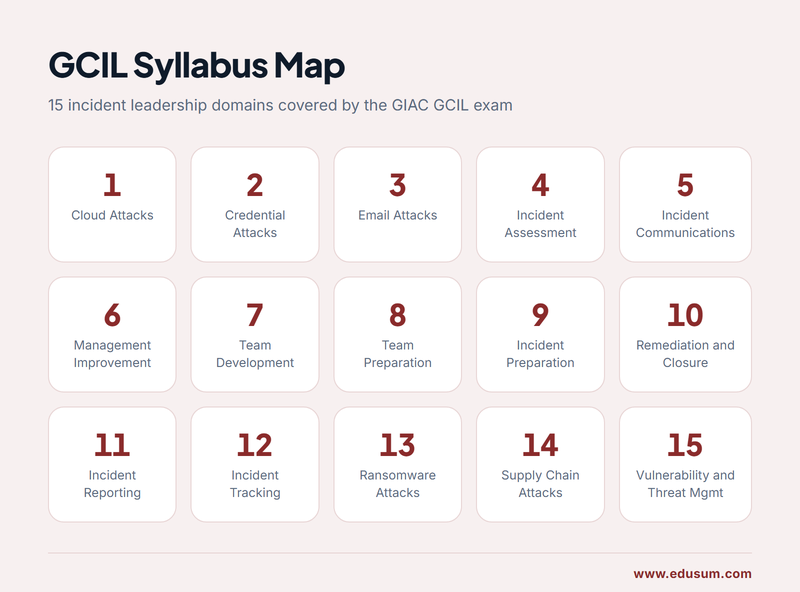
The exam focuses on several key areas:
-
Cloud Attacks: Understanding incident response within cloud environments, including common attack vectors, detection, and containment strategies specific to cloud infrastructure.
-
Credential Attacks: Strategies for detecting, responding to, and mitigating incidents involving compromised user credentials, such as phishing, brute-force, and credential stuffing.
-
Email Attacks: Handling incidents originating from email-borne threats, including business email compromise (BEC), malware delivery, and malicious links.
-
Incident Assessment: The process of rapidly evaluating the scope, impact, and severity of an incident to inform immediate response actions and resource allocation.
-
Incident Communications: Developing and executing effective communication plans with internal and external stakeholders, including legal, PR, executives, and affected parties.
-
Incident Management Improvement: Implementing lessons learned from past incidents, conducting post-incident reviews, and refining incident response processes and capabilities.
-
Incident Management Team Development: Building, training, and maintaining a high-performing incident response team, including defining roles, responsibilities, and necessary skill sets.
-
Incident Management Team Preparation: Establishing readiness through drills, tabletop exercises, and ensuring the team has the necessary tools, playbooks, and training before an incident occurs.
-
Incident Preparation: Proactive measures an organization takes to minimize the likelihood and impact of cyber incidents, such as risk assessments, policy development, and security controls implementation.
-
Incident Remediation and Closure: Steps taken to remove the threat, restore affected systems, and ensure the incident is fully resolved, followed by formal closure procedures.
-
Incident Reporting: Creating accurate and timely reports for internal management, regulatory bodies, and legal requirements, detailing incident facts, impact, and response.
-
Incident Tracking: Methodologies and tools for monitoring the progress of an incident response, ensuring all tasks are completed and maintaining a clear operational picture.
-
Ransomware Attacks: Specialized response strategies for ransomware, covering prevention, detection, negotiation (if applicable), recovery, and post-incident analysis.
-
Supply Chain Attacks: Addressing incidents that leverage vulnerabilities in an organization's supply chain, including third-party risks and vendor management in incident response.
-
Vulnerability and Threat Management: Integrating vulnerability scanning, threat intelligence, and risk assessment into the incident preparation and response lifecycle to proactively identify and mitigate weaknesses.
This comprehensive syllabus highlights the strategic depth required for the GCIL certification, moving beyond purely technical skills to encompass the leadership and management aspects of incident response. Mastering these areas is essential for success.
Misinterpreting GCIL Practice Exam Objectives
One of the most significant hidden mistakes candidates make when taking the GCIL practice exam is misinterpreting its true purpose. Many view practice tests merely as a means to memorize questions and answers, hoping to see similar items on the actual certification exam. This approach is fundamentally flawed and undermines the learning process. The practice exam's primary objective is to evaluate your understanding of the GIAC Cyber Incident Leader exam objectives, not to provide an exact replica of the final test.
Focusing on Recall Over Comprehension
Candidates often fall into the trap of rote memorization rather than striving for deep comprehension. When reviewing practice questions, they may simply try to recall the correct answer from memory instead of understanding why that answer is correct and why other options are incorrect. This surface-level learning becomes a major problem when the actual exam presents scenarios that require critical thinking and application of principles, rather than simple recall.
Failing to Analyze Incorrect Responses
Another common error stems from ignoring the details of questions answered incorrectly. A successful practice exam strategy involves a thorough post-mortem of every wrong answer. This analysis should extend beyond merely identifying the correct choice. Candidates should investigate the underlying concept, consult official GIAC Cyber Incident Leader training resources, and understand the nuances that led to their mistake. Without this detailed introspection, the same errors are likely to be repeated.
Neglecting In-Depth Review of Incorrect Answers
While it might seem obvious, a critical mistake many GCIL candidates make on their practice exams is neglecting a thorough review of their incorrect answers. Simply seeing the correct answer isn't enough; the real learning happens when you understand the 'why' behind the mistake. This detailed review process is fundamental to solidifying knowledge and identifying weak areas that need more attention.
Superficial Error Analysis
A common pitfall is a superficial review, where candidates quickly glance at the correct answer and move on. This casual approach means they miss the opportunity to reinforce their understanding of the underlying concepts, incident management methodologies, or specific attack types like Cloud Attacks or Ransomware Attacks. Without delving deeper, patterns of misunderstanding persist, leading to repeated errors. An effective review involves:
-
Identifying the specific topic or objective related to the incorrect question.
-
Consulting the relevant sections in their GIAC GCIL study guide or course materials.
-
Understanding why the chosen incorrect answer was plausible but ultimately wrong.
-
Explaining the correct answer in their own words, connecting it to broader GCIL exam topics.
This rigorous analysis transforms mistakes into powerful learning opportunities.
Overlooking the Root Cause of Knowledge Gaps
Often, an incorrect answer points to a more significant knowledge gap, rather than just a simple oversight. For instance, a mistake in a question about "Incident Communications" might not just be about a specific stakeholder, but a fundamental misunderstanding of communication protocols during a crisis. Ignoring these root causes leaves significant vulnerabilities in a candidate's preparation. Addressing these foundational issues head-on, perhaps through additional study or practical exercises, is vital for comprehensive readiness.
Underestimating the Value of Time Management During Simulations
The GCIL practice exam serves as a crucial dry run for the actual certification test, yet many candidates make the mistake of underestimating the importance of time management during these simulations. Treating the practice exam as an open-book, leisurely exercise will not prepare you for the strict 120-minute limit of the real exam. Developing a strategic approach to pacing yourself is as vital as knowing the material itself.
Ignoring the Clock During Practice
A prevalent error is not adhering to the time constraints while taking the GCIL practice exam. Candidates might pause frequently, consult notes, or take extended breaks, artificially inflating their scores and providing a false sense of readiness. The actual GIAC Cyber Incident Leader exam questions demand quick, confident decisions. If you're not practicing under timed conditions, you're not accurately assessing your ability to perform efficiently when it counts. Integrate strict timers into all your practice sessions to simulate real exam pressure.
Failing to Develop a Question Strategy
Without a time management strategy, candidates often spend too much time on difficult questions, leaving insufficient time for easier ones they could have answered correctly. This can significantly impact the overall score. A strong strategy involves:
-
Quickly assessing each question's difficulty.
-
Answering all easy and medium-difficulty questions first.
-
Flagging challenging questions to return to them later if time permits.
-
Allocating a maximum amount of time per question (e.g., 90 seconds for 75 questions in 120 minutes).
Practicing this strategy on the GCIL sample questions and answers helps build the discipline needed to navigate the actual exam effectively. You can find robust resources for this at GCIL certification sample questions.
Overlooking Crucial Incident Management Communication Skills
While the GCIL exam delves deeply into technical incident response, a common hidden mistake on the practice exam is overlooking the critical role of communication. Incident communications is a dedicated domain within the GCIL syllabus, signifying its importance beyond technical execution. Candidates often focus heavily on technical aspects like Cloud Attacks or Ransomware Attacks, inadvertently sidelining the nuanced skills required for effective stakeholder engagement.
Prioritizing Technicalities Over Stakeholder Needs
During practice scenarios, candidates might quickly identify a technical solution but fail to consider the communication ramifications. For example, a question about containment might involve selecting a technical control, but the broader context could imply a need for immediate notification to legal or public relations. Ignoring these non-technical, yet critical, communication elements means missing out on vital points and not fully grasping the incident leader's role. Effective leaders must be able to translate complex technical issues into clear, actionable information for various audiences, from technical teams to executive leadership and potentially external parties.
Inadequate Practice with Scenario-Based Communication Questions
The GCIL practice exam often includes scenario-based questions that test your ability to make appropriate communication decisions under pressure. A mistake is to treat these as simple multiple-choice questions without internalizing the impact of each communication choice. Candidates should mentally walk through the consequences of each communication option, considering how it affects trust, regulatory compliance, and business continuity. Practicing with a focus on comprehensive incident reporting and clear messaging will build this crucial skill set.
Failing to Adapt to Diverse Attack Scenarios
The GIAC GCIL certification covers a wide array of incident types, from Credential Attacks to Supply Chain Attacks. A subtle yet impactful mistake made by many candidates on the practice exam is failing to adapt their incident response mindset to the nuances of these diverse attack scenarios. They might apply a generic response framework to every situation, rather than tailoring their approach to the specific characteristics and implications of each threat.

Applying Generic Response Frameworks Universally
Each type of attack, whether it's an Email Attack or a sophisticated Supply Chain Attack, presents unique challenges and requires specific leadership considerations. For example, responding to ransomware involves distinct recovery protocols and potential negotiation strategies that differ significantly from managing a data breach stemming from compromised credentials. Candidates often struggle when the practice exam requires a finely-tuned response, instead defaulting to a one-size-fits-all approach. This demonstrates a lack of deep understanding in how to pass GIAC GCIL exam, which demands adaptability. Official certification objectives and trusted preparation resources can help develop this nuanced understanding.
Under-Practicing Specific Incident Types
Another facet of this mistake is uneven preparation across the syllabus topics. Candidates might feel more comfortable with familiar incident types and inadvertently neglect practicing scenarios involving less common or more complex threats, such as Cloud Attacks or advanced Vulnerability and Threat Management scenarios. This creates blind spots that can be exploited by the exam's comprehensive question bank. A balanced preparation strategy involves actively seeking out and practicing questions across all GCIL exam topics, ensuring no area is left underdeveloped. EduSum GCIL practice resources can also provide diverse perspectives and scenario-based preparation support.
Developing an Effective GCIL Preparation Strategy
Effective preparation for the GCIL certification goes beyond simply reviewing notes; it involves a strategic, multi-faceted approach. To truly master the material and excel on the GCIL practice exam, candidates must integrate various study techniques that build both knowledge and test-taking prowess. A well-rounded strategy targets all aspects of the exam, from content mastery to performance under pressure.
Leveraging Diverse Study Resources
Relying on a single source of truth can be a significant oversight. Instead, candidates should utilize a variety of GIAC Cyber Incident Leader training resources. This includes official GIAC materials, reputable third-party study guides, and hands-on labs or simulations if available. Diverse resources often provide different perspectives and reinforce concepts from multiple angles, leading to a more robust understanding. Ensure your preparation materials align with the GIAC GCIL exam objectives.
The Importance of Consistent Practice and Review
Consistency is key. Regular practice with GIAC Cyber Incident Leader exam questions, not just once but repeatedly, helps identify persistent weak areas. Each practice session should be followed by a detailed review, as discussed earlier. This iterative process of practice, review, and targeted study solidifies knowledge and builds confidence. Consider seeking out best GCIL practice questions from various reputable providers to get a broad exposure.
The Strategic Advantage of GCIL Certification
Earning the GIAC Cyber Incident Leader (GCIL) certification offers a substantial strategic advantage for cybersecurity professionals and their organizations. Beyond merely validating technical prowess, this credential signals a deep understanding of leadership in crisis, a skill set increasingly vital in the face of sophisticated cyber threats. The GCIL certification benefits extend to career progression, operational resilience, and industry recognition.
Career Progression and Enhanced Earning Potential
For individuals, the GCIL certification can be a powerful catalyst for career advancement. It positions professionals for leadership roles such as Incident Response Team Lead, Incident Manager, or Cyber Security Operations Manager. The GIAC GCIL certification benefits often include higher earning potential and increased demand in the job market, reflecting the specialized and critical nature of this skill set. This aligns with GCIL career opportunities for those seeking to specialize in leadership aspects of cybersecurity. Knowing the GIAC GCIL certification cost is often offset by these long-term career advantages.
Bolstering Organizational Security Posture
From an organizational perspective, employing GCIL-certified professionals significantly bolsters the overall security posture. These leaders are equipped to implement robust Incident Preparation, develop effective Incident Management Team Development strategies, and drive continuous Incident Management Improvement. This leads to faster, more efficient, and more effective responses to incidents, minimizing downtime and financial losses. The certification enhances an organization's ability to navigate the complex landscape of cyber incidents with confidence and strategic direction. The official GIAC certification page provides more insights into how this certification impacts professional growth and organizational security. For more on preparing for GIAC certifications, visit GIAC Cyber Incident Leader practice exam.
Frequently Asked Questions
Que. 1. What does the GIAC Cyber Incident Leader (GCIL) certification validate?
Ans.: The GCIL certification validates an individual's expertise in leading incident response teams, managing complex cyber incidents, and enhancing an organization's overall incident management capabilities. It focuses on the strategic and leadership aspects of cybersecurity response.
Que. 2. What is the difficulty level of the GIAC GCIL exam?
Ans.: The GIAC GCIL exam is considered a professional-level certification, indicating a moderate to high difficulty level. It requires a comprehensive understanding of incident response principles, leadership skills, and practical application across various attack scenarios.
Que. 3. How much does the GIAC GCIL certification cost?
Ans.: The exam price for the GIAC Cyber Incident Leader (GCIL) certification is typically $999 USD. This cost covers the exam attempt but does not include training courses, which are offered separately.
Que. 4. Are GCIL practice exams indicative of the actual exam?
Ans.: GCIL practice exams are designed to simulate the format, question types, and difficulty level of the actual certification exam, making them highly indicative of what to expect. They are crucial for identifying knowledge gaps and practicing time management.
Que. 5. What are the career opportunities after obtaining GCIL certification?
Ans.: Obtaining the GCIL certification opens up various career opportunities in cybersecurity leadership roles, such as Incident Response Team Lead, Incident Manager, Security Operations Center (SOC) Manager, and Cyber Security Consultant specializing in incident management.
Final Thoughts on Acing Your GCIL Practice Exam
Successfully navigating the GIAC Cyber Incident Leader (GCIL) certification journey, especially through the critical phase of practice exams, requires more than just technical knowledge. It demands a strategic mindset, disciplined practice, and a commitment to continuous learning. By avoiding the common hidden mistakes discussed – misinterpreting objectives, neglecting thorough review, poor time management, overlooking communication, and failing to adapt to diverse scenarios – you can significantly enhance your chances of success.
Embrace the GCIL practice exam as a diagnostic tool, designed to highlight your strengths and pinpoint areas needing further development. Approach each question with critical thought, meticulously review every answer, and practice under simulated exam conditions. This deliberate and comprehensive preparation will not only lead to passing the GCIL exam but will also solidify your expertise as a capable and confident cyber incident leader. Take the next step in your preparation by exploring comprehensive practice questions and study materials that align with the rigorous standards of GIAC. A solid preparation path can be found by exploring a dedicated resource for GIAC Cyber Incident Leader training and practice, such as GCIL certification training.
- GIAC Certification |
- GIAC Cybersecurity Leadership Certification |
- GIAC Cyber Incident Leader (GCIL) |
- GCIL Online Test |
- GCIL Questions |
- GCIL Quiz |
- GCIL |
- GIAC GCIL Certification |
- GCIL Practice Test |
- GCIL Study Guide |
- GIAC GCIL Question Bank |
- GCIL Certification Mock Test |
- GCIL Mock Exam |
- GIAC GCIL Questions |
- GIAC GCIL Practice Test |
- GCIL Syllabus |
- GCIL Books |
- GCIL Certification Syllabus |
- GIAC GCIL Books |
- GIAC GCIL Training |
- GCIL Certification Cost |
- GCIL Sample Questions |
- GIAC GCIL Practice Test Free |
- GCIL Certification Sample Questions


