
From DataX to CompTIA DataAI: A Clear Guide for DY0-001 Candidates
The Evolution: From DataX to CompTIA DataAI
The landscape of data science is no longer just about cleaning spreadsheets or building isolated models. It is about the seamless integration of data ecosystems with scalable artificial intelligence. Recognizing this seismic shift, CompTIA recently announced the rebranding of its advanced data certification from DataX to CompTIA DataAI.
This change is far more than a marketing facelift. It reflects a fundamental reality: data and AI are no longer adjacent disciplines; they are a singular, unified force. For professionals holding or pursuing the DY0-001 code, this transition signals that your expertise is now formally recognized as the backbone of modern AI implementation. Whether you are a senior data scientist, a machine learning engineer, or a quantitative analyst, the CompTIA DataAI certification validates your ability to manage the entire lifecycle of AI-driven data solutions.
Candidates who were previously preparing for DataX can rest easy. The exam code remains DY0-001, and the core rigorous standards remain intact. However, the context has shifted toward operational excellence in AI environments.
Why This Rebrand Matters for Your Career
If you have ever felt that your current certifications do not quite capture the "heavy lifting" you do with neural networks or MLOps pipelines, this rebrand is for you. The shift to CompTIA DataAI places you at the center of the AI revolution.
Validation of Senior-Level Expertise
Unlike entry-level certifications, CompTIA DataAI is designed for those with at least five years of hands-on experience. It tells employers that you are not just a "data person" but an AI architect capable of driving business value. In an era where "AI" is added to every job description, having a vendor-neutral, performance-based credential like the DY0-001 sets you apart from the noise.
Alignment with Industry Trends
Organizations are moving away from experimental AI and toward production-ready systems. The "Operations and Processes" domain in this exam ensures you understand how to deploy and monitor models at scale - skills that are currently in high demand and command six-figure salaries.
CompTIA DataAI (DY0-001) Exam Overview
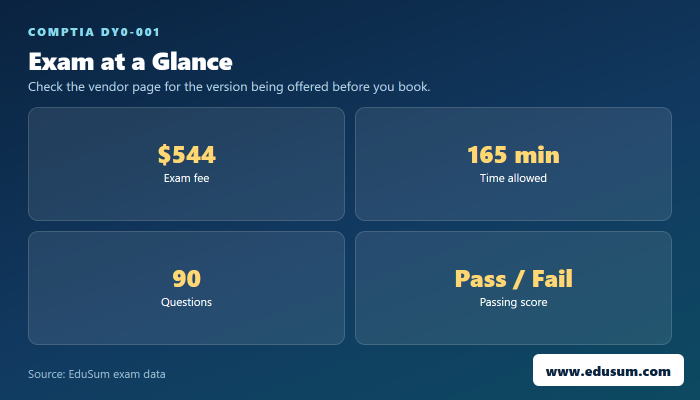
Before we dissect the technical requirements, let’s look at the logistical framework of the exam. This is a professional-grade test designed to challenge even seasoned experts.
Feature Details
-
Exam Name: CompTIA DataAI
-
Exam Code: DY0-001
-
Duration: 165 Minutes
-
Number of Questions: Maximum of 90 (Multiple-choice and performance-based)
-
Passing Score: Pass/Fail (No scaled score)
-
Exam Fee: 529 USD
-
Experience Level: 5+ years in Data Science recommended
The performance-based questions are particularly notable. They require you to solve real-world problems in a simulated environment, proving you can apply theory to practice under time pressure.
Deep Dive: The Five Critical Domains
Success on the CompTIA DataAI exam requires a balanced mastery of five distinct areas. Let’s break down exactly what you need to know for the DY0-001.
1. Mathematics and Statistics (17%)
This domain is the bedrock of trustworthy AI. Without a firm grasp of the underlying math, models become "black boxes" that can lead to disastrous business decisions.
-
Linear Algebra: Understanding tensors and matrix operations is non-negotiable for deep learning. You should be comfortable with eigenvalues and eigenvectors, as they are crucial for dimensionality reduction techniques like PCA.
-
Probability & Statistics: From Bayesian inference to hypothesis testing, you need to know how to validate that your results are not just a product of random noise. Synthetic modeling and probability distributions (Normal, Poisson, Bernoulli) are frequent topics.
2. Modeling, Analysis, and Outcomes (24%)
This is where you translate raw data into a narrative. This domain focuses on the iterative process of model design and the critical step of communication.
-
Exploratory Data Analysis (EDA): Mastering visualization and summary statistics to uncover patterns before the modeling begins.
-
Data Enrichment: How do you add value to your datasets? This includes feature engineering, handling missing values, and data augmentation - especially important when working with limited AI training sets.
-
Communicating Insights: A great model is useless if stakeholders cannot understand it. The exam tests your ability to translate technical metrics into business impact.
3. Machine Learning (24%)
As the core of the CompTIA DataAI certification, this section tests your ability to choose, build, and refine algorithms.
-
Supervised Learning: Deep understanding of regression, decision trees, and ensemble methods like Random Forest or XGBoost.
-
Unsupervised Learning: Clustering (K-Means, DBSCAN) and association rules.
-
Deep Learning: Neural network architectures, including CNNs for vision and RNNs/Transformers for language tasks. You need to know how to tune hyperparameters to prevent overfitting.
4. Operations and Processes (22%)
This is often the most challenging section for academics but the most vital for professionals. It covers the "how" of AI deployment.
-
MLOps: Integrating machine learning into CI/CD pipelines. You must understand model versioning, containerization (Docker/Kubernetes), and automated testing.
-
Monitoring and Maintenance: Once a model is live, the work isn't over. You need to monitor for "model drift," where the model's accuracy degrades over time as real-world data changes.
-
Governance and Ethics: Designing responsible AI systems that are transparent, secure, and free from bias.
5. Specialized Applications of Data Science (13%)
The final domain looks at the cutting edge of the industry.
-
Natural Language Processing (NLP): Sentiment analysis, entity recognition, and the mechanics of Large Language Models (LLMs).
-
Computer Vision: Image classification and object detection.
-
Time Series Analysis: Forecasting trends in financial or operational data.
Transition FAQs: Clearing the Confusion
Q: I already bought a DataX voucher. Do I need to exchange it?
A: No. Your DataX voucher is fully valid for the CompTIA DataAI (DY0-001) exam. The transition is automatic within the testing centers.
Q: Is the CompTIA DataAI exam harder than the old Data+?
A: Significantly. Data+ is a foundational certification. DataAI is an expert-level credential requiring deep technical knowledge of math and machine learning. It is intended for those with years of experience.
Q: Will my certificate say DataX or DataAI?
A: If you pass the DY0-001 exam after the official rebrand date (January 21, 2026), your certificate and digital badges will reflect the "CompTIA DataAI" name.
Q: How much programming knowledge is required?
A: While the exam is vendor-neutral, you should have a strong command of Python or R, as well as SQL. You should be familiar with common libraries like Scikit-Learn, TensorFlow, or PyTorch.
Q: Are there performance-based questions (PBQs)?
A: Yes. You will be required to perform tasks such as troubleshooting a model's performance or identifying errors in a data pipeline within a virtual environment.
Q: What is the best resource for DY0-001 practice?
A: For realistic simulations and time-management practice, the CompTIA DataAI DY0-001 practice test is widely considered the gold standard for final review.
Strategic Preparation for Success
Passing an expert-level exam like the DY0-001 requires more than just reading a textbook. You need a multi-layered approach that combines theory with heavy hands-on practice.
Step 1: Master the Syllabus
Start by downloading the official exam objectives from the CompTIA website. Use the domain percentages to allocate your study time. If you are a math whiz but have never touched a Docker container, spend 40% of your time on the "Operations and Processes" domain.
Step 2: Bridge the Gap with Official Courseware
Leverage resources like CertMaster Perform. These tools are designed by CompTIA to align specifically with the performance-based nature of the exam. They offer labs where you can practice data cleaning and model selection in a risk-free environment.
Step 3: Utilize High-Quality Practice Exams
One of the biggest hurdles in the 165-minute exam is time management. Using a dedicated DY0-001 CompTIA DataAI certification practice platform allows you to familiarize yourself with the phrasing of questions and identify your weak spots before the $529 investment is at risk.
Step 4: Join the Community
The data science community is incredibly collaborative. Engage in forums or study groups. Explaining a complex concept like "Stochastic Gradient Descent" to a peer is one of the best ways to cement your own understanding.
Step 5: Focus on the "AI" in DataAI
Since the rebrand emphasizes AI integration, pay special attention to the latest trends in Generative AI and Transformer architectures. Understanding how data feeds into these models - and how to evaluate their outputs - is key to scoring high in the "Specialized Applications" section.
Conclusion: Your Future in an AI-Driven World
The transition from DataX to CompTIA DataAI is a clear signal from the industry: the future of data science is inextricably linked to artificial intelligence. By earning your DY0-001 certification, you aren't just passing a test; you are claiming your seat at the table of the most important technological shift of our generation.
While the 165 minutes in the testing center may feel daunting, the reward is a validated, expert-level credential that commands respect and opens doors to leadership roles. Don't let the name change distract you - let it motivate you. The world needs professionals who can turn raw data into intelligent, actionable AI solutions.
For a deeper dive into what to expect on the big day, check out these CompTIA DataAI DY0-001 certification sample questions to test your current knowledge.
- DY0-001 |
- CompTIA DY0-001 Practice Test Free |
- DY0-001 Practice Test |
- CompTIA DataAI |
- CompTIA DataAI Certification |
- CompTIA DataAI Practice Test |
- CompTIA DataAI Questions |
- DataAI |
- DataAI Certification Mock Test |
- DataAI Mock Exam |
- DataAI Practice Test |
- DataAI Study Guide |
- DY0-001 DataAI |
- CompTIA DataAI Books |
- CompTIA DataAI Training |
- DataAI Books |
- DataAI Certification Cost |
- DataAI Certification Syllabus |
- DataAI Certification Sample Questions |
- DataAI Sample Questions


