
Complete Guide to the CCISO Exam: Cost, Domains, Salary, and Preparation Strategy
A lot of cybersecurity professionals hit the same wall. They have solid technical depth, years of security experience, and maybe even a respected certification or two. But when they aim for executive roles, the expectations change fast. The conversation shifts from tools and incidents to budgets, governance, audit readiness, vendor risk, and board communication.
That is where the CCISO Exam becomes relevant.
The EC-Council Certified Chief Information Security Officer (CCISO) credential is designed for professionals who want to move from security delivery to security leadership. EC-Council describes the program as one built for top-level information security executives and notes that it was developed by sitting CISOs for current and aspiring CISOs.
If you are researching the CCISO certification, this guide covers what matters most:
-
What the certification is
-
Who it is for
-
Current CCISO exam cost
-
The five CCISO domains
-
How the exam is structured
-
What kind of roles and salary outcomes can it support
-
How does it compare with CISSP
-
How to prepare without wasting time
Quick answer: The CCISO Exam is a leadership-focused cybersecurity certification exam from EC-Council. It tests executive-level knowledge across governance, risk, audit, operations, core security competencies, and business management topics. The official exam has 150 multiple-choice questions in 2.5 hours, and the exam voucher is listed at $999 after approval, with a $100 eligibility application fee in the self-study route.
For candidates who want hands-on readiness, Edusum’s CCISO 712-50 practice exam can fit naturally into the study plan, especially when paired with the official blueprint and a domain-by-domain revision cycle.
What Is the CCISO Certification?
The CCISO certification is EC-Council’s executive cybersecurity credential for professionals who are moving into, already serving in, or functionally operating at the CISO level. EC-Council says the program is focused not just on technical knowledge, but on applying information security management principles from an executive management point of view.
That distinction matters.
Many cybersecurity certifications validate operational capability. CCISO is meant to validate executive judgment. A CCISO candidate is expected to think about questions such as:
-
How does security strategy align with business goals?
-
Which risks deserve funding first?
-
How should third-party risk be governed?
-
What controls matter most for audit and compliance posture?
-
How do you justify security investment to senior leadership?
This is why the certification appeals to:
-
Senior security analysts
-
Security architects
-
Security managers
-
SOC leaders
-
Risk and compliance leaders
-
IT managers shifting into enterprise security leadership
-
Professionals already performing CISO-level functions without the title
CCISO is less about configuring security tools and more about leading security as a business function.
CCISO Exam Overview
Here is the current exam snapshot based on official EC-Council sources and the current CCISO exam information page:
-
Exam name: EC-Council Certified Chief Information Security Officer
-
Exam code: 712-50
-
Exam format: Multiple choice
-
Number of questions: 150
-
Exam duration: 2.5 hours / 150 minutes
-
Passing score: 60% to 85%, depending on form difficulty
-
Domains: 5
-
Vendor: EC-Council
The official exam page also notes that candidates must pass an exam covering all five domains and that the questions require “extensive thought and evaluation.”
That wording is a hint. This is not a memory-only exam. It tests judgment, prioritization, and executive interpretation.
The CCISO exam is a 150-question, multiple-choice certification exam from EC-Council that lasts 150 minutes and covers five executive-level cybersecurity domains.
CCISO Exam Cost
For most candidates, the first cost question is simple: how much does the exam itself cost?
Based on the current EC-Council application and handbook materials, the CCISO exam voucher is $999 after eligibility approval. For candidates taking the self-study path, there is also a $100 non-refundable eligibility application fee. EC-Council’s current FAQ adds that candidates who have purchased authorized training do not pay the application fee.
What you may need to budget for
Your total investment can include:
-
Eligibility application fee: $100 for self-study applicants.
-
Exam voucher: $999 after approval.
-
Training cost: varies by provider and learning format.
-
Practice resources: mock exams, question banks, and review tools.
-
Retake or voucher extension costs: these may apply depending on your situation and vendor policy.
An EC-Council eligibility process page states that vouchers can generally be extended once for a fee, but candidates should verify the latest rules directly before relying on that detail.
Is the CCISO exam expensive?
Yes, compared with mid-level cybersecurity certifications, the CCISO exam cost sits in the premium bracket. But that aligns with its intended audience: experienced professionals preparing for executive-level roles.
The better question is not “Is it cheap?” but “Does it match my career stage?”
If you are still building hands-on foundations, it may be too early. If you already manage teams, budgets, stakeholders, or governance functions, it can be a sharper fit.
Practical advice
Treat the exam fee as only one part of the decision. Also evaluate:
-
Your current leadership exposure
-
Your readiness for governance-heavy questions
-
Whether you can apply the credential to promotion, consulting, or leadership-track goals
CCISO Domains Explained
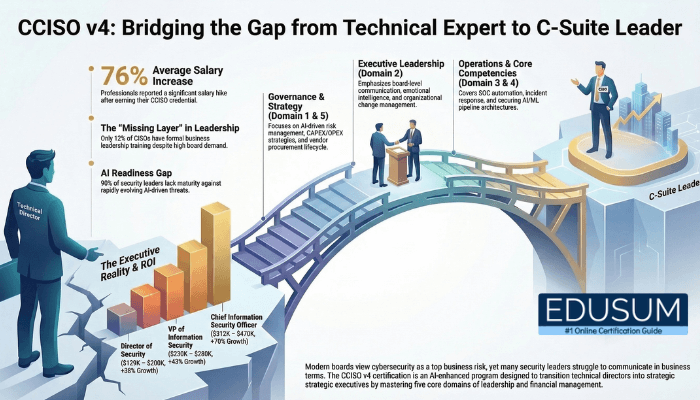
The official CCISO framework covers five domains. EC-Council’s current FAQ lists them as follows: Governance, Risk, Compliance; Information Security Controls and Audit Management; Security Program Management & Operations; Information Security Core Competencies; Strategic Planning, Finance, Procurement, and Third-Party Management.
1) Governance and Risk Management
This domain tests whether you can create and guide a security program at the enterprise level. It includes risk treatment, policy alignment, legal awareness, and governance structures.
In real work, this is the domain behind board reporting, risk appetite discussions, and security policy direction.
-
What to expect: risk prioritization, governance models, policy design, regulatory interpretation, business alignment.
2) Information Security Controls, Compliance, and Audit Management
This domain checks whether you can map controls to business requirements and prove they work under compliance and audit pressure.
This is where leadership meets accountability.
-
What to expect: control frameworks, internal audits, compliance readiness, evidence, assurance, and remediation planning.
3) Security Program Management & Operations
This area focuses on running security as an organized, measurable, sustainable program.
-
What to expect: operations planning, program oversight, incident readiness, metrics, security team leadership, and ongoing execution management.
4) Information Security Core Competencies
This domain keeps the exam grounded in technical reality. CCISO is executive-focused, but leaders still need a strong grasp of core security concepts.
-
What to expect: foundational security architecture, threat awareness, enterprise security principles, and technical decision context.
5) Strategic Planning, Finance, Procurement, and Third-Party Management
This is one of the most business-heavy parts of the exam. It covers security budgeting, procurement logic, contract oversight, and vendor risk.
-
What to expect: financial prioritization, procurement decisions, supplier assurance, outsourcing risk, and business case evaluation.
The CCISO domains are designed to test whether you can lead security as a business-critical function, not just manage tools or alerts.
CCISO Exam Questions and Format
The CCISO exam questions are multiple choice, but that should not make you underestimate the exam. EC-Council says the exam includes three cognitive levels and emphasizes that the questions require thought and evaluation, not simple recall.
What does that mean for candidates?
You should expect questions that ask:
-
What is the best executive response
-
Which control choice best aligns with business risk
-
How to prioritize a limited security budget
-
What governance action should come first
-
How to handle audit, compliance, or vendor-related scenarios
In other words, the exam often rewards judgment over memorization.
Are there official CCISO exam questions available?
EC-Council offers official training and an assessment path, but candidates often strengthen readiness through mock exams and scenario-based practice. The safest approach is to use CCISO practice questions that mirror executive decision-making rather than trivia memorization. EC-Council’s FAQ itself points candidates to an assessment exam as a readiness check.
For structured prep, candidates often combine:
-
Official blueprint review
-
Domain notes
-
Scenario analysis
-
Timed mock tests
-
Error-log review
A useful next step is to work through a CCISO 712-50 online practice test and measure both timing and weak domains.
CCISO Practice Questions: Why They Matter
Practice questions are not just for score prediction. For an exam like CCISO, they are a leadership rehearsal.
Good CCISO practice questions help you:
-
Spot how executive wording changes the “right” answer
-
Build speed for a 150-question exam
-
Identify domains where your operational background is strong, but your governance reasoning is weak.
-
Improve stamina for a long exam window
-
Reduce second-guessing under time pressure
What makes a good mock exam?
A strong mock should include:
-
Domain-balanced coverage
-
Realistic question phrasing
-
Scenario-driven choices
-
Timer-based attempts
-
Explanations for correct and incorrect answers
-
Score tracking by domain
Candidates who already know the theory usually benefit most from timed practice. That is often the step that turns “I understand this” into “I can pass this.”
CCISO Certification Salary and Career Opportunities
No certification guarantees a salary number by itself. Job title, geography, industry, scale of responsibility, and leadership experience matter more than the badge alone.
Still, the broader market for senior cybersecurity talent remains strong. The U.S. Bureau of Labor Statistics reports that information security analysts had a median annual wage of $124,910 in May 2024, and employment for the occupation is projected to grow 29% from 2024 to 2034, much faster than average. BLS also notes that analysts may advance into chief security officer and related management roles.
That does not mean a CCISO holder should expect an analyst-level salary. It means the broader cybersecurity market is healthy, and leadership-track roles often build on that demand.
Roles that align well with CCISO
-
Chief Information Security Officer
-
Deputy CISO
-
Director of Information Security
-
Security Program Manager
-
Governance, Risk, and Compliance leader
-
Cybersecurity consultant focused on strategy
-
Security transformation lead
-
Security operations executive or regional security head
How CCISO can affect earning potential
The strongest salary value of CCISO usually comes from three areas:
-
Promotion leverage
-
It can support a move from manager-level work into director or executive-track conversations.
-
-
Leadership credibility
-
It signals that you understand business-facing security leadership, not only technical depth.
-
-
Consulting or advisory positioning
-
It can strengthen your profile for governance, transformation, and board-facing advisory work.
-
Realistic salary framing
For a global audience, it is smarter to position CCISO certification salary as a leadership accelerator rather than promise a fixed salary number. The credential may help professionals compete for higher-value roles, but compensation depends on region, experience, team scope, and employer size.
CCISO vs CISSP: Which Certification Is Better?
This is one of the most searched comparisons, and the honest answer is simple:
Neither is universally better. They serve different goals.
EC-Council positions CCISO as an executive management credential for top-level information security leaders. ISC2 positions CISSP as a broad cybersecurity leadership and operations certification covering eight domains, with a 3-hour exam of 100 to 150 items and a 700/1000 passing score. ISC2’s current exam pricing page lists the CISSP exam at US $749 in many regions.
Choose CCISO if:
-
You want executive leadership positioning
-
You already work with budgets, governance, vendors, audit, or strategy
-
You want a business-facing CISO pathway
-
You prefer an exam aimed at enterprise security leadership
Choose CISSP if:
-
You want a broader security credential
-
You need a globally recognized benchmark across security domains
-
Your role still spans architecture, operations, engineering, and management
-
You want a certification often requested across many security job postings
Best practical interpretation
For many professionals, this is not an either-or decision forever. It is a sequencing decision.
A common logic is:
-
CISSP is first for broad recognition and foundational leadership credibility
-
CCISO next for explicit executive and business-leadership positioning
But for experienced professionals already working near the CISO layer, CCISO may be the more directly aligned next step.
CCISO is better for executive security leadership and business-facing CISO responsibilities, while CISSP is better for broad cybersecurity credibility across technical and management domains.
What Is the Best Strategy to Prepare for the CCISO Exam?
The best strategy is to study like an executive, not like a junior analyst.
Step 1: Start with the official blueprint
Match every study block to one of the five domains. Do not begin with random practice questions. Start with the structure first.
Step 2: Audit your real-world experience
Mark which domains you already live in at work and which ones you only touch lightly.
Many candidates are comfortable with operations and core competencies, but weaker in:
-
Finance
-
Procurement
-
Audit logic
-
Governance language
-
Board-level decision framing
Step 3: Build a 6- to 8-week study plan
A sample flow:
Week 1: Governance and risk
Week 2: Controls, compliance, and audit
Week 3: Program management and operations
Week 4: Core competencies
Week 5: Strategic planning, finance, procurement, third-party risk
Week 6: Practice questions and weak-area repair
Week 7: Timed mocks
Week 8: Final revision and exam pacing
Step 4: Use layered resources
Your study stack should include:
-
Official EC-Council information pages
-
Your own experience notes
-
Domain summaries
-
Practice questions
-
Timed mock exams
-
A revision sheet for executive terms and decision frameworks
Step 5: Practice timing early
150 questions in 150 minutes means your pacing matters. You need to get used to reading carefully without overthinking every scenario.
Step 6: Review why answers are wrong
That is where the biggest score gains happen. Executive exams punish shallow assumptions. The wrong answers often reveal whether you are thinking tactically instead of strategically.
Common Mistakes to Avoid in the CCISO Exam
1) Studying it like a technical cert
This is the biggest mistake. CCISO expects executive reasoning.
2) Ignoring finance and procurement
Many technically strong candidates lose points here because they underprepare the business side.
3) Memorizing without scenario practice
The exam rewards applied judgment, not only recall.
4) Underestimating time pressure
One minute per question goes quickly.
5) Skipping eligibility planning
EC-Council’s path includes an eligibility process, and the requirements vary depending on whether you use authorized training. Check the current rules before you plan your test date.
6) Relying on outdated PDFs without checking current pages
This matters. EC-Council’s current FAQ says the certification is valid for three years, while older application PDFs visible in search results still show one year. Use the current FAQ and current handbook-style resources as your primary source when you verify policy details.
FAQs About the CCISO Exam
Q.1. What is the CCISO exam?
Ans.: The CCISO exam is EC-Council’s executive cybersecurity certification exam for experienced professionals pursuing CISO-level leadership. It covers five domains and tests governance, operations, compliance, risk, finance, and strategic decision-making.
Q.2. How much does the CCISO exam cost?
Ans.: For self-study applicants, EC-Council materials indicate a $100 eligibility application fee and a $999 exam voucher after approval. Candidates using authorized training may follow a different fee path.
Q.3. How many questions are on the CCISO exam?
Ans.: The exam has 150 multiple-choice questions and lasts 2.5 hours.
Q.4. What are the CCISO domains?
Ans.: The five domains are Governance and Risk Management; Information Security Controls, Compliance and Audit Management; Security Program Management & Operations; Information Security Core Competencies; and Strategic Planning, Finance, Procurement, and Third-Party Management.
Q.5. Is CCISO harder than CISSP?
Ans.: They are difficult in different ways. CISSP is broader across security domains, while CCISO is more executive and business leadership focused. The harder one depends on your background.
Q.6. Is CCISO worth it for experienced professionals?
Ans.: It can be worth it for professionals targeting director, head of security, or CISO-track roles, especially if they already manage risk, compliance, budgets, or security programs. Its value is strongest when matched to a leadership career goal.
Q.7. How long is the CCISO certification valid?
Ans.: EC-Council’s current FAQ says the certification is valid for three years and renewed through continuing education requirements plus a renewal fee. Because older PDFs visible online show a shorter period, candidates should verify the latest rule on the current official FAQ before acting on it.
Conclusion
The CCISO Exam is built for a specific kind of cybersecurity professional: someone who is moving beyond implementation and into enterprise leadership.
That is why this certification stands out.
The framework connects security to governance and links incidents to measurable business impact. It also ties security controls to budgets, vendor management, audit readiness, and executive accountability. EC-Council’s own framing makes this clear: CCISO is aimed at top-level information security executives and emphasizes management principles from an executive point of view.
If your goal is to become a stronger technical specialist, another certification may fit better. But if your goal is to lead security programs, influence business decisions, and grow toward the CISO office, the CCISO path deserves serious attention.
For the next step, pair the official EC-Council resources with a strong practice routine:
-
Review the blueprint
-
Map your domain gaps
-
Take timed mocks
-
Refine business-side reasoning
-
Use a focused CCISO practice exam to build exam-day confidence
If you want additional context and preparation insights, read our complete CCISO certification overview and try the 712-50 CCISO mock exam to assess your strengths and identify areas for improvement.


