
5 Steps to Excel in the GIAC Linux Incident Responder Certification Exam
The digital landscape is a battleground, and skilled incident responders are the frontline defenders. Among the most respected credentials in this field is the GIAC Linux Incident Responder (GLIR) Certification. This certification validates your expertise in identifying, analyzing, and responding to security incidents on Linux systems, making you an invaluable asset in any organization's cybersecurity arsenal. For those aspiring to enhance their incident response capabilities and earn this prestigious certification, a clear roadmap is essential.
The GIAC Linux Incident Responder certification exam, designed to rigorously test your practical knowledge, consists of 82 questions, to be completed within a 3-hour timeframe. A minimum passing score of 66% is required. What makes this exam particularly unique, and often a source of both relief and trepidation, is its open-book format. While it may seem like an advantage, successfully navigating an open-book exam requires strategic preparation – it's not about memorizing facts, but about knowing where to find them swiftly and efficiently. This guide will walk you through five crucial steps to help you not only prepare for but excel in the GIAC Linux Incident Responder Certification exam.
5 Steps to Ace GIAC Linux Incident Responder Certification Exam
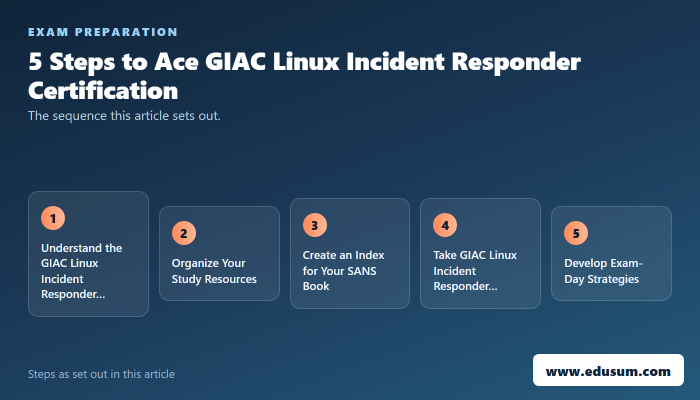
Step 1: Understand the GIAC Linux Incident Responder Certification Exam Objectives
The foundation of any successful certification journey lies in a thorough understanding of what you’ll be tested on. For the GIAC Linux Incident Responder (GLIR) exam, familiarity with its comprehensive objectives is paramount. This isn't just a list; it's your study roadmap.
-
Familiarize yourself with the domains and key topics covered in the GLIR exam. The GIAC GLIR certification delves deep into critical areas such as:
-
Analyzing Anti-Forensics Techniques
-
Analyzing Linux Application Events
-
Analyzing Linux Events
-
Evidence Collection and Mounting
-
Evidence Collection and Mounting
-
Linux File System Artifacts
-
Linux File System Fundamentals and Analysis
-
Linux Memory and Device Profiling Analysis
-
Linux OS Event Log Introduction
-
Linux OS File System Structure
-
Linux OS Fundamentals
-
Linux Threat Hunting and Incident Response
-
Linux Timeline Analysis
-
- Highlight critical areas: Pay particular attention to Linux fundamentals, which underpin all other topics. Mastering forensic analysis techniques, understanding various log analysis methodologies, and being proficient in incident response strategies are non-negotiable. These core competencies will be heavily weighted in the exam.
- Discuss leveraging the official GIAC exam blueprint as a roadmap for study. The official GIAC website provides a detailed blueprint of the GLIR exam objectives. This document is your most authoritative source for understanding the scope and depth of knowledge required. Use it to structure your study plan, ensuring no critical area is overlooked.
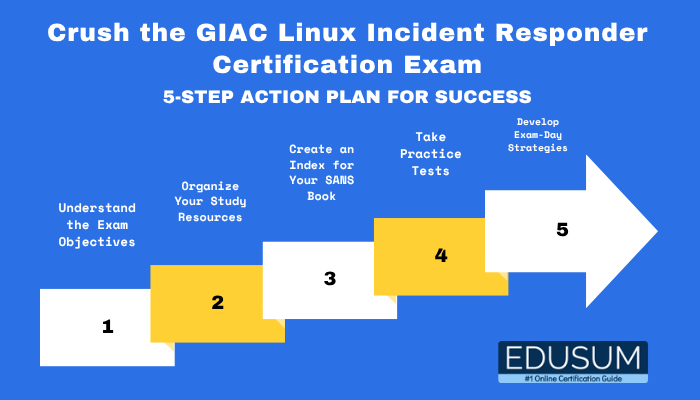
Step 2: Organize Your Study Resources
With a clear understanding of the exam objectives, the next step is to gather and organize your study materials. The quality and accessibility of your resources will significantly impact your preparation efficiency, especially for an open-book exam.
-
Importance of using the SANS course materials, particularly the official book provided during training. The SANS SEC504: Linux Threat Hunting & Incident Response course is specifically designed to prepare you for the GLIR exam. The course materials, especially the official textbooks, are gold mines of information. They align directly with the exam objectives and are often what you'll be referencing during the exam itself. Treat these books as your primary study companions.
-
List additional helpful resources, such as Linux incident response tools and community guides. While SANS materials are central, supplementing them with other resources can deepen your understanding. Consider:
-
Official Linux documentation: For core Linux commands and concepts.
-
Open-source incident response tools: Hands-on experience with tools like Autopsy, Volatility, or Sleuth Kit can solidify theoretical knowledge.
-
Community forums and blogs: Insights from experienced incident responders can offer practical perspectives and tips.
-
Online practice exam platforms: Websites like EduSum.com offer practice questions that can help you gauge your readiness and identify areas for improvement.
-
-
Mention the value of practice exams to identify weak areas. Engaging with GIAC Linux Incident Responder Certification Questions is crucial. Practice exams, such as those found on EduSum.com help you:
-
Familiarize yourself with the exam format and question types.
-
Identify knowledge gaps and areas where you need to focus more study.
-
Improve your time management skills under exam conditions.
-
Gain confidence by tracking your progress.
-
Step 3: Create an Index for Your SANS Book
This step is arguably the most critical for an open-book GIAC exam. Simply having the books open isn't enough; you need to be able to find specific information rapidly. An effective index transforms your SANS materials into a powerful, searchable knowledge base.
-
Explain how indexing helps during the open-book exam. Your customized index acts as a super-efficient table of contents, allowing you to pinpoint exact pages for specific topics, commands, or concepts. Without a well-organized index, you'll waste precious time flipping through hundreds of pages, potentially running out of time before you even find the answer.
-
Tips for creating a detailed, structured index, including:
-
Highlighting key concepts and page numbers: As you study, make a note of every important term, tool, command, and methodology. Record the exact page numbers where these are discussed.
-
Using color-coded tabs or digital notes for easy navigation: Physical tabs can mark major sections, while different colors can signify different categories (e.g., green for commands, blue for tools, red for definitions). If using digital versions, leverage annotation features and a robust search function.
-
Step 4: Take GIAC Linux Incident Responder Certification Practice Tests
Preparation isn't complete without rigorously testing your knowledge and exam-taking skills. This is where GIAC Linux Incident Responder Certification Questions from practice exams become invaluable.
-
Simulate exam conditions: Take full-length practice tests under timed conditions. This will help you get accustomed to the 3-hour limit and the pressure of the exam.
-
Utilize platforms like EduSum: EduSum provides a range of practice exams tailored to the GIAC GLIR certification. These exams often mimic the real test environment, allowing you to experience the interface and question styles.
-
Analyze your performance: Don't just take the tests; meticulously review your answers, both correct and incorrect. Understand why an answer was correct or incorrect. This process reveals your weakest areas and helps you refine your index and study plan.
-
Refine your index based on practice test results: If you found yourself struggling to locate information for certain questions during practice, add those topics and their corresponding page numbers to your index. This iterative process strengthens your open-book strategy.
Step 5: Develop Exam-Day Strategies
The culmination of your preparation is exam day. Having a solid strategy for navigating the open-book format and managing your time efficiently is key to success.
-
How to efficiently use the open-book format:
-
Quickly locating information in your index: This is where your meticulously crafted index shines. When you encounter a question that requires a lookup, consult your index immediately. Don't waste time trying to recall information you can quickly find.
-
Deciphering question patterns to find the best answer: Many GIAC questions are scenario-based. Read the question carefully to understand what is being asked. Identify keywords and technical terms that can guide you to the relevant section in your books. Often, questions will touch on specific tools, commands, or methodologies discussed in the SANS course.
-
-
Time management tips for the multiple-choice format:
-
Allocate your time wisely: With 82 questions in 3 hours, you have roughly 2 minutes and 11 seconds per question. This includes lookup time.
-
Don't get stuck on one question: If a question is proving difficult and you can't quickly find the answer, make an educated guess, mark it for review, and move on. You can always revisit it if time permits.
-
Prioritize questions: Answer the questions you know confidently first, then tackle those requiring a quick lookup, and finally, dedicate time to the more complex or ambiguous questions.
-
-
Staying calm and confident during the exam: The open-book format can reduce some pressure, but the sheer volume of information can be overwhelming. Take deep breaths, trust your preparation, and remember that you have the resources at your fingertips. Your calm demeanor will allow you to think clearly and make the best use of your indexed materials.
Advantages of Earning GIAC GLIR Certification
Beyond the immediate satisfaction of passing a challenging exam, the GIAC Linux Incident Responder Certification offers significant advantages for your career and professional development. This credential is widely recognized by employers as a benchmark of practical expertise in a critical cybersecurity domain.
Firstly, holding the GLIR certification demonstrates a specialized skill set that is in high demand. Organizations are constantly battling sophisticated threats, and having certified professionals who can effectively respond to Linux-based incidents is invaluable. This can lead to increased job opportunities, career advancement, and often, a higher earning potential.
Secondly, the GLIR certification deepens your technical prowess. The rigorous preparation involved in understanding GIAC Linux Incident Responder Certification Online content, along with the practical application emphasized in the SANS course, significantly enhances your ability to perform advanced incident response activities on Linux systems. You'll gain a deeper understanding of file system forensics, memory analysis, log examination, and threat hunting techniques.
Finally, earning a GIAC certification connects you to a global community of cybersecurity professionals. It signifies a commitment to continuous learning and professional excellence, opening doors to networking opportunities and further specialized training. The GIAC Linux Incident Responder Certification Cost, while an investment, pales in comparison to the long-term career benefits and the enhanced ability to protect critical systems from cyber threats.
Conclusion
The journey to earning your GIAC Linux Incident Responder Certification is a demanding yet incredibly rewarding endeavor. By meticulously following these five steps – understanding the exam objectives, organizing your study resources, diligently creating an effective index, leveraging GIAC Linux Incident Responder Certification Questions through practice tests, and developing robust exam-day strategies – you significantly increase your chances of success.
Remember, the GLIR is not just about passing an exam; it's about validating and enhancing your skills as a crucial defender against cyber threats on Linux systems. With dedicated effort, strategic preparation, and the right resources, you can confidently approach the exam and join the ranks of elite cybersecurity professionals. Embrace the challenge, leverage the power of an organized open-book strategy, and unlock a new level of expertise in Linux incident response.
FAQs
1. What is the GIAC Linux Incident Responder (GLIR) certification?
- The GLIR certification validates expertise in identifying, analyzing, and responding to security incidents on Linux systems, focusing on forensic analysis and threat hunting.
2. How many questions are on the GIAC GLIR exam and how long is it?
- The GIAC GLIR exam has 82 multiple-choice questions and a time limit of 3 hours.
3. Is the GIAC Linux Incident Responder exam open book?
- Yes, the GIAC Linux Incident Responder exam is an open-book exam, allowing candidates to reference approved materials.
4. What is the passing score for the GIAC GLIR certification?
- A minimum passing score of 66% is required to pass the GIAC Linux Incident Responder certification exam.
5. Where can One find practice questions for the GIAC Linux Incident Responder exam?
- One can find practice questions and online practice exams for the GIAC Linux Incident Responder certification on platforms like EduSum.com.
6. Is the GIAC GLIR certification worth it?
- Yes, the GLIR certification is highly valued in the cybersecurity industry, demonstrating specialized skills in a critical and in-demand area.
7. What is the approximate GIAC Linux Incident Responder Certification Cost?
- The cost of the GIAC Linux Incident Responder certification is $999 USD.
8. How important is creating an index for the GLIR exam?
- Creating a detailed index for your study materials is crucial for quickly locating information during the open-book GLIR exam.
- GIAC Certification |
- GIAC Linux Incident Responder (GLIR) |
- GLIR Online Test |
- GLIR Questions |
- GLIR Quiz |
- GLIR |
- GIAC GLIR Certification |
- GLIR Practice Test |
- GLIR Study Guide |
- GIAC GLIR Question Bank |
- GLIR Certification Mock Test |
- GLIR Mock Exam |
- GIAC GLIR Questions |
- GIAC GLIR Practice Test |
- GLIR Syllabus |
- GLIR Books |
- GLIR Certification Syllabus |
- GIAC GLIR Books |
- GIAC GLIR Training |
- GLIR Certification Cost |
- GLIR Sample Questions |
- GIAC GLIR Practice Test Free |
- GLIR Certification Sample Questions


